

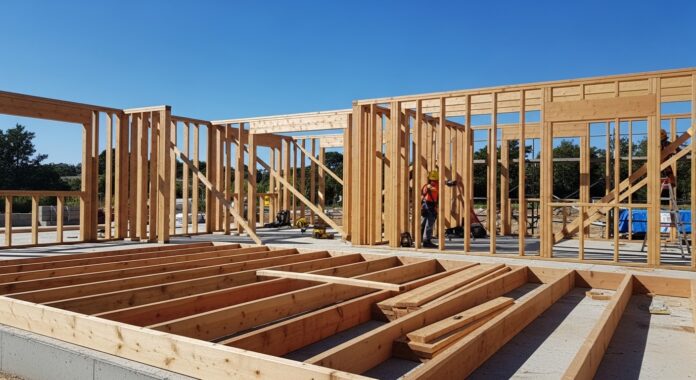
Timber is also among the most important materials in the construction of houses, especially in framing the structural skeleton of a building. Depending on the timber selected, the strength and stability of the house are to be established, as well as its resistance to weather, pests, and wear and tear over time. Timber is chosen by the builders depending on availability, price, durability, and adherence to the local building codes. During the early planning stages, construction professionals often use construction material takeoff services to estimate the exact quantity and type of timber required for framing. This ensures accurate budgeting, minimizes waste, and helps select the most suitable wood species for each structural component.
Softwoods such as pine, spruce, and fir are most popular out of the broad selection of choices because they are flexible and cost-effective. In the meantime, hardwoods and engineered timbers are applied in particular locations in which extra strength or design freedom is required. Knowing the timber to use in the framing of houses assists the homeowner and the builder to make better-informed construction selections that are safer and more economical.
1. Softwood Timber – The Most Common Framing Choice
The most preferred wood in framing residential houses and buildings is softwoods since it is light, easy to cut, strong, and economical. These are timbers that grow quite fast, and hence they are sustainable and found in most parts.
Widely used varieties of softwood in framing are:
- Pine (Radiata, White, or Southern Pine): This is one of the framing timbers that is very popular all over the world. It has a smooth grain, good nail-holding capacity, and dimensional stability. Pine is simple to work with, and when treated, it is very resistant to insects and decay.
- Douglas Fir: Douglas Fir is good among the load-bearing structures, such as beams, joists, and roof trusses, due to its better strength and stiffness. It is straight-grained and is very resistant to warping.
- Spruce: Spruce is light and easy to handle; it has many applications in the wall studs and roof framing. It is smooth and has a stable performance in dry climates.
The softwoods are normally applied in framing walls, floors, and roofing, where they offer the structural support required without an unjustified weight in the building.
2. Hardwood Timber- Strength and Longevity
Although most residential framing is done with softwoods, hardwoods are sometimes used where strength, durability, or beauty are needed. Hardwoods are produced using slow-growing trees, which are denser, heavier, and more resistant to wear and damage.
Popular hardwoods applied in framing are:
- Oak: Oak is very strong and durable enough to be used in large beams, posts, and any other structural part on a traditional or heritage-style house.
- Ash: It is strong and flexible, and it is applicable in structural frames necessitating a combination of toughness and stability.
- Teak and Mahogany: This is another material that is frequently used in the tropics because it is naturally resistant to rot, water, and termites. They are, however, premium and are expensive compared to softwoods.
The entire frame is not made of hardwoods, however, because they are heavy and expensive, but they might be incorporated at important load-bearing locations or ornamental elements of the structure.
3. Engineered Timber – Modern Strength and Stability
Engineered timbers are composite wood products produced with the adhesive bonding of layers of wood or fibers in the presence of heat and pressure. They are also becoming popular in the contemporary building business since they are strong, precise, and consistent with less waste.
The usual manufactured wood materials are:
- Laminated Veneer Lumber (LVL): LVL is used with beams, headers, and lintels and is uniform in strength, with no warping.
- Glue-Laminated Timber (Glulam): Glulam is manufactured using several layers of wood held together by a bonding material and is used in making large spans and curved buildings.
- I-Joists: Lightweight and are made to either support floors or roof systems, with high strength-to-weight ratios and use of less material.
Timber whose stability is engineered is also stable already, which minimizes the chances of shrinking, twisting, and cracking as it does with solid wood. It is also able to support long spans and ornamental architecture, which would be challenging using natural timber.
4. Treated Timber – The Key to Protection and Life
No matter the type of timber, it is important to treat it in order to have long-lasting durability. Wood that is untreated is susceptible to rot and termites as well as water. Pressure treatment of timber is done using preservatives that improve the decay, insect, and fungal resistance.
Types of common treatment are:
- CCA (Copper Chrome Arsenate): It provides excellent defense against rot and termites, and its main application is on outdoor or ground contact frames.
- ACQ (Alkaline Copper Quaternary): It is arsenic-free and therefore safer and is used in residential buildings.
- Borate Treatment: It is applied in interior framing (it prevents insects and fungi) but does not impair the stickiness of the paint.
During humid or tropical weather, it is a requirement to use treated timber as framing that can withstand decades without structural degradation.
Choosing the Right Timber for Your Home
The selection of timber to be used in the framing of the house should take into account the following factors:
- Climate: Treated softwood or naturally resistant hardwood is recommended in humid or termite-prone regions.
- Budget: Pine and spruce softwoods are the most economical for most construction in a home.
- Design Requirements: Engineered timbers are most suitable for long spans or modern designs.
- Sustainability: It is always a good idea to use certified timbers (e.g., FSC or PEFC) that ensures that the wood is responsibly.
Putting all these into consideration will guarantee you a strong, durable, and cost-effective house frame.
Conclusion
House framing is timber, which is mostly dependent on project requirements and the environment. Most homes use softwoods, including pine, spruce, and Douglas fir,because they are easy to use, strong ,and affordable. Engineered wood and treated timber are relevant in the contemporary construction industry in order to enhance strength or provide flexibility in the design.
In the meantime, hardwoods are suitable for special structural construction or ornamental framing. The kind of timber used and its proper treatment will ensure that the house structure is stable and will last a long time.
FAQs
What is the best timber for house framing?
Pines and Douglas fir are the most appropriate timbers to be used in the framing of houses because of their balance in terms of strength, affordability, and convenience in handling.
Is treated timber necessary for framing?
Yes, particularly where it is humid or where there is a great danger of termites. Timber that is treated is not prone to rot, insects, or decay, and hence the frame has a longer life.
Can hardwood be used for house framing?
Hardwood may be used, but it is usually only used when the framing is heavy-duty or decorative since it weighs and costs more than softwoods.


