

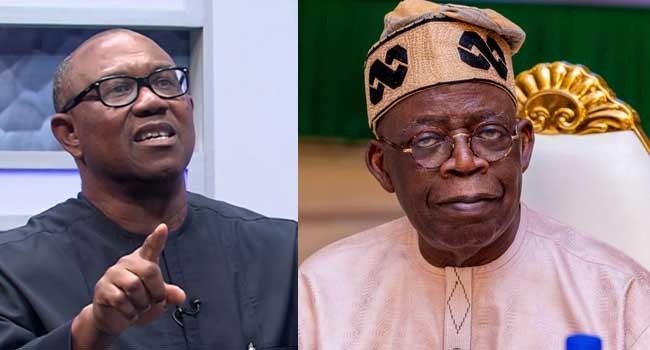
The presidential candidate of the New Nigeria Democratic Congress (NDC), Peter Obi, has accused President Bola Tinubu’s administration of undermining investor confidence, arguing that the government’s celebration of macroeconomic stability contradicts the investment risks highlighted by the United States government.
Obi said the 2026 Nigeria Investment Climate Statement by the US Department of State exposed persistent challenges, including corruption, insecurity, inconsistent regulatory enforcement, weaknesses in the judicial system, port delays and power sector problems.
In a statement made available to The News Chronicle, the former Anambra State governor described the report as further evidence of what he called the incompetence, ineffectiveness and corruption of the All Progressives Congress (APC)-led administration.
He also expressed concern over the report’s warning that foreign businesses could face arbitrary detention, travel restrictions and immigration enforcement in commercial or regulatory disputes with Nigerian authorities.
The report noted that routine business trips could escalate into detention where a company faces regulatory suspicion or charges, adding that Nigeria had previously used exit bans and arbitrary detention as leverage in commercial disputes involving multinational firms.
It also identified port inefficiency as a significant hidden cost for investors, noting that while the Lekki Deep Seaport had eased pressure on the country’s maritime trade, traditional ports in Apapa and Tin Can continued to experience cargo delays exceeding 20 days because of manual examinations.
Obi argued that a competent and responsive government would treat such findings as a call for urgent intervention, directing investigations and implementing measures to address the concerns raised by one of Nigeria’s key trading partners.
He said the report was particularly troubling given Nigeria’s need to attract foreign direct investment (FDI) to unlock its economic potential.
According to him, the Tinubu administration’s failure to address the underlying challenges was partly responsible for Nigeria’s inability to attract foreign investment commensurate with its market size and opportunities.
Citing capital importation figures for the first quarter of 2026, Obi said Nigeria attracted $10.37bn in total capital inflows, but only $135.08m, representing about 1.3 per cent, came through foreign direct investment.
He added that foreign portfolio investment accounted for approximately $9.86bn, or 95.1 per cent, of the total inflows, with loans and other capital sources making up the remainder.
The figures, Obi argued, underscored the gap between the administration’s claims of macroeconomic stability and its ability to attract long-term investments that create jobs, expand productive capacity and strengthen the economy.
He described the situation as a contradiction, accusing the Tinubu administration of celebrating economic stability while allowing conditions that could discourage foreign investors.
“It is paradoxical that while the Tinubu administration is celebrating macroeconomic stability, it is unwittingly scaring away foreign investors. What a shame,” Obi said.


