

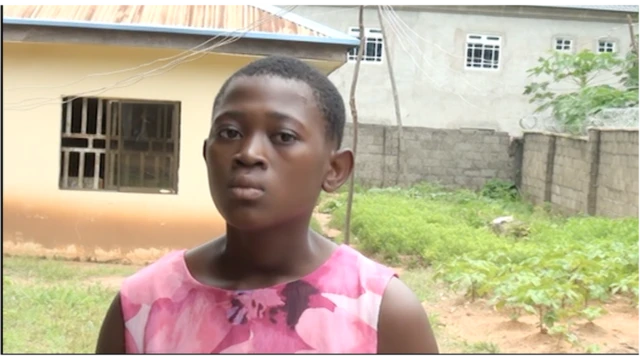
She was only eight. Too young to understand that the hands that tucked her into bed at night were not meant to harm her. Too young to know that her silence would one day become her death sentence. Her name was Ochanya Ogbanje, and her story is not an isolated tragedy. It is a mirror of who we have become as a people, a society that teaches its children to be quiet when they are hurt and to respect those who break them.
Ochanya was sent to live with relatives so she could have a better education. It was supposed to be a chance at life. Instead, it became her undoing. For years, the man she called uncle and his son violated her, tearing at her body and her spirit until the pain became part of her daily life. No one heard her. No one noticed. No one saved her. When she finally broke, when her small frame could no longer carry the weight of her secret, she was already dying.
She died at thirteen. Five years of torment, wrapped in silence. Five years of a nation pretending not to see.
What is most unbearable about her story is not just what was done to her, but how easily we moved on. We reacted with outrage when the news broke. There were hashtags, protests, editorials. And then the noise faded. As it always does. Her name became one more statistic in a country that buries its children in files and court delays. The men accused of destroying her childhood stood before the law, but justice, like everything else here, was slow, hesitant, uncertain.
We like to think monsters live in dark corners. But they live among us in homes that appear respectable, in churches that preach holiness, in schools that ignore warning signs. They live in parents who silence their daughters to protect the family name, in neighbors who hear screams and turn up the volume of their televisions, in institutions that would rather protect perpetrators than believe victims.
Ochanya’s death is an indictment. It asks a question we have refused to answer, what kind of country eats its children and calls it normal? What kind of people watch a child suffer and still sleep at night?
Every day, another child becomes a victim. A house help beaten for breaking a plate. A niece touched by an uncle. A student preyed on by a teacher. A girl accused of seducing the man who assaulted her. We see these things. We hear them. We whisper about them. But we do not act. Because in Nigeria, silence is safer than truth.
The truth, however, is that our silence is violence. Our indifference is complicity. And our excuses are part of the machinery that keeps children unsafe.
If we had listened when Ochanya whispered, she might have lived. If we had believed her, protected her, punished her abusers swiftly and decisively, maybe she would have grown up to tell her story herself. But we didn’t. We failed her. And in failing her, we failed every child who still believes adults will protect them.
Justice in Nigeria is often a long corridor that leads nowhere. Ochanya’s case began with public outrage. Her story pierced the nation’s conscience. There were protests, hashtags, and promises. The Benue State Government pledged to ensure justice. The National Agency for the Prohibition of Trafficking in Persons (NAPTIP) took over the investigation. Newspapers carried her photo a small, bright face that became the symbol of all the children this country has failed.
The alleged perpetrators a senior staff of Benue State Polytechnic, Andrew Ogbuja, and his son Victor were charged. The courtrooms filled. Cameras flashed. There was hope, briefly, that this time would be different. But like most things in Nigeria, the fire dimmed. Hearings were postponed. Witnesses grew weary. Files went missing. And slowly, the nation moved on.
Years passed. Ochanya remained buried, but the truth was never laid to rest. Her case became a ghost that hovered over our institutions a reminder of how easily outrage dissolves when time passes, when the next scandal arrives, when the public loses interest.
It fizzled out, not because the evidence was weak, but because our will was. Because we live in a country where the poor do not get justice, where influence can choke truth, and where the memory of a child fades faster than the promises of politicians.
And now, suddenly, her name has returned. Ochanya is back on our lips, her story replaying on our airwaves, her face back on timelines. Why now? Why again? Is it because the world cannot truly forget innocence betrayed? Is it because her spirit will not rest until justice breathes again? Or is it because, deep down, we know we cannot keep burying our guilt beneath silence?
Could it be that the voices we silenced are beginning to speak again through the headlines, through the discomfort, through the collective unease that grips us whenever we remember her name? Could it be that Ochanya has refused to be forgotten because she never truly left?
Maybe she is the echo we deserve. Maybe her story has resurfaced to ask the questions we have avoided: What happened to the man and his son? Why is justice in Nigeria always delayed until it dies? Why did the outrage end when the child did? Why did institutions that swore to protect the weak return to business as usual?
Or perhaps it is something deeper a haunting reminder that there are thousands of Ochanyas still walking among us, still whispering for help, still unseen.
It is easy to forget, in the noise of new tragedies, that justice for one child can heal the conscience of a nation. But in Nigeria, justice is slow, hesitant, almost apologetic. When the cameras left and the outrage dimmed, the courtroom grew quieter. Adjournments became routine. Faces changed. Files disappeared. The momentum of the people gave way to the machinery of bureaucracy. And somewhere in that silence, the urgency died.
Those who harmed her lived on while she became a memory discussed only on anniversaries. We have a way of letting time do the work that justice should do. We allow distance to numb our anger until all that remains are headlines from years past. But time does not heal what has not been made right. The dead do not forget. The spirit of a wronged child lingers where truth has been buried.
Maybe that is why her name has returned. Maybe that is why the airwaves now carry her story again not because someone planned a revival, but because conscience cannot stay silent forever. Because sometimes, when a people forget, the dead remember for them.
This return of her story is not coincidence. It is conscience. It is the universe asking us what kind of people we have become. It is her spirit, restless, circling around us, demanding closure not only for herself but for every child whose pain has been dismissed as a family matter.
Until justice is done, until the guilty are held accountable, until the system changes, there can be no peace not for her, and not for us. Because a nation that betrays its children will never know rest.
So we must ask again and again,Where is justice? Where is truth? Where is the outrage we once had? And how many more children must die before we learn that silence is also a form of violence?
Ochanya’s story has come back to us because it was never finished. It has come back to remind us that evil only triumphs where memory fades. It has come back because her voice, though stilled by death, has found its way into our collective guilt. And until we answer her, until the truth is not just spoken but lived, she will remain the child who refuses to be forgotten, the spirit that calls a nation to its knees.
The lesson from Ochanya’s life is not just about justice, it is about conscience. It is about how a nation defines itself by what it tolerates, what it excuses, what it forgets. We cannot claim to be moral if we cannot keep our children safe. We cannot claim to be human if we cannot hear their cries.
Remember her. Speak her name. Let her death not be the end of her story but the beginning of a reckoning. Let every parent, teacher, pastor, and leader hear her voice in their silence. Because somewhere, right now, another eight-year-old girl is whispering for help. The only question that remains is whether we will listen this time.
It is possible that Ochanya’s spirit has not found rest. How can it, when those who hurt her still breathe freely, and the laws that should have protected her remain weak? How can peace come to a child whose truth was delayed, debated, and dragged through endless corridors of justice?
Maybe she has come back to remind us that silence is never the end. That injustice does not die just because we stop speaking about it. Maybe she has returned to ask all the questions we have refused to answer.Why did her case fade away? Why did those who swore to fight lose their voices? Why did we let her story become another forgotten campaign? Why do we continue to call ourselves a moral people while our children remain unprotected?
Every question is an echo of her presence. Every uneasy silence, a sign that we know she is still waiting. And until we answer not with words, but with justice she will keep returning, quietly, insistently, asking the same thing, When will you hear me?
Stephanie Shaakaa
08034861434


