

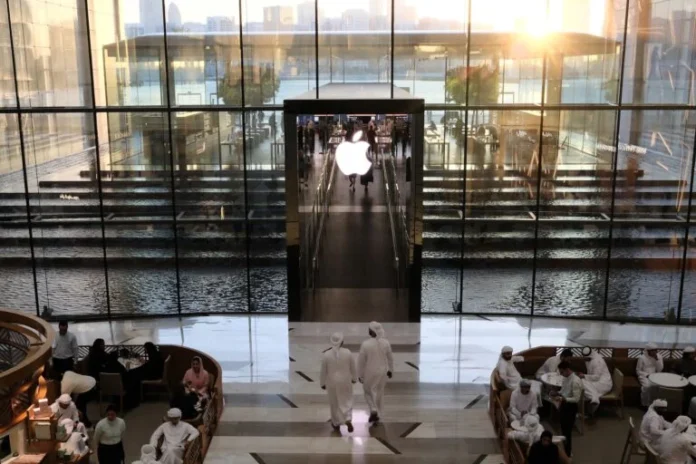
The White House said on Tuesday, March 31, that the United States military is prepared to prevent any attacks by Iran following reported threats from Iran’s Islamic Revolutionary Guard Corps (IRGC) against major U.S. technology companies operating in the region.
According to Iranian state media, the IRGC warned it would target U.S.-linked firms “as of tomorrow” in response to recent attacks on Iran. Companies cited in those reports include Apple, Google, and Meta, along with Intel, Tesla, and Palantir Technologies.
A White House official, speaking on condition of anonymity, said:
“The United States military is and was prepared to curtail any attacks by Iran, as evidenced by the 90 percent drop in ballistic missile and drone attacks by the terrorist regime.”
No independent verification has been provided to support the claim of a reduction in attacks, and there is no publicly available evidence linking the named companies to military operations.
U.S. President Donald Trump, speaking in the Oval Office on Tuesday, March 31, said the conflict could conclude within weeks.
“We’re finishing the job,” Trump said. “We will be leaving very soon — maybe in two weeks, maybe three.”
He added that a negotiated settlement remains possible:
“It’s possible that we’ll make a deal before that.”
The White House also announced that Trump would address the nation at 9:00 p.m. Washington time on Wednesday, April 1, to provide an update on Iran.
Trump indicated that the United States may not take responsibility for securing the Strait of Hormuz, a key shipping route for global oil supplies.
“What happens with the strait, we’re not going to have anything to do with,” he said.
In a post on Truth Social earlier the same day, he wrote:
“The U.S.A. won’t be there to help you anymore… Go get your own oil!”
The Strait of Hormuz typically carries about one-fifth of global oil shipments. Its disruption has contributed to price volatility, although Brent crude fell by approximately 3.2 percent to $103.97 per barrel on March 31 due to the possibility of the conflict ending.
Israeli Prime Minister Benjamin Netanyahu said the campaign against Iran had “changed the face of the Middle East,” adding:
“We will continue to crush the terror regime.”
Iranian President Masoud Pezeshkian stated that Iran is open to ending the conflict under specific conditions:
“We have the necessary will to end the war, provided there are guarantees it will not happen again.”
Strikes continued across multiple locations on Tuesday, March 31 and Wednesday, April 1, including reported attacks in Tehran, Isfahan, and parts of Lebanon. In Lebanon, authorities reported casualties following Israeli strikes in southern Beirut.
Financial markets reacted to signs of a possible short-term resolution:
- U.S. equities rose on March 31
- Japan’s Nikkei index opened more than 3 percent higher on April 1
- South Korea’s Kospi gained nearly 5 percent
Oil prices remain elevated compared to pre-conflict levels, with Brent crude still significantly above its late-February baseline.


