spot_img
spot_imgspot_img
October 7, 2026 - 8:54 PM

Tough Economic Decisions: Between Charles De Gaulle and Bola Tinubu

—

It is no news that the naira has been devalued by about fifteen percent. Basic economics teaches that the raison d’etre behind any devaluation is to massively encourage exports that thrive better with a weaker currency.

However, it is economically suicidal for it to happen in an import-dependent economy like ours. We are so import dependent that we even shamelessly import toothpicks.

The naira has fallen to over 800 naira to 1 USD as at the last time I checked yesterday which portends a dangerous signal for the frail economy.

It is not in doubt that President Bola Tinubu means well for the country but is clearly misunderstood to be somewhat sadistic given the short-term pain his policy of fuel subsidy removal is currently causing. I want to assure Nigerians that the pain is only for a short while which will be overshadowed by the gains of saving of funds from the funds that would hitherto have been spent on the subsidy.

About 400 billion in less than two months has already been saved from subsidy which is a very good sign of great things to expect from the Bola Tinubu led administration.

Many critics of the ‘abrupt’ subsidy removal criticize Tinubu fondly called Jagaban – after his title as Jagaban Borgu of Niger State for not providing his countrymen with some palliatives.

I daresay even though I haven’t met Asiwaju in person that he has nothing but good intentions for his people. ‘Bolekaja’ Economists and hustler ‘public policy analysts’ who dote the social media landscape as well as having a huge presence online portray Asiwaju’s lack of provision of palliatives as anti-people.

I vehemently disagree with the palliatives option as it only works in much smaller countries and economies.

The palliatives which include conditional cash transfers was a gargantuan flop in India and China so why should Tinubu implement a failed policy on an equally large population like Nigeria’s?

Critics can only be justified to say that Asiwaju is inept and incompetent if the 400 billion naira saved from the previously planned subsidy payment is frittered away or siphoned like is the norm with ‘governance’ in Nigeria.

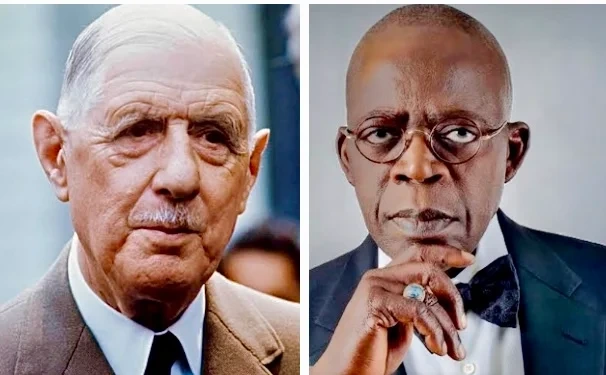
Charles De Gaulle of France and Tinubu share some similarities. They were both liberty fighters albeit of a different hue. De Gaulle was a distinguished soldier and fought many battles most notably World War II where together with the other allied forces of the United States, United Kingdom and the defunct Union of Soviet Socialist Republics defeated the Axis forces led by Nazi Germany. Tinubu was a pro-democracy fighter who joined the barricades from the streets of Lagos. They both fled into exile to the UK. De Gaulle went on a self-imposed exile to the UK on June 15, 1940, because he refused to accept the French government’s armistice with Adolf Hitler’s Germany. Tinubu also fled to the UK because the then-murderous General Sani Abacha led the government marked him for assassination because of his committed involvement in the June 12 de-annulment struggle. They both made effective use of the radio during their years in exile. De Gaulle used the enormous reach of the British Broadcasting Corporation to rally support for France during World War II and he famously told his countrymen on June 18 1944 that “Whatever happens, the flame of French resistance must not be extinguished, and it will not be extinguished.” Tinubu used Radio Kudirat to rally the pro-democracy forces both in the country and Diaspora for the mandate of the late presumed winner of the June 12 election, Chief M.K.O. Abiola to be restored and for the military to immediately return to the barracks where they truly belong to.

They both emerged as leaders at a time both countries were at their lowest ebb.

De Gaulle famously said:  “How can you govern a country which has 246 varieties of cheese?” to aptly describe the terrible economic, and political situation of France which necessitated the need for a strong leader. Tinubu also emerged under similar circumstances in Nigeria no thanks to the inept political leadership of his predecessor and economic hara-kiri of Godwin Emefiele unarguably the nation’s worst CBN Governor.

De Gaulle had to take decisions that were first perceived as economically unpopular but later viewed by pundits as well as economic historians as being in the best interest of France. From March 22nd to May 2nd 1968, there was civil unrest in France. Demonstrations and protests began in major French cities. Protest waves were accompanied by violent suppression efforts from the French authorities. Demonstrators united around the problems of a just country, a conservatism of the university system, increased unemployment, and market globalization. Questions bothering the new generation included the American army’s presence in Vietnam in 1968, the limited scope of actions for the universities in France, racial segregation, etc.

The civil unrest that started in Paris quickly spread to other provinces of France. Ten million people rebelled. The metro stopped in Paris. Airports were closed. Ships with red flags appeared on the coast of France, and railway and sea traffic were disrupted. Big cities were in danger of starvation.

Charles de Gaulle’s answer to the protest was simple: yes to reforms, no to chaos. The general appointed snap parliamentary elections. The French preferred peace to revolution, and de Gaulle won once again.

Tinubu is facing something similar to the aforementioned and like De Gaulle, the initial pains will definitely give way to long-lasting gains, especially in the area of the economy.

I conclude with the eternal words of Otto Von Bismarck, the former German Chancellor which is the Locus Classicus for strong leadership for the ultimate common good.

“The position of Prussia in Germany will not be determined by its liberalism but by its power […] Prussia must concentrate its strength and hold it for the favourable moment, which has already come and gone several times. Since the treaties of Vienna, our frontiers have been ill-designed for a healthy body politic. Not through speeches and majority decisions will the great questions of the day be decided—that was the great mistake of 1848 and 1849—but by iron and blood”.

Bringing it closer home, the iron and blood of the subsidy removal will be felt in the nearest future in the form of gargantuan gains in the best interest of the economy and polity.

For the courage to yank off subsidy which his predecessor lacked the courage to do never mind the gibberish uttered by Garba Shehu is the sign that indeed a Daniel has come to judgement.

0 0 votes
Article Rating
Subscribe
Notify of
0 Comments
Oldest
Newest Most Voted

Share post:

Subscribe

Latest News

More like this
Related

BREAKING: 20 NYSC Prospective Corps Members Freed After Kidnappers Demand N50m Each

Twenty prospective members of the National Youth Service Corps...

Improve welfare of Nigerian Teachers 

I was and I am a teacher. I was a Parents Teachers Association hired teacher at Oba Akinbiyi High School (II), Mokola, Ibadan in 1997. Apart from that stint, I also taught briefly at a private secondary school during my National Youth Service at Asaba, Delta State as well as at another private secondary school at Akowonjo area of Lagos state around 2001 / 2002. My late father, Deacon Isaac Oyeniyi Ojo taught for about 40 years across several primary schools in Oyo and Osun sates and retired as a headmaster in 1995. At present, I don’t just teach but train people across various democratic institutions namely election management bodies (INEC and SIECs), political parties, media, national and state legislative assemblies, police, and civil society organisations. Information gleaned from the website of UNESCO says “World Teachers’ Day is held annually on 5 October to celebrate all teachers around the globe. It commemorates the anniversary of the adoption of the 1966 ILO/UNESCO Recommendation concerning the Status of Teachers, which sets benchmarks regarding the rights and responsibilities of teachers, and standards for their initial preparation and further education, recruitment, employment, and teaching and learning conditions. In 2026, the Day marks the 60th anniversary of the Recommendation concerning the Status of Teachers.” In Nigeria, this year's celebration focused on five interconnected pillars: innovation, mobility, Artificial Intelligence, inclusion, and professional excellence. The Minister of State for Education, Prof. Suwaiba Ahmad, announced that the selection process for the 2026 World Teachers' Day awards was digitised to promote transparency, accountability, and efficiency. The celebration includes a symposium, a march-past featuring state flags and cultural attire, and the recognition of 14 awardees, including the first, second, and third best teachers receiving prestigious car gifts, while the best Federal Unity College received a bus. Other prizes include laptops. In commemoration of the World Teachers Day, Dr. Akin Ayeni and I were guests on a breakfast programme on Ekiti 91.5 FM, Ado Ekiti last Monday where we dissected the plights of Nigerian teachers and proffered solutions to them. The host was Ademola Adeleke. I enumerated some of the plights of Nigerian teachers to include: Low wages, insecurity, quackery, inadequate classrooms, lecture theatres, libraries and laboratories, high turnover of staff especially in private schools, high workloads, disrespects from parents, students and even government. I made a proverb on the programme. Elo ni teacher ngba, ti o ntuto s’owo ka’wo osu (meaning, how much does a teacher earn that he or she needs to use saliva to count salary). This was a random joke even among teachers when they used to collect their salary in cash. This day, they receive their wages via online money transfer. The proverb however is meant to drive home the paltry nature of the salaries and wages of teachers cum lecturers. I recall the sticker produced by Academic Staff Union of Universities many years ago which has the inscription “My take home pay cannot take me home”. That’s very instructive. On issue of insecurity, according to Daily Trust of October 1, 2022, “The registrar of the Teachers Registration Council of Nigeria, Professor Josiah Ajiboye, said attacks on schools by insurgents have claimed the lives of more than 2,295 teachers in the North East between 2009 and 2022.” The PUNCH in its June 5, 2026 online edition reported that “An estimated 603 students and teachers have been kidnapped in seven mass abductions across schools in Nigeria between March 2024 and May 2026 under President Bola Tinubu, despite the N145bn Safe Schools Initiative.” Recall that on May 15, 2026, a total of 46 persons – seven teachers and 39 students – were abducted from Community High School Ahoro-Esinele and Yawota Baptist Nursery and Primary School in Oriire Local Government Area of Oyo State. Thankfully, most of them were rescued though two teachers were murdered by the bandits.  Michael Oyedokun, was reportedly beheaded, while John Olaleye, was shot dead during the attack. It is noteworthy that some university lecturers have also been abducted in the past. The heavy workloads and low wages have resulted into brain drain and high turnover of teaching staff across our academic institutions. Many education graduates don’t want to teach. The lecturers in tertiary institutions are leaving in droves for greener pasters abroad. Many teachers today take the job as a last resort when better options are not available. Many of the private schools recruit untrained teachers. They side step the federal government policy of having every teacher certified by Teachers Registration Council of Nigeria. Recall that the TRCN regulates the teaching profession in Nigeria by setting standards, accrediting teacher education programmes, registering qualified teachers, and enforcing professional ethics.  It establishes national minimum standards for teacher education and monitors teacher training institutions, including Colleges of Education, university faculties, polytechnic schools of education, and the National Teachers Institute. Unlike in the 20th century when teachers in Nigeria were widely respected and seen as mini-God, in contemporary times, there have been situation where pupils and students openly abuse teachers, bully them and even beat them up. Some irresponsible parents have even gone to school to harass and molest teachers for caning or meting out corporal punishments to their wards and children. Thus, many teachers now work in an atmosphere of fear. Mrs. Comfort Fasunwon is a multiple award-winning teacher in Ondo State, here is an excerpt from what she wrote on her Facebook wall in commemoration of the 2026 World Teachers Day “To my fellow teachers, today.  Teaching is not always easy. There are days when the workload is heavy, resources may be limited, and the results of our efforts may not be immediately visible. Yet we continue to show up, teach, encourage, correct, inspire and believe in our students. Sometimes, the greatest reward of a teacher is not a certificate or trophy. It is seeing a child who once struggled begin to understand. It is watching a student grow in confidence. It is meeting a former student years later and hearing the words, “Ma or sir, you made a difference in my life.” My plead to government at all level as well as private schools’ owners is to ensure that their schools are well resourced and staff welfare is made paramount. Professionalism should be their watchwords. Teachers’ rewards shouldn’t be in heaven; a foretaste of that should be here on earth. Best wishes to fellow teachers and nation builders. Remember the popular song that says “Anyone who hates teachers will homeschool his or her  child” I.G: @jideojong  

Over 22,000 Arms Recovered Across Nigeria in 10 Years – NCCSALW

The National Centre for the Control of Small Arms...

NBA Calls for End to Torture, Deaths in Nigeria’s Detention Centres

The Nigerian Bar Association (NBA) has called for tougher...
Join us on
For more updates, columns, opinions, etc.
WhatsApp
0
Would love your thoughts, please comment.x
()
x