

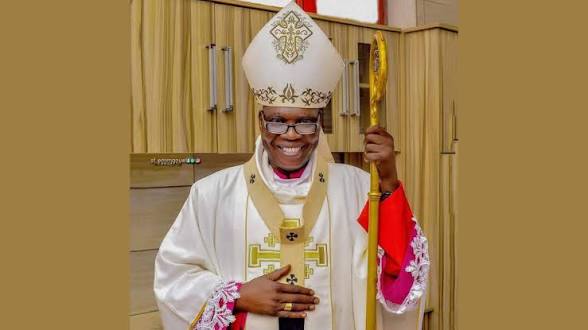
A delegation of the Catholic Bishops’ Conference of Nigeria (CBCN) paid a courtesy visit to President Bola Tinubu last week. The outcome was anything but cordial. The bishops got a raw deal. Their presence appeared not to please the president, who was only a step away from open hostility.
Led by the President of the CBCN, Archbishop Matthew Ndagoso, the bishops likely expected a more receptive audience. They probably believed that telling the president the truth that many around him would not tell him could help the country. Their requests were straightforward: allow the Independent National Electoral Commission (INEC) to conduct free, fair and credible elections, and guarantee equal treatment for Christians by protecting their constitutional rights.
As religious leaders concerned about the nation’s peace and stability, the bishops believed they had a duty to present the unvarnished truth about the state of the country. That was the essence of their visit.
But the bishops were, perhaps, impolitic. How could they ask a president who, in their estimation, knows he would lose a genuinely free and fair election to willingly submit himself to such self-annihilation? The undertone of their request was not lost on the president. A truly free election, under the current circumstances, could pave the way for a change of government.
The president was visibly uncomfortable with the implication. When he responded, there were no diplomatic niceties. The customary reverence usually extended to clerics disappeared. Instead, he went on the offensive.
He defended INEC as though he were its spokesman, insisting that the electoral commission remained neutral and suggesting that those who thought otherwise were merely crying wolf. Speaking more like a campaigner than a head of state receiving religious leaders, he acknowledged that there were people seeking his office and declared, in a combative tone, that he would wrestle with them to the finish.
At that moment, the bishops must have realised that what began as a courtesy visit had turned adversarial. The president had drawn them into the harsh realities of political contest, where, in Machiavellian fashion, the end justifies the means. He effectively warned them to expect a fierce battle between himself and those seeking to replace him.
The president’s visible irritation may have been heightened by the presence of some bishops known for their outspoken criticism of poor governance. Among them was John Cardinal Onaiyekan, Emeritus Archbishop of Abuja. Tinubu may have viewed his presence as a direct challenge.
The president seemed determined not to allow critics like Onaiyekan to score what he may have perceived as an easy political point.
Cardinal Onaiyekan has since reflected on the meeting, concluding that the president was not favourably disposed to the delegation. According to him, both Tinubu and his aides appeared angry throughout the encounter. Yet, Onaiyekan said he was not disappointed because he never expected anything different. In his view, the president rejected the bishops’ concerns because they confronted him with truths he was unwilling to hear.
Looking back, one may argue that the bishops should never have embarked on the visit. Given the president’s previous disposition to similar interventions, the outcome was perhaps predictable.
A similar episode occurred in August 2024 when The Patriots, an independent association of eminent Nigerian statesmen led by Chief Emeka Anyaoku, visited the president at the Presidential Villa.
Their requests were familiar. They urged Tinubu to support the drafting of a new democratic constitution that would better accommodate Nigeria’s diverse peoples. They also encouraged him to engage aggrieved youth groups in dialogue as a way of easing tensions and addressing growing insecurity.
The president was unmoved. He replied that his priority was fixing the economy.
Having made the economy the centrepiece of his administration, it is unsurprising that, nearly two years later, he told the Catholic bishops that the economy was doing well. But many Nigerians struggling under severe economic hardship would disagree with that assessment.
How the idea of the CBCN visit originated remains unclear. However, it is difficult to imagine that figures like Cardinal Onaiyekan and Bishop Matthew Hassan Kukah were enthusiastic about it.
Both men have consistently challenged successive governments over issues of governance and national development. Onaiyekan has repeatedly spoken against poor leadership, while Kukah has built a reputation as one of Nigeria’s most outspoken clerics. Neither could reasonably have expected an overnight transformation in Tinubu’s approach to governance.
The same may not necessarily be true of Archbishop Matthew Ndagoso, who led the delegation. Though a respected cleric, Ndagoso has not been as prominent in national political engagement. It is also unclear how well he knows Tinubu personally. Had he possessed the same level of familiarity as Onaiyekan and Kukah, the visit might never have taken place.
Tinubu understands Nigeria and its complexities very well. He knows the country’s strengths, weaknesses and political realities. He is not easily persuaded by public criticism or moral appeals. Long before becoming president, he appeared to have formed his own ideas about how he intended to govern.
That, some critics argue, explains why accusations of nepotism have not altered his pattern of appointments. The more he is criticised for favouring people from his ethnic group for strategic positions, the more such appointments appear to continue. Whether people approve or disapprove seems to make little difference to him.
Not long ago, many Nigerians believed Tinubu had accumulated too many political liabilities to secure a second term. Today, with the next presidential election drawing closer, the public conversation has shifted. Instead of focusing on the administration’s perceived shortcomings, attention has increasingly turned to the inability of opposition parties to unite.
Many Nigerians have resigned themselves to the possibility of Tinubu’s re-election. For such observers, the expectation is not necessarily that he would prevail in a genuinely free and fair election, but that incumbency gives him significant influence over institutions such as INEC, the police, the military and other state structures.
Ironically, many who express such fears overlook their own democratic right to insist on free, fair and credible elections.
Tinubu, however, understands these political realities. That is why he confidently told the Catholic bishops he was prepared to wrestle those seeking his office to the finish. Notably, he did not dwell on creating an electoral environment where every vote would count. Instead, he emphasised the political battle ahead.
Perhaps, if more members of the religious leadership fully appreciated this reality, there would have been little reason for a visit that ultimately produced dramatic optics but, in the end, may achieve very little.
QUOTE:
“The bishops were impolitic. How could you tell a president who knows that he would fail in his second term bid in a free and fair contest to subject himself to such self-annihilation? The undertone of that request was not lost on the president.”


