

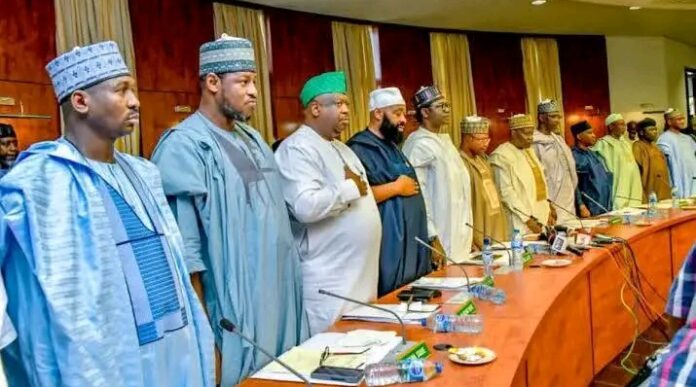
The North today faces existential threats more severe than at any point in recent history, threats which, if not confronted urgently and decisively, risk consuming us all. This reality compels me to write with the earnest hope that these thoughts reach our governors before they sit again to deliberate on the fate of the region. I do not claim exclusive wisdom, nor do I assume that my proposals are the strongest that will surface. My objective is simple: to provoke urgency. To awaken our leaders to their responsibility, for history will judge them either for saving this region through courageous leadership, or for hesitation that left millions at the mercy of chaos.
Who Are the Real Leaders of Northern Nigeria?
If leadership is defined as the capacity to shape policy, influence security, and drive development, then Northern State Governors, collectively, are the real political leaders of the North. Nigeria is a federation. Powers are dispersed. Real authority in security, social stability and development sits significantly at state level.
Therefore, if the North must be saved, it must be through a united front led by Governors, speaking with one voice and acting with one resolve. They can rally Northern members of the National Assembly beyond party lines, mobilise the region behind a strategic cause, and declare, firmly, that the North will no longer endure pervasive violence, economic stagnation, fragmentation and neglect. The tools are within their hands. What remains is intent.
A Region Under Siege
Never in our national history have Northerners felt so insecure, so exposed, so uncertain of their future. From Boko Haram in the North-East, banditry to farmer-herder and ethnic-religious conflicts ravaging the North-West, and North-Central, our land bleeds in multiple places simultaneously. The region groans; drifting ever closer to a precipice many once thought unimaginable. Only decisive action, guided by strategy rather than emotion, can halt this descent.
A House Divided Against Itself
Another danger, less spoken, but deeply destructive, is the collapse of internal social cohesion. The spirit of unity that once defined the Sardauna era has eroded. Today: Muslim vs Christian divisions widen. Ethnic hostilities deepen. State and geopolitical fragmentation weaken regional purpose. No region succeeds while its people mistrust one another. Development cannot emerge where suspicion is stronger than solidarity. The North’s internal wounds are open, and unless deliberately healed, no meaningful progress can occur. Leadership has been largely reactive and state-centric, not region-centric. Personal and sectional interests have repeatedly overshadowed collective destiny. This vacuum made it easier for external interests to exploit Northern disunity, weakening our bargaining power at the national centre.
A Betrayed Public Mood
The average Northerner today is disappointed, even angry, with leaders past and present. There is widespread perception of neglect, lack of courage, lack of compassion, and lack of visionary planning. The blame is collective: Politicians, elders, businessmen, clerics, scholars, youth, all contributed in some measure to the decline. Yet God endowed the North with abundant land, population, natural resources, sunlight, wind corridors for renewable energy, vast arable farmlands, and hydropower potential. Still, we lag behind. Are we waiting for outsiders to develop the North for us? We often speak of One Nigeria, and indeed, unity is essential, but as Mallam Aminu Kano wisely said:
“Nigeria is one nation, but everyone knows his father’s house.”
Unity does not forbid self-development. The South West is builds its region while believing in Nigeria. Why do we hesitate to do the same?
Understanding the Two Norths: Geographic and Geoeconomic
Because the North is now politically divided into three federating zones, I propose that we recognise two parallel identities:
1. The Geographical North
This is the physical territory, the North-West, North-East and North-Central, each made up of states, and each state further made up of LGAs. In network terms, states are regional nodes, while LGAs are sub-nodes. They provide administrative reach, population engagement and grassroots execution.
2. The Geoeconomic North
This refers to the North as a single economic bloc, united by shared interests in trade, security, energy, agriculture and market stability. Geoeconomics is the fusion of economy, geography and politics, where resources, markets and production become instruments of power. The North must therefore operate geographically as three zones, but economically as one powerhouse. Diversity should be strength, not weakness, and political differences should be negotiating leverage, not fault lines.
Political Value as Bargaining Power
From 1999 to date, election outcomes show clearly that Northern votes have consistently played a king-making role in presidential contests. Even under voter apathy, the North remains the electoral centre of gravity.
Imagine if this political asset was tied to a common economic and security bargaining blueprint. Imagine if every candidate seeking Northern support negotiated within a documented Northern development framework. Power would no longer be gifted, it would be traded for progress.
What Northern Governors Must Do Now.
1. Convene a Grand Stakeholders’ Dialogue. Engage traditional rulers, scholars, security experts, youth, women, business leaders, civil society, to build consent for a Northern agenda.
2. Establish a Northern Truth & Reconciliation Commission (Modeled after South Africa’s healing process), to mend ethno-religious fractures and restore trust.
3. Create a Northern Security Intelligence Taskforce (Comprised of experts from all the three zones), to design a unified response to banditry, insurgency, farmer-herder conflict, kidnapping and cross-border terrorism.
4. Task economic experts from the 3 zones (To develop a Master Economic Blueprint), with short, medium and long-term strategies for each state, including:
• agricultural industrialisation
• renewable energy expansion
• mining sector regulation and value-addition
• infrastructure development
• intra-regional trade corridors
• poverty eradication and youth employment
• education and healthcare reforms
5. Harmonise All Outputs into One Northern Compact. A single actionable document, binding on all governors, with periodic evaluation and implementation benchmarks.
A Pragmatic Economic Blueprint for State-Led Development
The Governors should assemble a team of the finest economic and development thinkers from across the three Northern zones, not to merge the North into a single command economy, but to produce a flexible, state-driven development Blueprint.
This Blueprint must provide workable, step-by-step pathways for every state to grow according to its own internal strengths, resources, culture, population size, and political peculiarities. No state will be forced to align with another’s speed or pattern of growth. Instead, each will apply the Blueprint at its own pace, using its comparative advantages to drive prosperity from within.
This is crucial for public understanding, the Geoeconomic North is not an attempt to re-establish old hegemonies or impose a monolithic economic command. Rather, it is a cooperative framework ensuring: Kano advances at the pace of its industry and commerce. Niger and Kebbi expand through agriculture and energy corridors. Bauchi, Plateau or Taraba deepen mining and tourism potential. Borno and Yobe rebuild through cross-border trade and reconstruction. Benue, Kogi, Nasarawa and Kwara leverage their central logistics positions. No two states are the same and this Blueprint respects that reality.
What the Blueprint Should Contain.
Each state should be guided through a structured pathway to:
1. Boost internal commercial activity through fair taxation, investor confidence and reduced bureaucratic bottlenecks.
2. Develop infrastructure housing, roads, transport corridors, reliable water systems, and stable electricity networks, to kickstart industrialization.
3. Diversify revenue streams by unlocking natural resources rather than depending on federal oil allocations.
4. Revamp agriculture with mechanisation, storage, processing and market linkages, from subsistence to value-chain wealth creation.
5. Design state-specific poverty alleviation models that empower households sustainably.
6. Invest in education and healthcare, recognising that no region develops faster than its human capital.
A North Growing Together: But Not Uniformly.
The aim is regional alignment, not regional uniformity. Just as Europe grows collectively but each country advances differently, the North can stand as one geoeconomic power-bloc while preserving state autonomy and identity. The Blueprint is therefore a compass, not a chain. A guide, not an imposition. A unifying vision, not a tool of domination. Those who attempt to twist the narrative into ethnic or religious supremacy will find no substance, for the goal is prosperity, not control. Growth, not subjugation. Security, not dominance. If properly understood and implemented, this Blueprint will allow every state to rise from where it stands, at a pace that is both realistic and sustainable, yet connected to a broader Northern economic renaissance. If this is done faithfully, history will remember this generation of governors as the ones who rescued the North from collapse and set it on a path to prosperity.
Final Word
The North cannot wait.
Delay is decay.
Silence is surrender.
The time to act is not tomorrow.
It is now.


