

On July 6, 2026, Nigeria’s government announced it had finally broken a 46-year jinx. Ajaokuta Steel Company signed a reported 20-year gas supply agreement with the Nigerian National Petroleum Company Limited, with Gas Aggregation Company of Nigeria and NNPC Exploration and Production also involved.
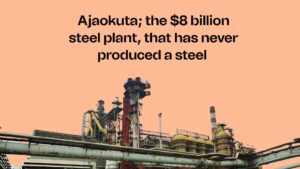
Three million standard cubic feet per day of firm gas and up to 47 million standard cubic feet per day of interruptible gas, up to 50 million scf per day to feed a power plant servicing a steel complex that has swallowed more than $8 billion without ever rolling a single coil of commercial steel.
That number is not rhetoric. The Federal Government estimates it has spent at least $5 billion, the World Bank puts it at about $7 billion not adjusted for inflation. Between 2020 and 2025 alone, Punch’s review showed N7.21 billion spent running Ajaokuta across 501 transactions even as iron and steel imports exceeded N1 trillion in 2025, averaging N526 billion annually.
The Minister of Steel Development, Prince Shuaibu Abubakar Audu, puts the annual import bill at about $4 billion, roughly N5.6 trillion, while Nigeria’s iron and steel industry remains dependent on recycled scrap.
The government now says revamping will cost between $2 to $5 billion to revamp the entire complex based on estimates by experts, with the light steel mill section costing about N35 billion, far exceeding current allocations. In the 2025 Budget, N6.21 billion was seemingly earmarked for salaries alone for a plant that doesn’t produce.
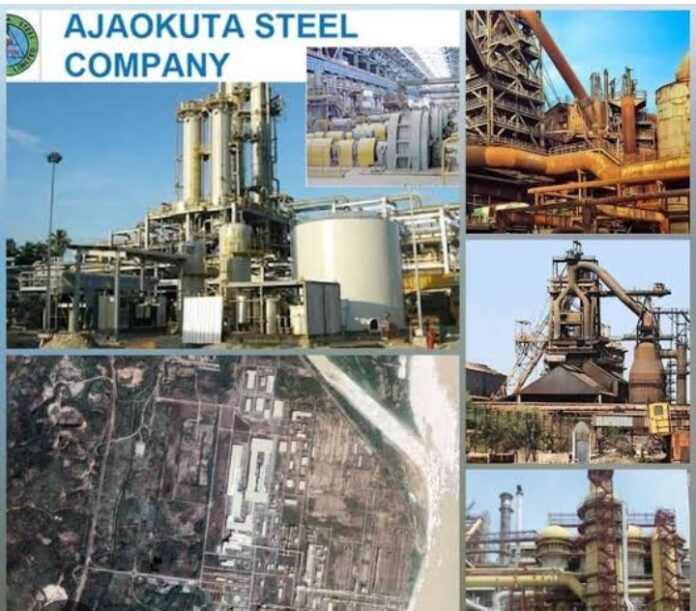
The plant sits on 24,000 hectares in Kogi State, a 68 kilometre internal road network, 24 housing estates, its own hospital and a seaport that never received a ship. It was meant to produce up to 5.2 million tonnes of liquid and finished steel annually, heavy plates, flat sheets, wire rods, bars, structural shapes.
The 24,000-hectare complex has been mired in legal disputes, policy somersaults by succeeding administrations, raw material shortages, obsolete technology and bureaucratic bottlenecks.
It was a Soviet child. A Soviet survey team discovered commercial iron ore in Itakpe in the early 1970s. On July 13, 1979 Nigeria signed a Global Contract with Tiajpromexport of the Soviet Union, TPE, for a new metallurgical enterprise. TPE deployed 1,000 Russian experts and 3,500 Nigerian workers. Of the 482 units that make up the entire complex, 476 were commissioned by October 1993. Within four years construction reached 84 per cent completion. Shagari called it the bedrock of industrialisation.
It was never only Soviet. When construction began in 1980, TyazhPromExport handled the core smelting technology, while a consortium of European firms — Wimpey of the UK, Boskalis of the Netherlands, Fougerolle of France, and Julius Berger — executed civil and auxiliary works.
An Irish engineer who was a member of Ajaokuta’s construction team in the 1980s later told US Embassy officers that the project began with Russian and German technical partners and may have thought feasible, but within a few months senior officials were already siphoning off millions in kickbacks.
That 2003 cable, published by WikiLeaks, was blunter: since 1979, Ajaokuta Steel Complex has been used as a mechanism to grant contracts to contractors performing substandard work at overinflated prices while providing senior Government officials with large kickbacks.
1991 broke it. A retired civil servant from the Federal Ministry of Information said precisely in 1991 he was opportune to have monitored two separate documentaries on Ajaokuta and the Aluminum Smelter at Ikot Abasi.
He got the first hint that the steel complex will never be able to produce flat iron sheets due to a defect in its installation capacity. The French film producer who made it told him it has to do with the steel technology the Russian contractors have installed.
“I think that the Russian technology is a stale one.” The same year, according to that official, powerful countries, namely France, America, Germany, Britain etc, including organisations like World Bank and IMF started reaching out to the Nigerian government to terminate the project with the Russians.
Then came December 25, 1991. The Soviet Union collapsed. TPE lost its state budget. Engineers were evacuated by 1993. Construction stopped. In 1994 the Abacha regime declared the plant 98 per cent mechanically complete and mothballed it. That figure was based on equipment weight installed, not operational readiness. No coking coal mine existed.
The Itakpe rail line wasn’t completed until 2020. Control systems were obsolete Soviet analog. Midway through construction Nigeria switched Phase 2 equipment from Soviet to Western specifications, creating fundamental incompatibility with the Soviet-designed blast furnace.
The Nigerian authorities who now run the ruins say the same thing the Soviets said: we can’t run without gas.
Nasir Naeem Abdulsalam was appointed Managing Director in April 2025 to lead the turnaround. Without gas, you can’t operate the steel plant, he said, describing gas supply as critical to steel production and the independent power generation serving the complex.
“We have had several different investors across different countries ask the same question: ‘How do we get the supply of gas?’ Without gas, you can’t operate the steel plant. You can’t operate the independent power generation that we have there.
“For now there are only limited signs of production, engineers operating a modular blast furnace producing manhole covers, utility poles and rail-track components for a small domestic market.”
The man who must make that gas matter is Minister Audu. In September 2024 his ministry signed a Memorandum of Understanding with Messrs. Tyazhmashpromexport, TPE, the original builders based in Russia, to rehabilitate, complete and operate the plant and NIOMCO Itakpe. Then the war stopped it. Audu said in Abuja, Russia-Ukraine war has stalled earlier deal.
“Due to constraints as a result of the Russia-Ukraine war, we are now exploring partnership with the Republic of China for the revitalisation of both ASCL and NIOMCO,” he said.
The economists who have watched this for 40 years don’t buy gas as the only problem.
Economist Kalu Aja, who has visited the site, put it starkly: No Nigerian can visit Ajaokuta, see investments of more than $8bn rotting in the African sun, and not cry. He is right — it is less a factory than a mausoleum.
Aja has highlighted three basic conditions without which Ajaokuta cannot work: 1. A functioning Itakpe iron ore supply chain via NIOMCO. 2. The Itakpe-Ajaokuta-Warri rail line to move inputs and outputs efficiently. And a blast furnace that actually works. All three are not functional.
Development economist Banji Oyelaran-Oyeyinka, speaking at the Virtual International Conference on Ajaokuta, blamed the failure on poor leadership, corruption and policy inconsistency.
He described the project as a monumental white elephant, lamenting that despite billions invested since the 1970s, the plant has failed to produce steel at industrial scale.
“We invested between $6 billion and $10 billion, yet decades later Ajaokuta remains idle — a monument to unrealised potential.” He noted Nigeria currently imports roughly $4 billion worth of steel annually, a situation that continues to strain foreign exchange reserves.
Economist and public policy expert Dan Kunle went further. In an open letter to President Bola Tinubu in July 2026, he called for a final and decisive decision on the future of Ajaokuta Steel and NIOMCO, warning that no serious investor is waiting to inject billions into Ajaokuta in its present status and that the complex should be unbundled and sold to private investors with a track record.
Private sector is skeptical. Aliko Dangote, Africa’s richest man, had set his sights on West Africa as his target market like Andrew Carnegie, saying “we want to make sure every single steel that we use will come from Nigeria.”
He later shelved steel investment plans, saying his board decided they shouldn’t do steel because “if we do steel business, we will be called monopoly,” and urged other Nigerians to invest.
That leaves Nigeria spending around $4 billion on steel imports annually, despite having around 74 steel plants and fabricators.
Ajaokuta is not just steel. The same Soviet Union that built it also built two extensive oil pipeline systems stretching 920 kilometres with total output of 18.7 million tons per year between 1977 and 1982.
When the Soviet Union collapsed, Nigeria lost that alternative technical partner. The Senate now says Nigeria lost $300 billion in ten years to poor oil measurement because meters were never installed.
Rust. Everywhere rust. On Sept 29 I walked past a plate that still reads Made in USSR. Diesel and hot dust. A caretaker in faded blue overalls wiped it with a rag. My own rag is still on my table in Diobu, Port Harcourt, black with soot at 6:14 a.m. Same black. Different source.
The hope of 1991 in Berlin was that market access would bring prosperity. In Ajaokuta the hope was that when the Cold War ended, Nigeria would finally finish what the Soviets started. Instead the plant died because its builder died.
The Ministry spokesman Salamatu Jibaniya did not respond to three calls on September 2-3 seeking comment on gas pricing. The TPE Moscow number listed in the 2019 MoU is disconnected.
Thirty-five years after the red flag came down in Moscow, Ajaokuta is still at 98 per cent, and Nigeria still imports $4 billion of steel it was built to make.
•Onwumere writes from Rivers State


