

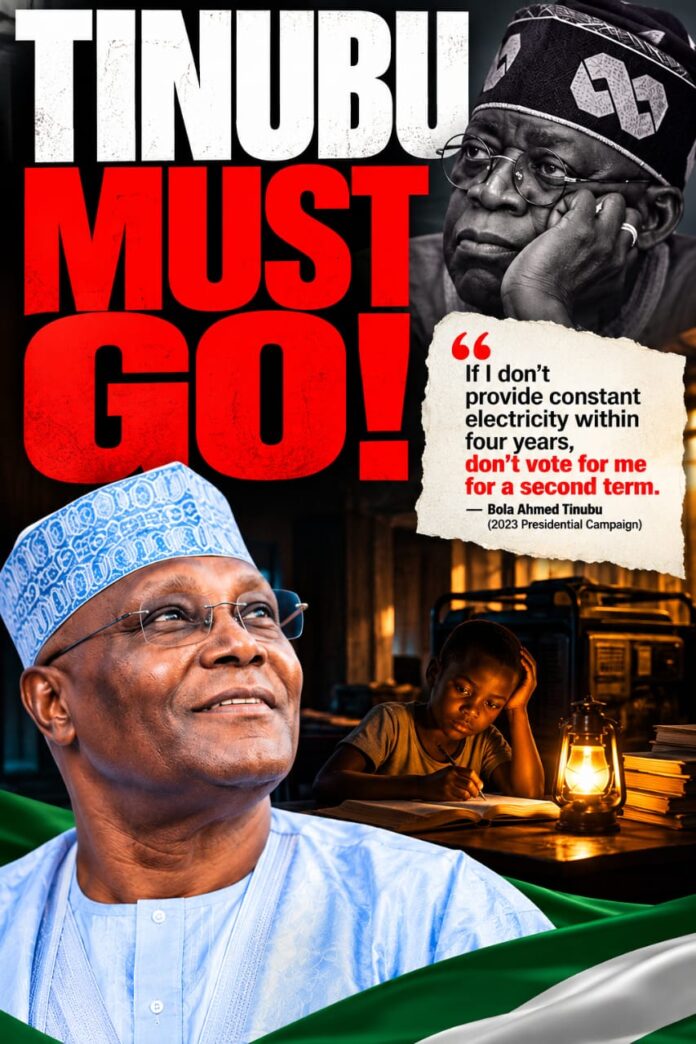
Electricity. Accountability. The standard Nigerians were asked to remember.
The campaign ground was alive with applause. The promises were bold. The expectations were high.
Among them was a promise about something millions of Nigerians understand without needing an economist to explain it: electricity.
In 2023, Bola Ahmed Tinubu challenged Nigerians to hold him accountable for his electricity pledge. His message was blunt: if he failed to provide constant electricity within four years, voters should not return him for another term, while he also referred to providing adequate reasons if he could not deliver.
It was a campaign promise. Nigerians heard it. The country has a right to revisit it.
Because electricity is not merely a line in a manifesto.
It is the barber waiting for power to open his shop.
The tailor calculating the cost of running a generator.
The manufacturer adding diesel expenses to the price of goods.
The student struggling to study when the lights go out.
The family paying for public electricity and then spending more to generate its own.
When power supply falters, the cost does not disappear. It moves from the national grid into the pockets of ordinary Nigerians.
And so, as the next presidential election approaches, a straightforward question returns:
THE PRESIDENT SET THE STANDARD. HOW SHOULD NIGERIANS ASSESS THE RESULT?
What progress has been made against the promise?
How reliable is electricity supply for households and businesses?
What has happened to the cost of powering small enterprises and Nigerian industries?
What measurable improvements can citizens point to?
These are not questions that should be settled by applause, political loyalty or counter-accusations. They require evidence: electricity supply data, progress against stated targets, the cost of power, and an honest account of what remains unfinished.
The administration may point to inherited challenges and ongoing interventions. Those claims, too, should be examined against measurable results. The existence of a difficult starting point does not make a campaign promise irrelevant; equally, a promise alone does not establish whether progress has or has not occurred.
THIS IS WHERE THE NATIONAL CONVERSATION MUST GO BEYOND SLOGANS.
For the African Democratic Congress and the presidential campaign of Former Vice President Alhaji Atiku Abubakar, the electricity debate presents a wider policy question: what practical steps would make power more reliable, reduce the burden of self-generation, and allow Nigerian businesses to produce at competitive costs?
That alternative must be explained in concrete terms, with credible targets, implementation plans and measurable commitments.
Nigeria needs a public debate in which every candidate is asked what they will deliver, how they intend to deliver it, and how citizens can hold them accountable.
Because when the lights go out, political arguments do not power the generator. And when businesses spend more to produce less, campaign promises cannot pay the bill.
A promise belongs to the campaign. Accountability belongs to the people.
As Nigerians look towards 2027, the question is simple:
WHAT WAS PROMISED, WHAT HAS BEEN DELIVERED, AND WHAT MUST CHANGE?
That is the conversation electricity deserves.
That is the standard every presidential campaign should be prepared to meet.
Engr Linus Anagboso
(BIGPEN)
Publicity secretary
Head Of Media and strategic communications ADC Anambra State.


