

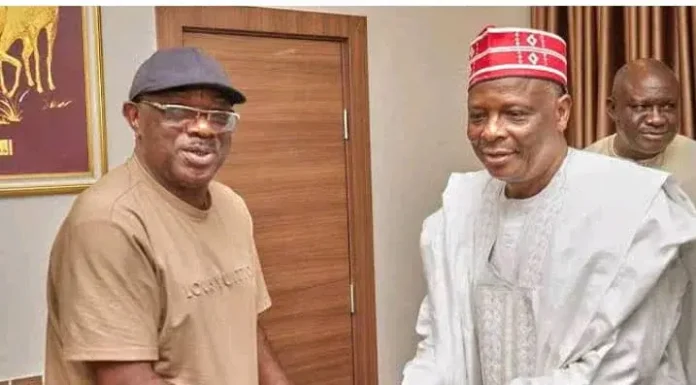
Kwankwaso, in a statement issued on Saturday while addressing what he termed “misleading narratives” surrounding his political moves, had argued that speculations about internal realignments within the African Democratic Congress (ADC) amid its crisis were premature. He also likened the ADC’s current challenges to the situation that led to his exit from the NNPP.
“We left the NNPP due to externally influenced legal problems that made our stay perilous. The ADC has now also been forced into this difficulty,” Kwankwaso had said.
But reacting on Sunday, NNPP founder, Dr. Boniface Aniebonam, rejected the claim, insisting that Kwankwaso’s exit was self-inflicted rather than driven by outside interference.
“Kwankwaso has always been his own personal problem.
“The exit of Kwankwaso, Elder Buba Galadima, Dr Ahmed Ajuji and others from the NNPP was not influenced externally but by Kwankwaso’s intense fight to take over the NNPP, a party he did not register,” Aniebonam stated.
He further accused the former Kano governor of habitually shifting blame, noting that such tendencies contributed to political setbacks, including defections within the party.
“It was the same attitude that led to the defection of Gov. Ahmed Yusuf of Kano State to the All Progressives Congress (APC).
“Kwankwaso and Galadima’s expulsion from the NNPP was ratified by the courts. A man who without second thoughts betrayed the trust of his good friend, who gave him a free platform to run for presidential election in 2023. To turn around to make insinuations of external influence is ungodly.
“We warned the ADC. Kwankwaso may still do same in any party he finds himself. He should move on and stop insinuations against his perceived enemies.
“We still wonder if it was the external influence that advised Kwankwaso to attempt to hijack the NNPP.
“We are fully convinced that the attempt by Kwankwaso and Galadima to hijack the NNPP and convert it to their personal belongings triggered escalating legal battles. Therefore it’s inappropriate for him to claim existence of external influence over the escalated legal battles.”
Aniebonam also pointed out that the agreement between the NNPP and the Kwankwasiya Movement was strictly tied to the 2023 general elections, enabling Kwankwaso and his allies to contest without financial obligations.
“The contract of agreement was for the purposes of the 2023 general elections, which enabled Kwankwaso to contest the presidential election and other elective positions among its members at no cost.
“Kwankwaso came a very distant fourth after President Tinubu, Abubakar Atiku and Peter Obi. However, his members under the platform of Kwankwasiya movement as members of NNPP won the governorship and other elective positions in Kano state.
“Unfortunately, Kwankwaso could not manage the success in Kano, leading to mass defection of NNPP members to the APC.


