

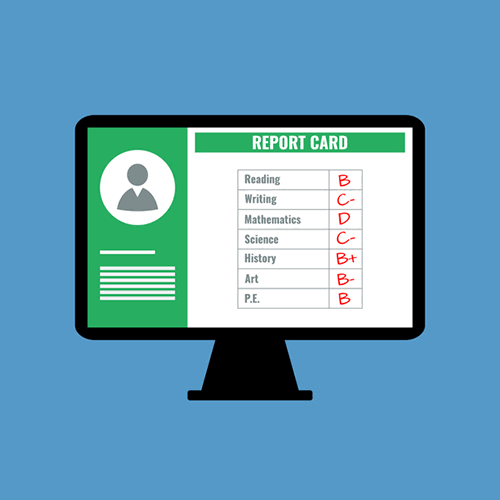
Education stakeholders have called for the adoption of digital report cards in primary and secondary schools to improve access to academic results, preserve records and prevent manipulation.
However, some stakeholders maintain that hard-copy report cards remain essential for tracking pupils’ academic performance over time.
They expressed their views in separate interviews with the News Agency of Nigeria (NAN) in Abuja on Tuesday, highlighting the benefits and challenges of both systems.

Ms Lois Tofumi, a member of the Board of Directors of St. Philip’s Academy, Abuja, said the school had introduced a PIN-based portal to prevent result manipulation and reduce errors during collation.
Tofumi said the initiative reflected the growing role of technology in education and the need to prepare pupils for computer-based examinations.
“The world is evolving into a technology-driven era. In the past, we heard stories of students using pens to alter grades or erase scores.
“Moving to an online portal eliminates those temptations and prevents manual collation errors,” she said.
She explained that parents and pupils could conveniently access results using assigned Personal Identification Numbers (PINs) on mobile phones or computers.
Although she acknowledged concerns about access charges, particularly among families with several children, Tofumi described the fees as affordable, considering the cost of maintaining the system.
Similarly, Malam Idris Alhassan, Principal of Zinaria International School, said digital platforms enabled parents to monitor their children’s academic performance without visiting school premises.
Alhassan said the school had operated a digital results system for seven years, allowing parents living outside Abuja and abroad to access their children’s academic records remotely.
He added that the system helped preserve academic records, making it possible to retrieve and print results years after graduation.
“Even if you come to the school 20 years from now, the database can still provide the result for printing. “The safety of that document for future use is another important consideration,” he said.
Alhassan acknowledged that digital platforms could initially pose challenges for parents who are unfamiliar with technology or lack functional email addresses.
However, he said schools could overcome these difficulties by patiently guiding parents until they became familiar with the system.
A parent in Abuja, Mrs Mimidoo Tile, also supported digital report cards, citing their accessibility and durability compared with physical documents.
Tile said hard-copy results could be misplaced, damaged, or lost during relocation or domestic incidents, including fires.
She, however, identified difficulties with password recovery and limited digital literacy as challenges associated with electronic report cards.
According to her, some schools provided access to digital results at no additional charge beyond regular tuition fees, making the benefits outweigh the disadvantages.
In contrast, Mrs Onyinyechi Otie, an education stakeholder, argued that hard-copy report cards remained more effective for monitoring pupils’ academic progress over time.
Otie said physical report cards allowed parents to compare their children’s performance across terms and academic sessions, unlike printouts obtained from cybercafés, which could easily be misplaced.
She expressed concern that such printouts might not provide the comprehensive academic history contained in properly maintained physical records.
Otie also highlighted challenges associated with collecting report cards, noting that some underperforming pupils avoided collecting their results, while some parents failed to visit schools because of outstanding fees.
READ ALSO: Australia’s Emergency Departments Struggle to Meet Growing Needs of Older Patients
She urged parents to visit schools regularly to collect their children’s report cards and to engage with teachers directly to understand their academic performance and identify areas for improvement.
The stakeholders advocated a balanced approach that combines digital and hard-copy report cards to strengthen record-keeping, improve parental access and enhance the monitoring of pupils’ academic progress.


