

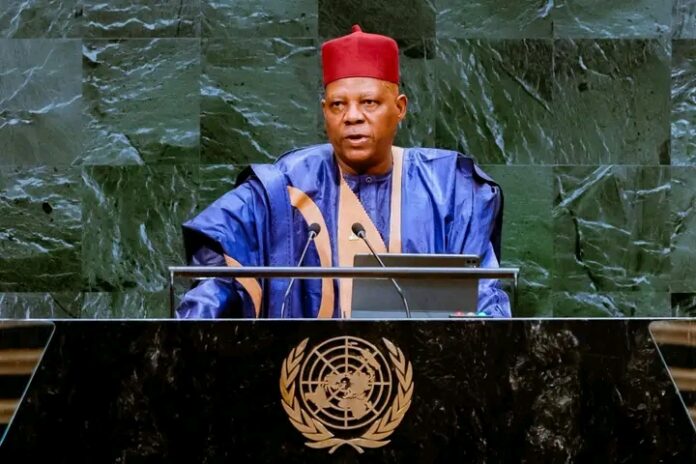
Vice President Kashim Shettima has called for comprehensive reform of the United Nations Security Council, saying Africa can no longer remain central to the Council’s agenda while being excluded from permanent membership.
Shettima made the call while addressing the 81st Session of the United Nations General Assembly, where he argued that the structure of the Security Council should reflect the realities of the contemporary world rather than the balance of power that existed in 1945.
The Vice President said Nigeria was demanding, in line with the Ezulwini Consensus and the Sirte Declaration, at least two permanent seats for Africa with all the rights and responsibilities attached to permanent membership, including veto power for as long as it exists.
He also called for five non-permanent seats for the continent.
“The reform of this institution must begin with the reconstitution of the Security Council. For the world of 2026 cannot remain captive to the distribution of power in 1945,” Shettima said.
“Africa cannot continue to fill the Council’s agenda while remaining absent from its permanent membership.”
Shettima said Nigeria’s position was based on the principle that countries seeking greater representation must also be prepared to take on greater responsibilities in maintaining international peace and security.
He highlighted Nigeria’s contributions to peace operations and regional security efforts in Liberia, Sierra Leone, Darfur, Mali and The Gambia, as well as its role in mediation, democratic governance, counter-terrorism and maritime security through regional and continental partnerships.
The Vice President also urged the international community to uphold the founding principles of the United Nations, including dialogue, mutual respect and collective responsibility.
Shettima called for greater international action on climate change, stressing that developing countries must be allowed to industrialise, reduce poverty and expand energy access while pursuing low-carbon development.
He reaffirmed Nigeria’s commitment to the Paris Agreement and its Energy Transition Plan, which targets net-zero emissions by 2060.
According to him, Africa contributes less than four per cent of global greenhouse gas emissions but faces disproportionate consequences from climate change.
He therefore called for climate finance to be guided by equity and shared responsibility, with international commitments translated into accessible and predictable funding.
On technology and artificial intelligence, Shettima said Nigeria would not support efforts to allow fear of emerging technologies to undermine their potential benefits.
He said artificial intelligence could be deployed in areas such as healthcare, education, agriculture, governance and economic productivity.
The Vice President said Nigeria was investing in digital public infrastructure, broadband connectivity, innovation systems, research institutions and technology entrepreneurship, while encouraging international partnerships with Nigerian innovators.
Shettima also called for reforms to the international financial architecture, noting that debt servicing was placing pressure on resources needed for education, healthcare and infrastructure in developing countries.
He advocated wider access to concessional financing and debt sustainability frameworks that take developmental needs into account.
READ ALSO: Anambra First Lady Empowers 5,000 Anambra Residents, Urges Vigilance During Flood Season
He further identified the African Continental Free Trade Area as an opportunity to strengthen regional value chains, increase intra-African trade, promote industrialisation and attract investment.
According to him, Africa must move beyond exporting raw materials by increasing value addition, manufacturing, technological innovation and knowledge-driven growth.
On security, Shettima said terrorism, organised crime, cyberattacks and illicit financial flows had demonstrated the limitations of isolated national responses.
He said Nigeria’s experience in combating Boko Haram, ISWAP and other armed groups showed that military operations must be supported by education, economic opportunities, accountable governance and community protection.
He also called for urgent diplomatic action to address conflicts in Sudan and other war-torn countries, with greater emphasis on protecting civilians and ensuring humanitarian access.
Shettima urged the United Nations to devote more resources to peacebuilding, mediation, institution-building and sustainable development, arguing that conflict prevention should receive greater international attention.
He concluded by calling for a more inclusive and effective United Nations, stressing that global cooperation remained essential in addressing conflicts, climate change, development challenges and the responsible use of technology.


