

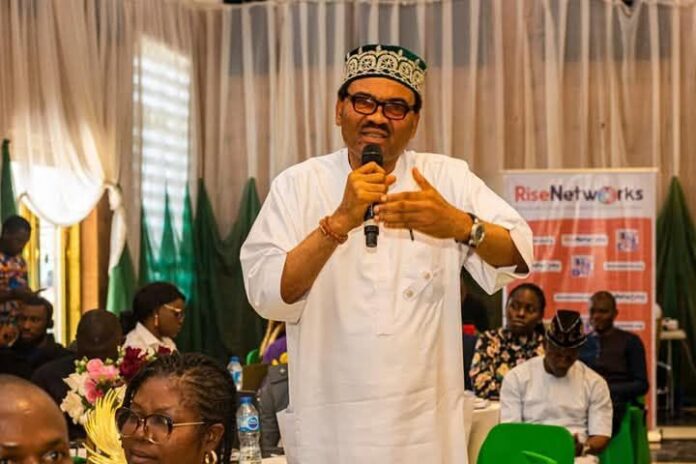
Citizen advocate Prince Chris Azor has called for Nigeria’s fiscal reform accountability framework to go beyond government disclosures and include independent verification of public finance claims, particularly figures relating to fuel subsidy savings and revenue distribution.
Azor, President of the International Peace and Civic Responsibility Centre (IPCRC), made the call in a public statement on Wednesday in response to a Business a.m. article titled “The Reform Numbers: Following the Money,” published between August 24 and 30, 2026.
He argued that while the newspaper’s analysis rightly questioned the assumption that reported subsidy savings automatically translate into available public funds, a more critical issue was whether the government’s figures had been independently verified.
According to him, claims that ₦15.8 trillion was saved from subsidy removal and subsequently shared among the three tiers of government require greater scrutiny.
He noted that the reported distribution of ₦5.43 trillion to the Federal Government, ₦6.52 trillion to states and ₦3.88 trillion to local governments appeared to assume that the entire subsidy savings entered the Federation Account before being allocated.
“How much revenue did subsidy removal actually generate? How much did the Nigerian National Petroleum Company Limited (NNPCL) remit? How much did it retain, and have the obligations cited to justify retained revenues been independently audited?
“These are not accounting details,” he said, adding that they directly affect the credibility of the reform programme.
Azor also raised concerns about local government finances, arguing that it is misleading to suggest that councils have benefited from increased allocations when many still cannot demonstrate independent control over those funds.
Citing the Supreme Court’s 2024 judgment on local government financial autonomy, Azor maintained that implementation has remained problematic, creating a significant accountability gap.
He said, “Citizens cannot effectively hold local governments accountable for resources they do not independently control.
“There must be greater transparency in public procurement, and accountability should not begin and end with announcing completed projects.”
Instead, he said the public should be able to verify whether contracts were lawfully awarded, properly appropriated, adequately funded and supported by the required approvals.
He referenced the July 2026 Treasury Circular directing Ministries, Departments and Agencies (MDAs) not to create financial obligations without the necessary Warrant or Authority to Incur Expenditure, describing it as evidence that announced projects and reported spending do not automatically prove lawful expenditure or project delivery.
READ ALSO: Matawalle: Nigeria Needs Prayers, Unity Ahead of 2027 Elections
The IPCRC president advocated a comprehensive accountability chain that tracks public funds from appropriation through procurement, approvals, contract awards, releases, payments, implementation and final project verification.
He argued that ministerial presentations alone do not constitute an audit trail, saying Nigerians should be able to independently reconcile NNPCL remittances, Federation Account Allocation Committee distributions, state receipts, local government allocations, procurement records, payments and project outcomes.
Azor also urged governments to publish detailed information on infrastructure projects, including project locations, contractors, contract values, payments made, completion timelines and physical progress, to enable public verification.
He challenged civil society organisations to expand accountability efforts beyond Abuja by scrutinising how states and local governments receive, budget, release and spend public funds.
He also advocated greater use of the Freedom of Information Act, audit reports, procurement records and independent civic-tracking mechanisms to strengthen public oversight.
According to him, the true measure of Nigeria’s reforms should not be the size of figures announced by government officials, but whether citizens can trace authorised public spending to tangible improvements in their communities through transparent management and independent verification.


