

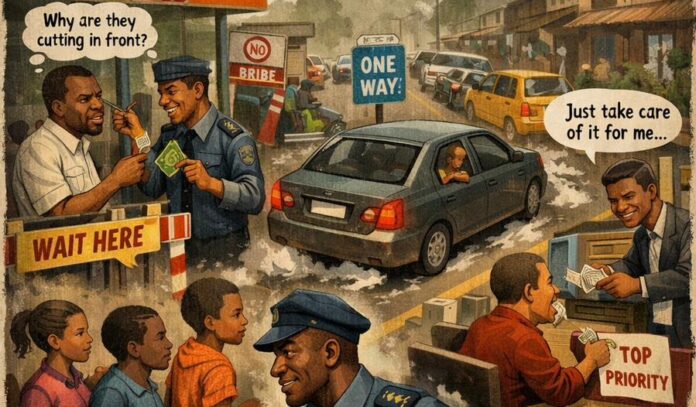
Assistant Corruption Officers series. Week 5, continuing seamlessly from Week 1.
There is a silent slogan that many Nigerians live by, even if they never print it on banners or chant it at rallies:
“Queue is for fools.”
It is not written in the constitution. It is not taught in schools. But it is practiced everywhere, at fuel stations, banks, traffic junctions, offices, markets, and government buildings.
It is the unofficial national anthem of convenience.
The Small Crimes We Don’t Count
Most Nigerians do not see themselves as lawbreakers.
After all, they are not stealing billions. They are not looting treasuries. They are not signing fake contracts.
They are just: Driving against traffic “for a short cut”. Jumping a line “because I’m in a hurry”. Tapping light “because NEPA is cheating us”. Using a friend’s document “just this once”. Paying someone to “help me pass through”.
Small things.
Normal things.
Harmless things.
Except that when millions of people commit small things every day, the country becomes one big thing that doesn’t work.
The Culture of Shortcuts
Nigeria has become a nation addicted to shortcuts.
Why wait when you can bypass? Why follow process when you can know somebody? Why do it right when you can do it fast? This mindset does not stop at traffic lights. It climbs into offices, classrooms, courts, and ministries.
Soon, nothing moves on merit.
Everything moves on connection.
And once a society replaces process with proximity, fairness disappears.
The Irony We Refuse to See
We insult politicians for cutting corners. We curse leaders for breaking laws. We criticize institutions for ignoring rules.
Then we get into our cars and drive into oncoming traffic. We complain about corruption in power, while practicing corruption in motion.
Leadership is not created in government buildings. It is trained in daily behavior.
The National Classroom
Children are always watching.
They watch their parents bribe their way out of trouble. They watch adults laugh at rules.
They watch elders praise “sharp guys” who beat the system.
So what do they learn?
Not that honesty is noble, but that honesty is slow. Not that law matters, but that law is optional. Not that patience is virtue, but that impatience is power.
This is how a nation educates itself into disorder.
Why Rules Feel Like Enemies
Many Nigerians see rules as obstacles, not protections. The traffic law is “delaying me.”
The office procedure is “wasting my time.” The regulation is “blocking my progress.”
So we fight the system instead of fixing it.
But a society that treats its own rules as enemies will eventually become an enemy to itself.
The High Price of Low Discipline
Lawlessness does not just create inconvenience.
It creates:
Unsafe roads. Unreliable services. Corrupt institutions. Weak justice systems. Distrust between citizens and state.
When no one respects the line, everyone is always pushing. And a country that is always pushing cannot move forward.
The Hard Mirror
Nigeria’s problem is not that laws are weak.
It is that respect for law is weak.
We want order from government but freedom for ourselves. We want discipline from leaders but exceptions for our behavior.
That contradiction is where national failure is born.
Final Reflection
A nation is not built by big speeches alone. It is built by small daily obedience.
Every time a Nigerian chooses to wait instead of push, to follow instead of bypass, to obey instead of negotiate, the country moves one step forward.
Every time we don’t, we push it back.
Next week, we confront the quietest accomplice of all:
“The Silence Industry” — How Looking Away Became a National Habit.
To be continued.


