

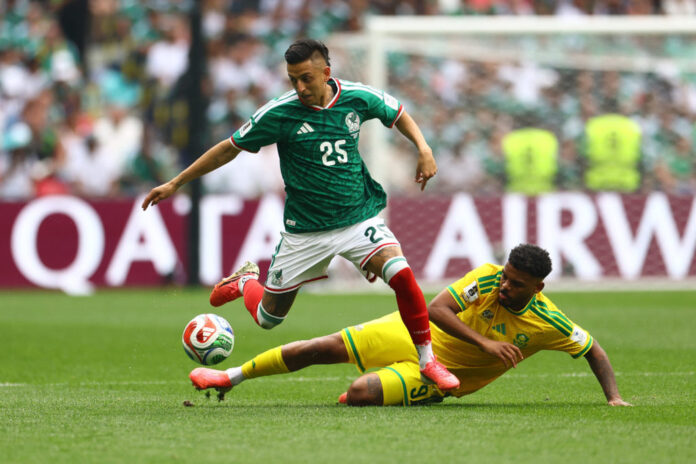
March M 0, Mexico 2
Supa Xeno rolled the ball to Dudu
and Dudu dribbled and delivered
it to We First, who unfortunately
fumbled, miskicked and tumbled.
Spaza Shopu was not impressed.
On that global stage, such slipups
don’t frequently go unpunished.
Mexico meticulously took control,
aimed and … hammered home!
The giant stadium reverberated.
Restarting the game at the center
of the field of play was none other
U A Folena. He set the ball rolling
to Bakavaye, Bakavaye released it
to Awa Jobisi, Awa Jobisi to Supa
Xeno, then to Anti-afro and Apateti.
He was smoothly dealt with by Diaspora
Afrika, who ably left March M defenders
for dead before unleashing a lovely volley.
It’s a goal! Afrika roared and celebrated!
Commentary By Qinisela Possent Ndlovu
This is a protest poem against the South Africans’ xenophobic attacks on foreigners and Africans. The poem is Ndaba’s portrayal and interpretation of the iconic first World Cup match against Mexico in which Mexico won 2- 0.
Africans and the rest of world cheered because of how South Africans as a government, people and media tend to treat the (black) Diaspora in their country.
The following words capture the Xenophobia against foreigners and Africans which is being played back to the intolerant South Africans in poetic banter and humour: Supa Xeno is short for Xenophobia, “passed the ball”, here Dudu is short for Operation Dudula, an anti-migrant group. We First stands for these South African groups’ continuous claim that “we (should) come first in South Africa” since it is their country.
In this poem one comes across a South African player who is funnily referred to as Spaza Shopu. Spaza shops are small supermarkets owned by foreigners and Africans in South African which sadly have been targets for attacks. The poet captures their status and predicament in iconic lines of condemnation:
On that global stage, such
slipups
don’t frequently go unpunished.
U A Folena is a moniker for a South African player and this signature screams,” you are a foreigner”, a position and a misnomer that is being interrogated and rejected by several black Africans living in South Africa because they are indigenous to Africa. In the poem we also read about another South African player by the name Bakavaye. This name is repeated twice to emphasize the clarion call for foreigners to leave South Africa because Bakavaye is a street term which means “go away”.
Awa Jobisi is another South African player with a moniker which stands for “our jobs”, while Anti- afro is an echo of the demonstrators’ anti-African migrant sentiment, and Apateti is a moniker for apartheid, a symbol of racial discrimination.
The poet uses tropes and names to explore critical issues of black solidarity, dignity and unity beyond the African continent. For instance, by presenting a player from the Diaspora who mightily defends Africa against the South African team— personified by Match M, short March Millenium, Ndaba queries and derides “marches” against foreigners and Africans. If Diaspora represents African fineness and force outside of Africa, the South African component of the equation exposes and embodies an errant antithesis of values of valor, authenticity, growth, honesty, motivation, and self-esteem. It is a betrayal of the basic principles of humanity, unity and empathy.
The poet captures how Africans celebrated when a goal was scored against the South African soccer team at the recent World Cup match pitting Mexico against South Africa. The piece is a scathing attack in banter and humour against afrophobic South Africans, and it is a personal and poetic response to how Africans expressed their generally growing resentment, unease and frustration over a sequence of endless and disparaging afrophobic outbreaks in South Africa. This poet makes use of the historic first game of the World Cup 20206 in Mexico— where South Africa lost 2 nil to Mexico—to highlight the gravity and growing position of that multilayered socio-political challenge that is surely setting South Africa up for an ill-fated showdown against other unhappy African nations.
No wonder, the poet depicts a victory against South Africa that is loud and celebrated across Africa and beyond. He captures, with clarity, the Zimbabwean mood as we watched the game.
Biography of the reviewer
Qinisela Possent Ndlovu is a Zimbabwean writer and educator in Communication and Public Relations at Bulawayo Polytechnic. Also known as “Bangkhaya,” his work explores culture, heritage, family, faith, and contemporary African life, often weaving in local languages and vernacular.
Bio of the author
Ndaba Sibanda is a Bulawayo-born poet, novelist, and nonfiction writer who has a passion for themes and topics around conservation, nature, development and justice.


