

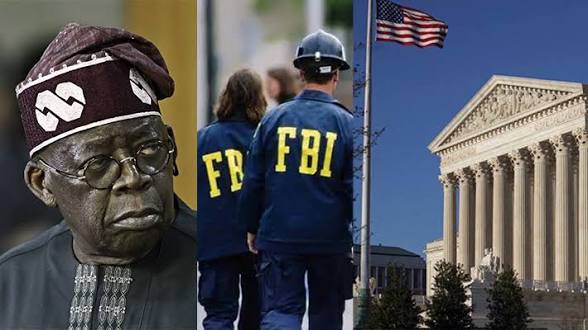
The United States Federal Bureau of Investigation (FBI) has raised security concerns over the possible release of records relating to President Bola Ahmed Tinubu, telling a US court that disclosure of information contained in the files could expose individuals connected to an investigation to serious risks, including possible violent attacks.
The FBI made the submission in an ongoing Freedom of Information Act (FOIA) lawsuit filed by American transparency activist Aaron Greenspan, who is seeking access to historical records relating to Tinubu from the early 1990s.
The records sought include what Greenspan described as Tinubu’s complete FBI file, as well as FBI Form 302 interview reports involving him in connection with an FBI case covering the period between 1992 and 1993.
In its filing before the court, the FBI said it relied on several exemptions under the US Freedom of Information Act to withhold portions of the requested records.
Among the exemptions cited was Exemption 7(F), which permits law-enforcement agencies to withhold information where its disclosure could reasonably be expected to endanger an individual’s life or physical safety.
The FBI also relied on exemptions relating to personal privacy, confidential sources and investigative techniques.
According to the bureau, releasing certain information could expose individuals who participated in or assisted the investigation to possible retaliation.
The FBI argued that some people whose names or identifying information appear in the records could be perceived as having provided information or participated in the investigation, potentially making them targets of persons connected to the criminal activities under investigation.
The agency said the disclosure of such identifying information could therefore endanger their lives or physical safety.
The FBI further informed the court that it could not publicly provide its full explanation for relying on Exemptions 7(E) and 7(F), arguing that doing so could itself reveal sensitive information it was seeking to protect.
It consequently requested permission to provide additional explanations and disputed materials privately to the judge under seal.
The dispute centres on historical US law-enforcement records connected to Tinubu and an alleged drug-trafficking investigation from the early 1990s.
One of Greenspan’s FOIA requests sought the entire FBI file relating to Tinubu, while another requested FBI Form 302 interview reports involving him in a case identified as 245-IP-71386-UUUUUU between 1992 and 1993.
Greenspan has also sought records from other US agencies, including the Drug Enforcement Administration, Central Intelligence Agency, Internal Revenue Service and immigration authorities, as part of the wider FOIA litigation.
The latest development follows an order by US District Judge Beryl Howell, who is handling the matter at the District Court for the District of Columbia.
The court allowed the FBI to submit additional explanations and disputed materials ex parte and in camera, meaning the information would be provided privately to the judge for review rather than immediately placed on the public court record.
The FBI subsequently submitted confidential material to the court on August 28, according to reports on the latest court filing.
The documents remain under seal while Judge Howell considers the government’s arguments.
Reports surrounding the case have also indicated that an FBI search identified 399 pages of potentially responsive records relating to Tinubu. However, the publicly available court notice confirms only the submission of sealed material and does not publicly disclose the contents of the records.
The figure of 399 pages and descriptions of the alleged contents of the files have been attributed to commentary surrounding the case and have not been independently established by the publicly available court filing.
The records have attracted renewed public attention because of Tinubu’s long-running legal history in the United States, including a 1993 civil forfeiture case involving $460,000 that was forfeited to the US government.
However, the existence of law-enforcement records concerning an investigation does not, by itself, establish that Tinubu committed a crime.
The current FOIA case is focused on whether the US government can legally withhold the requested records and whether portions of the materials should eventually be released to the public.
Similarly, the FBI’s warning about possible violence does not amount to a finding that anyone is currently planning an attack. Rather, the bureau is arguing that the disclosure of certain identities or sensitive information could reasonably create risks to the physical safety of people connected to the investigation.
The court is expected to ultimately determine which information can legally remain withheld and whether any portions of the records should be released publicly.


