

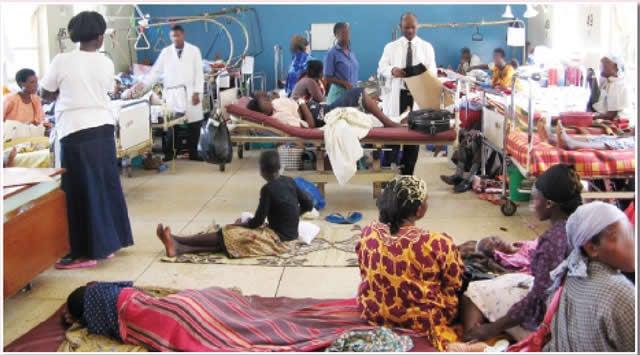
“May Nigeria not happen to you.”
What a heartbreaking sentence.
We have somehow reached a point where surviving our own country has become a prayer request.
Where falling sick is frightening not only because of the illness, but because you don’t know whether the closest hospital has a doctor, a nurse, electricity, oxygen, blood, drugs, equipment, an ambulance, a functioning theatre, or even a bed.
And this is where I want to speak, respectfully but painfully, to the Nigerian government.
To the President
To the 36 state governors.
To ministers, commissioners, legislators and every person entrusted with public resources.
Please, look at healthcare again. Not as another item in a budget. Not as another project to commission. Not as another building to put your name on.
Look at it as LIFE.
Nigeria’s population was estimated at 237.5 million people in 2025.
And according to the WHO African Region’s latest workforce assessment, Nigeria has about 4.1 doctors per 10,000 people in 2024.
That is roughly 1 doctor for every 2,400 people. 1 doctor attending to 2,400 citizens!
The problem is not just the number.
It is where those doctors are. It is whether they are actually practising. It is whether there is a nurse beside them. Whether there is a laboratory scientist. Whether there is a pharmacist. Whether there is electricity. Whether there is water. Whether there is an ambulance. Whether there is a functional operating theatre.
Whether the hospital has the equipment necessary actually to save the person who walked through its doors.
And then comes the brain drain.
In 2024, Nigeria’s Federal Ministry of Health reported that 4,193 doctors and dentists left the country. Across doctors, nurses, pharmacists, and medical laboratory scientists, a staggering 43,221 health professionals migrated between 2023 and 2024. They fvcking left the country, man.
Even before that, the Coordinating Minister of Health had said that Nigeria had lost approximately 15,000–16,000 doctors over five years. In 2025, he put the figure at more than 16,000 doctors over five to seven years.
Think about that.
We train them here. We educate them here.
Families make sacrifices to send them through medical school here.
The Nigerian state invests in the ecosystem that produces them.
And then the conditions become so difficult that other countries get to benefit from that investment.
The United Kingdom. Canada. The United States. Australia. And others.
The 2024 migration data showed the United Kingdom among the biggest destinations for Nigerian health professionals.
This is not just “Japa.”
This is the export of human capacity from a country that desperately needs it.
And we should be honest about something else:
This is not an argument against Nigerians leaving. People have the right to seek better lives.
The question is:
Why are we making it so difficult for them to stay?
Why should a Nigerian doctor have to leave Nigeria before being able to practise in an environment where the basic tools required to save a life actually exist?
And why should a Nigerian patient have to suffer because the doctor who could have treated them has gone somewhere else?
This is where the conversation about hospitals becomes bigger than hospitals.
Nigeria has 774 Local Government Areas.
The Federal Ministry of Health currently lists only 33 teaching hospitals, 24 Federal Medical Centres and 22 federal specialty hospitals in its federal hospital network.
But healthcare is not supposed to mean that everybody travels to a major city whenever something serious happens.
Primary healthcare is supposed to be the foundation.
Secondary hospitals are supposed to provide more advanced care.
Tertiary institutions are supposed to handle the most complex cases.
That means the question should not simply be:
“How many hospitals have we built?”
It should be:
“Can a Nigerian get appropriate care when they need it, wherever they live?”
That is the real question.
And the answer, unfortunately, is still NO! for far too many Nigerians.
The government itself acknowledges that more than 30,000 primary healthcare centres are not yet optimally functional.
At the same time, note that there has been progress that should be acknowledged. The Federal Government says more than 10,800 PHCs have been revitalised, around 72% of PHCs now offer an integrated service package, and quality scores have improved.
That is good.
But this is not a reason to stop. It is a reason to go further.
Because a country of almost 240 million people cannot afford to celebrate basic functionality as though it were the finish line.
And then there is the money.
Nigeria and other African countries committed themselves to the Abuja Declaration, which called for at least 15% of national budgets to be devoted to health.
We are still far from that commitment.
The Federal Ministry of Health itself acknowledged in 2025 that national government health financing remained below the Abuja Declaration target. It also reported government health expenditure at about 5.2% of GDP, with per-capita health expenditure around $43 and out-of-pocket spending at about 71% of health expenditure.
The WHO reported that household out-of-pocket payments accounted for roughly 72% of Nigeria’s current health expenditure in 2023.
That number should frighten us.
Because it means sickness can become a financial catastrophe.
A family can spend the money meant for school fees.
A trader can lose the capital that keeps their business alive.
A parent can sell property.
A family can borrow money.
And sometimes, even after all of that, they may still lose the person they were trying to save.
This is what healthcare failure looks like.
It is not an abstract statistic.
It is somebody’s mother. Somebody’s father. Somebody’s child. Somebody’s brother. Somebody’s sister. Somebody’s only breadwinner. Somebody’s entire world.
And that is why I struggle when healthcare is treated like just another government project.
A hospital is not a cinema. It is not a city park. It is not a decorative roundabout with ribbons. It is not a political billboard for campaigns. It is not something we should build only because an election is approaching.
A functioning hospital is as fundamental to a society as clean water, food, roads and security.
You can live without a cinema. You can postpone visiting a park. You can survive without another monument.
But when somebody is having a medical emergency, time becomes life.
A hospital ten minutes away can mean the difference between life and death. A functioning ambulance can mean the difference between life and death. A trained doctor can mean the difference between life and death. A nurse can mean the difference between life and death.
Electricity can mean the difference between life and death. Oxygen can mean the difference between life and death. Blood can mean the difference between life and death. A functioning theatre can mean the difference between life and death.
Healthcare is not a luxury.
It is infrastructure. It is human security. It is national security.
And if we want to understand how far behind we are, look at the resources available in other health systems.
The OECD reports an average of 3.9 practising doctors per 1,000 people across OECD countries in 2023. The UK had about 3.4, Germany about 4.7, while the United States had about 2.7 practising doctors per 1,000.
Nigeria’s 2024 figure of about 4.1 doctors per 10,000 people is roughly 0.41 per 1,000.
Read that again.
Not 4.1 per 1,000.
4.1 per 10,000.
0.41 per 1,000.
Not even up to half a doctor for 1,000 people
That is the scale of the gap.
And when we look at hospital beds, the contrast is also enormous. Across OECD countries, there were an average of 4.2 hospital beds per 1,000 people in 2023, while countries such as Japan and South Korea had around 12.5 and 12.6 beds per 1,000 respectively.
The point is not that Nigeria must suddenly become Germany, Britain, Japan or America.
We have our own realities.
But we must at least become a country where a sick person can reasonably expect the healthcare system to be there for them. That assurance that there is hope in the hospital.
And we cannot ignore the human cost.
Nigeria’s 2023 Demographic and Health Survey reported maternal mortality at 512 deaths per 100,000 live births, down from 576 in 2018. Under-five mortality was 110 deaths per 1,000 live births, while skilled birth attendance was only about 53%.
The WHO’s international maternal mortality estimates paint an even graver picture, estimating Nigeria’s maternal mortality ratio at roughly 1,000 deaths per 100,000 live births in 2023, reflecting the difference between national survey estimates and international modelled estimates.
These metrics show a clear, sad and tragic chain reaction: Because 47% of women give birth without skilled medical help, complications go untreated, driving an abnormally high maternal mortality rate.
The newborns who survive face an under-funded pediatric system, leading to 1 in 9 dying before age five.
The message is devastating:
Too many Nigerian women are still dying from pregnancy and childbirth.
And many of the causes are not mysterious.
They are problems that functioning health systems know how to prevent, detect and treat.
So yes, let us pray!?! I am a Nigerian. I understand prayer. I understand saying “May Nigeria not happen to you.”
But I believe that we have used that sentence for too long. Because prayer should not become the substitute for (good) governance.
We cannot leave everything in the hands of God when God already gave us the resources, the intelligence, the doctors, the nurses, the engineers, the land, the oil, the gas, the human capital and the institutional tools to build something better.
What we need is the will to use them properly.
When politicians fall seriously ill, many have access to treatment abroad. They can fly. They can seek specialists. They can enter facilities with equipment most Nigerians will never see.
But what about the Nigerian who cannot afford a flight to London?
What about the mother in a rural community? What about the child in a poor household?
What about the civil servant who has spent a lifetime paying taxes?
What about the trader whose entire livelihood is in the cash sitting in their account?
What about the farmer who cannot afford a private hospital?
Who protects them?
That is the question.
And this is not about attacking one political party. It is not about North versus South. Christian versus Muslim. Igbo versus Housa or Yoruba. APC versus PDP. Federal versus state.
This is about the Nigerian human being.
Every government, federal, state and local, has a responsibility to contribute to a health system that actually works.
And the citizens also have a responsibility.
We must speak. We must ask where the money went. We must ask how much was budgeted. How much was released? How much was spent.
Which hospital received it. What equipment was purchased? How many doctors were employed? How many nurses were employed? How many ambulances are functional?
How many theatres work? How many hospitals have reliable electricity and water? How many communities have access to emergency care?
We must stop focusing all our collective energy on trivialities and irrelevant distractions that contribute nothing to our development: like irrelevant banter, who is sleeping with whom, who is dancing on TikTok, IG etc, who bought the latest car or iPhone, or who is dating who. Those should be afterthoughts
We must stop waiting until tragedy touches our own family before we become angry.
Because by then, it may already be too late.
Influencers and popular personalities need to do better. Use your platforms for things like this. Yes, you have your brand and niche, but when the need arises, speak up. Call the government and institutions to action, because human life comes before whatever content you create, movie you make, or music you record.
And to the Nigerian government, I am begging you:
Please make healthcare one of the first things you think about when you think about governance.
Before the next monument. Before the next vanity project. Before the next political rally. Before the next government convoy. Before the next campaign promise.
Think about the hospital. Think about the emergency ward. Think about the maternity ward. Think about the child who needs oxygen.
Think about the patient waiting for surgery. Think about the doctor who wants to stay but cannot work properly. Think about the nurse working under impossible conditions.
Think about the rural community that has no specialist within reach. Think about the family standing outside a hospital begging for money.
Think about life.
Because a country is not truly developing when its airports are beautiful but its citizens are afraid to fall sick.
A country is not truly progressing when its politicians can access world-class healthcare abroad but ordinary citizens cannot access basic emergency care at home.
A country is not truly prosperous when it produces brilliant doctors who must leave before they can practise properly.
And a country cannot keep telling its citizens, “May Nigeria not happen to you.”
At some point, the government must make Nigeria a place where Nigeria happening to you does not mean tragedy.
Lasisi Elenu (@lasisielenu/X), thank you again for making that video, it is a source of inspiration for this article. As a comedian, it must have been truly painful to you to do that.
Thank you for forcing us to look at something many of us would rather scroll past.
And to every Nigerian reading this: Please, let us stop making this conversation only about prayer.
Pray. Yes. But also ask questions. Speak.
Demand accountability. Demand functioning hospitals. Demand doctors. Demand nurses.
Demand medicines. Demand emergency care. Demand health insurance. Demand electricity and water in our hospitals.
Demand that the money allocated to healthcare actually reaches healthcare. Demand better.
It is your right
Because the next person who needs that hospital may be you.
It may be me. It may be our mother. Our father. Our child. Our friend.
And if that day comes, none of us should have to depend on luck.
Healthcare is not a luxury. Healthcare is not a favour from the government. Healthcare is not charity.
Healthcare is a right, a necessity, and one of the most basic responsibilities of a functioning state.


