

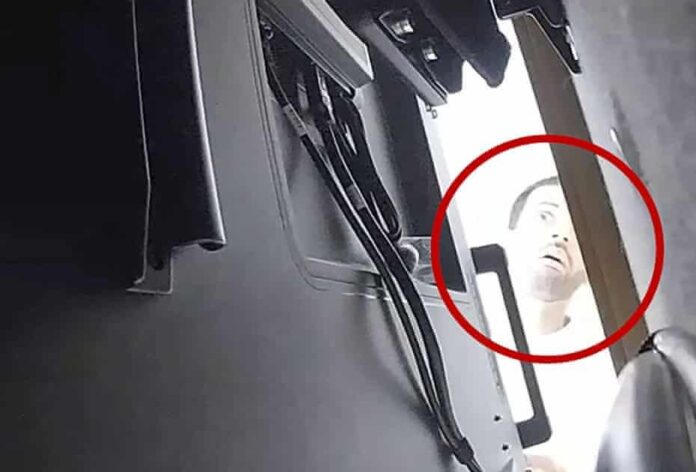
Federal agents in the United States arrested Abdulrahman Alfozan, 35, a Saudi engineer at OpenAI, on Friday 9 October. Prosecutors accuse him of hiding a recording device in an executive conference room at the company’s San Francisco office.
He made his first court appearance on Tuesday 13 October. He has not commented, and it is unclear who his lawyer is.
Prosecutors say Alfozan, who has worked at OpenAI since July 2025, plugged a thumb-sized recorder into a USB port behind a television on or about 28 September. He wrapped it in toilet paper. The device had a microphone and stored its data in encrypted form.
The complaint says he used an AI work tool for about a month, until 16 September, to ask about building addresses, meeting rooms, room capacities and calendars.
The complaint did not say what he planned to do with the recordings. FBI Director Kash Patel said the aim was to capture sensitive talks about OpenAI’s superintelligence work. OpenAI said it had evidence that Alfozan planned to place more devices around the building. It’s unclear whether he worked for anyone else.
Attorney General Todd Blanche called the case “a serious threat to our national security.” OpenAI said it has no sign that he took model weights, source code, or customer data. The company has fired him.
How he was caught
OpenAI staff found the device on 30 September. The company then turned its own tools on it. “We used our models to understand the device,” OpenAI said, and they pointed to a specific employee who had planted it days earlier.
The room had no camera when the device went in. Footage from elsewhere in the building showed Alfozan near the room almost a dozen times in September, though he had no authority to enter it or join meetings there. OpenAI then added a camera, and it recorded him checking behind the television.
Days before his arrest, he left a bag unattended in another room. Staff opened it and found his wallet, his identification, and a second, similar recorder.
The Guardian reports that the FBI traced prompts to build and encrypt a recorder to a chatbot account used by his spouse. The same account referred to unique identifiers of the recovered device.
Prosecutors have charged him with using or trying to use a device to intercept oral communications. A conviction carries up to five years in prison, a fine of up to $250,000, and three years of supervised release. He returns to court on 19 October. The FBI is still investigating, and a charge is not a conviction.


