

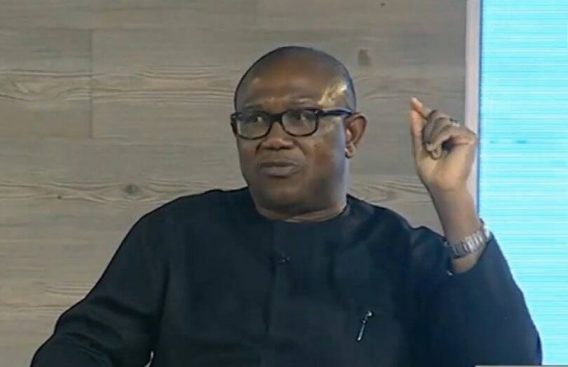
In a political environment where the presidency is often treated as the ultimate prize: an office to be captured, consolidated and, where possible, retained, the proposition that a president could deliberately limit himself to a single term sounds less like conventional politics and more like a provocation. Yet, that is precisely what former Anambra State Governor and the presidential candidate of the Nigeria Democratic Congress (NDC), Mr. Peter Obi, has put on the table.
Predictably, the proposition has generated skepticism. Can four years be enough to govern Nigeria? Can a president confront insecurity, corruption, unemployment, infrastructure deficits, educational decay, healthcare challenges and an increasingly complicated economy within a single term? The answer to these questions is obviously no, but that may be the wrong question by all permutations. But there is a “but”. I shall come back to this.
The more important question is: Can one term of four years be enough to restart the country, repair her institutional decay and place her on a trajectory that succeeding administrations would find difficult to reverse? Or, put differently, what if four years is not enough to solve Nigeria’s problems but is sufficient to change the conditions that make going back to the years of infamy practically impossible?
This is at the core of Obi’s one-term proposition: when leadership is measured by the tangibility of what is left behind at the end of an administration that makes it sacrilegious or treasonable for a new administration to go back to the old order.
History has a peculiar way of exposing the difference between occupying power and using power. Some leaders spend years protecting the office they hold; others use the limited time available to them to transform institutions, enthrone higher values and change the trajectory of the countries they lead away from the precipice to a more prosperous and egalitarian path.
Nelson Mandela epitomizes this type of leadership. When Mandela became South Africa’s first democratically elected president in 1994, he inherited a country emerging from the ruins of apartheid; a nation deeply divided along racial, political, and economic lines. His presidency became one of the most consequential transitions in modern political history. Yet Mandela did not remain in office indefinitely. After a single term, he voluntarily relinquished the presidency. His major achievement was that he restored peace and set the nation on a path of irreversible healing after years of a white supremacist regime.
Some may argue that South Africa was still deeply unequal when he left. Poverty had not disappeared, and the economic scars of apartheid remained. But Mandela had helped establish the foundations of a democratic order capable of outliving him. That distinction offers an important lens through which Nigeria should examine Peter Obi’s audacious one-term proposition.
At first glance, Obi’s proposition seems like a political harakiri in an environment where the campaign for a second term in office starts almost immediately as the rugs for the ceremonial swearing-in of the president (and other elected office holders) is being rolled away from the venue. It is rarely regarded as a four-year national assignment. Most often, it is treated as an eight-year project, an entitled sacrosanct that is acceptable to all. We hear such statements as “there is no vacancy in Aso Rock Villa”; “the President should be allowed to continue the good work he has started”, etc, even in the face of obvious non-performance by the incumbent.
Obi, however, appears to frame the presidency differently: as a finite national assignment rather than an indefinite political entitlement. And this is why his unprecedented one-term pledge is generating animated discourse in the polity.
The proposition deserves more than the predictable partisan dismissal that four years is too short, or that a politician promising not to seek a second term must really be desperate to occupy the office. The more serious issue is whether the quality of leadership can compensate, at least in part, for the brevity of tenure. Murtala Mohammed, a military head of state, ruled Nigeria for approximately six months (July 1975 to February 1976), yet his tenure is still a reference point in pragmatic leadership.
His short term was extraordinarily consequential by the remarkable achievements recorded. He created new states, from 12 to 19; he proposed and established a panel to relocate the federal capital from Lagos to Abuja; he carried out comprehensive civil service reforms; he committed to return Nigeria to civil rule in 1979, among others. These policies were so profound that the succeeding government of General Olusegun Obasanjo could not reverse them; he merely saw them to full actualization.
Some may argue that this was a military era with military command and not as complicated as a democracy. Yes, they are right, but only just another example. Then let’s look at a “democracy example” of Lateef Jakande, who was governor of Lagos State for 51 months (October 1, 1979- December 31, 1983) before the Second Republic was toppled by the military. Jakande’s administration was able to record monumental achievements in six major areas: education, housing, health, transportation, physical infrastructure and institution-building, within this short period. It is on record that Jakande increased primary and secondary schools’ enrolment by offering free education and constructing an additional 22,000 classrooms to accommodate more pupils.
He established the Lagos State University, Lagos State College of Education and the Nigerian Institute of Journalism. Jakande’s administration also cut down the housing deficit in Lagos by building several low-cost housing estates in different parts of the state. The administration built the General Hospitals in Gbagada and Ikorodu. His most audacious project, the Lagos Metroline, was truncated by the military administration. All these and more within a short period of four years and three months. Jakande was able to achieve all these because he was not corrupt and was focused on the people instead of amassing wealth for himself and his family. This is why Obi will make a great impact in four years because he will lead by example as Jakande did in Lagos. And his antecedents in public office as governor of Anambra State and chairman of government agencies speak volumes of the unique qualities of the man, Peter Obi.
The 21st-century Nigerian leader cannot afford to think only about the next election, the next political appointment or the next distribution of patronage. Such a leader must possess the courage to make difficult decisions, build strong institutions, invest in human capital and pursue policies whose benefits could fundamentally alter the nation’s future. This is where the criticism of Obi’s one-term proposition becomes particularly interesting.
Former Edo State Governor and former labour leader, Adams Oshiomhole, among others, have questioned the wisdom and feasibility of Obi’s proposal. But the critics also owe Nigerians an answer to a broader question: If longevity in office is a prerequisite for transformational leadership, what exactly did eight years of previous administrations accomplish that could not have been achieved within a more focused and disciplined one-tenure of four years?
The question is not whether four years or eight years is inherently superior. It is whether time in office, without political will, vision, institutional discipline and effective execution, automatically produces transformation.
Václav Havel provides another useful historical reference, although his tenure does not fit the one-term model in the strict sense. As president of Czechoslovakia and later the Czech Republic, Havel emerged at a historic turning point following the collapse of communism. His presidency was closely associated with the transition towards democratic governance, the restoration of civil liberties, the strengthening of the rule of law and the country’s reorientation towards a democratic Europe.
His significance lies in the broader lesson his leadership offers: presidents who inherit countries at historic turning points may be judged more appropriately by the direction in which they move the state than simply by the number of years they occupy office. Nigeria today finds itself at its own critical intersection. The country does not merely require another occupant of Aso Rock. It requires a leadership capable of confronting institutional weaknesses that have persisted across successive administrations.
Mandela did not leave office because South Africa’s problems had disappeared; they had not. He left because in his conception of leadership, service to the nation was not synonymous with permanent occupation of office. Mandela did not pretend that one term could erase every footprint of apartheid. Instead, his administration concentrated on creating political and institutional conditions from which a new South Africa could emerge.
The Government of National Unity implemented the Reconstruction and Development Programme, designed to address the enormous socio-economic consequences of apartheid. The government also established and strengthened democratic institutions during those formative years. The Constitutional Court, for instance, was formally opened in 1995.
Mandela’s 1994 State of the Nation address was similarly framed around constructing a people-centred society founded on political and human rights, dignity and freedom from want, hunger, deprivation, ignorance and fear. He understood something Nigeria’s political culture often forgets: a leader does not have to finish the journey to change the road. That is the Mandela lesson, and it is precisely the lesson that ought to inform the debate over Peter Obi’s one-term proposition.
A one-term presidency should not be interpreted as a promise that four years will solve every Nigerian problem. No serious government could eradicate every manifestation of poverty, insecurity, corruption, unemployment, infrastructural deficits and institutional weakness within four years. The proposition should instead be understood as a commitment to changing the architecture within which those problems are reproduced.
A President Peter Obi may not be able to eliminate corruption in four years. But he can build institutions in which corruption becomes harder to perpetrate, easier to detect and costlier to defend. He may not be able to transform the entire education system in four years, but he can establish sustainable funding mechanisms, restore standards, strengthen teacher development, modernise curricula and create policies that succeeding governments would find difficult to dismantle.
President Obi may not completely defeat insecurity, but he can reform the security architecture, improve intelligence coordination, strengthen accountability and establish a coherent national security doctrine. He may not transform Nigeria into an industrial superpower in one term. But he can create the fiscal, infrastructural, regulatory and investment environment in which industrialisation becomes increasingly difficult for succeeding administrations to abandon. That is the difference between governing for a term and governing for a legacy.
Eight years of corruption, fiscal indiscipline, ineptitude, nepotism and all other practices antithetical to the utilitarian values of democracy do not automatically produce stronger institutions, nor add value to the quality of life of the governed. Time is an opportunity; it is not an achievement.
Rather than asking whether four years is enough to “fix Nigeria”, Nigerians should envision what a competent administration could realistically accomplish in four years with a clear mandate, disciplined leadership and a focused commitment to institutional reforms.
The significance of Peter Obi’s one-term argument is therefore not necessarily about doing everything; it is about offering a different type of leadership- servant leadership- that will rebuild Nigeria’s faulty democratic foundation and align the country with global best practices in elected offices. A president that is accountable to the people and not a feudal lord.
A four-year presidency would not automatically become a success simply because the president promised not to seek re-election. The real test would be whether a President Obi could translate the promise into a measurable governing programme. What will be accomplished in the first 100 days? Which institutions will be reformed? Which expenditures will be eliminated? How will corruption be attacked? How will security be re-organised? What measurable targets will exist for education, healthcare, electricity, infrastructure and industrial productivity? And, perhaps most importantly: What will be legally and institutionally protected against reversal after 2031?
Nigerians should neither dismiss Obi’s proposal as naïve nor accept it as proof of competence. It should demand evidence: show them what will remain standing when the president walks away. Because perhaps that is the real meaning of leadership. Not how long a man can remain in power, but how much power he is willing to institutionalise beyond his tenure.
Mandela left office after one term, but the world did not conclude that he had failed because South Africa still has problems till today. Nigerians need not look for a president who promises to solve every problem in four or eight years. It should look for a president capable of changing the trajectory of the country and building institutions strong enough to continue the journey after he is gone. That is the real challenge embedded in Peter Obi’s one-term proposition.
And perhaps the question Nigeria should be asking is no longer: “Can four years be enough?”
It should be: “What kind of leader could make four years count?”
Kalu Okoronkwo is a communications strategist, a leadership and good governance advocate dedicated to impactful societal development, and can be reached via kalu.okoronkwo@gmail.com


