

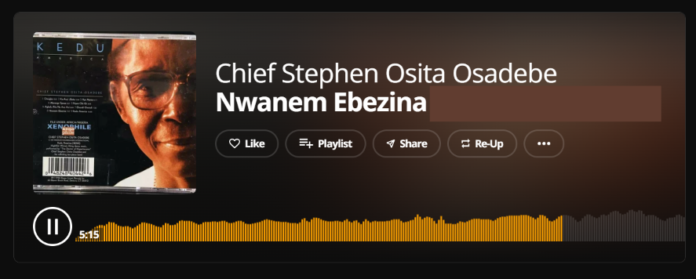
“Nwanne m Ebezina” is one of those songs, man.
 Those songs that don’t need an introduction. It just begins, puts you in the mood and takes you away without your permission. You could cry.
The conga drums, guitars, percussion, horns, trumpet and the entire band come together before Osadebe’s voice enters seamlessly, carrying that deep, measured authority that made him so recognisable.
Before we look at the lyrics, you should know the common story behind this legendary song.
According to the people who tell the history of the song, it was about one of Osadebe’s musicians. The band were preparing to travel abroad for a performance and had been lodged in a hotel near the airport while the arrangements were being completed. Osadebe instructed everyone not to leave because they could be called to depart at any moment.
Osadebe heard about his colleague’s regret and thought of the song as a way of consoling him while also reminding him of the consequence of the choice he had made.
And that brings me to the title: Nwanne m Ebezina.
In Igbo, ‘nwanne m’ means my sibling, my person or my brother, while ‘ebezina’ means do not cry, stop crying or cry no more. So the title itself is intimate. Osadebe is not speaking to a crowd. He is speaking to someone close to him.
My brother, don’t cry anymore. That is the emotional doorway into the song.
This is where Osadebe’s songwriting becomes more interesting than simply retelling the incident. He does not spend the entire song condemning the man. He consoles him while acknowledging that the mistake has already happened. The opportunity has been lost, and there is no point pretending otherwise.
The music therefore carries two emotions at once: regret and reassurance.
https://x.com/arinzechukwum_/
The lyrics are built around the things Osadebe was so good at using: direct Igbo speech, repetition, proverbial imagery and everyday wisdom. He did not need complicated language to make a point. He could take an ordinary human experience and turn it into something philosophical.
One of the most striking images associated with the song is the line about the guinea fowl: “Ogazi amaka mma, mana ejighi ya ago mmuo.” it means, even though a guineafowl is beautiful, it doesn’t make it right to appease the gods.
The idea is simple: something (the guinea fowl in this case) may be so beautiful, but its beauty does not make it suitable for every purpose (especially appeasing the gods). In traditional Igbo spirituality (Odinani), the people use regular domestic fowls (such as cocks or hens– ọkụkọ), goats (ewu), aturu (sheep), rams (ebule), and cows (ehi) to appease the gods and ancestors, not Ogazi (guinea fowl)
Felix Okechukwu Nnamani on Facebook said that “Guinea fowl is very beautiful, with white spots all over its body. It can also be eaten and tastes delicious. But despite its beauty and sweetness, our ancestors still chose ordinary fowl for certain traditional practices like “Igoo Mmuo.””

“Life is about making the right choices at the right time. When it comes to [important life choices like] marriage.. do not let [fleeting pleasure] beauty or attraction rush you into making the wrong choice. Sometimes, what looks beautiful is not what is meant for you. Leave what belongs to the street on the street, despite the beauty. Choose wisely, and understand your timing.”
That proverb moves the song beyond the individual incident. The musician saw something attractive in the moment and pursued it. But what looked desirable at that moment was not what mattered most. That is the larger lesson in the song.
Life constantly puts distractions in front of us. The danger is not simply in enjoying something attractive; it is in allowing a temporary desire to make you abandon something more valuable. In the story behind Nwanne m Ebezina, it is simple: he left the hotel, pursued what he wanted, and missed the journey.
That is why the song can still speak to people who have never heard the story behind it. You do not have to be a musician or miss an international tour to understand regret. Everybody understands the feeling of looking back and wishing a decision had been different.
Osadebe understood something equally important: regret can consume a person if they never learn to move beyond it. Hence the consolation: Nwanne m Ebezina. It’s okay. Don’t cry anymore.
The brilliance is that the song does not pretend the mistake did not matter. It did. Osadebe reminds the person of the gravity of the mistake while recognising that crying cannot change what has already happened.
So poetic in nature, that is classic Osadebe. The lesson is there, but he does not have to shout it at you. He lets the proverb do the work. And then there is the music;
“Nwanne m Ebezina” is more than a lyric worth analysing. It is a beautifully constructed piece of Igbo highlife.
The version most widely available today comes from ‘Kedu America’, Osadebe’s 1996 album released through Xenophile/Green Linnet. The album was recorded in December 1994 at Studio Unicorn in Redding, Connecticut, during Osadebe’s American tour. The entire album was recorded in one day. It runs for 69 minutes and 18 seconds, with “Nwanne m Ebezina” appearing as the eighth track at 7 minutes and 30 seconds.
The album was produced by Andrew Frankel and Nnamdi Moweta, with Frankel also credited as producer in Billboard’s contemporary review.
The band was not small. Osadebe was backed by a ten-piece ensemble built around the sound that had made his music so distinctive: guitars, bass, drums, Igbo congas, horns, claves and backing vocals.
Osadebe handled the lead vocals and arrangements. John Odagwe played bass guitar, Ezikel Uti lead guitar, Fidelis Mazua rhythm guitar, Dede Uzoma drums and Chukwodozi Obi Igbo congas. Christian Ibekwe played trumpet, Stephen Udechukwu trombone and backing vocals, Joseph Ugokwe tenor saxophone and backing vocals, Willie “Pepper” Chijoke claves and backing vocals, while Obi Osadebe contributed backing vocals.
And you can hear why that combination worked; the guitars provide the foundation. The bass gives the groove its body, the congas and percussion keep everything moving, the horns add colour and punctuation, while the backing vocals give the arrangement another layer around Osadebe’s lead.
Most importantly, the arrangement gives the musicians room to show themselves to the audience. It is not just about Osadebe, but the entire crew, each and every one of them. It shows how significant every single instrument and instrumentalist is
The guitars can breathe, the percussion can settle into the rhythm, the horns can answer the vocal, the congas can step forward. Every musician contributes to the atmosphere instead of simply filling space behind the singer. That is part of the beauty of Igbo highlife music. And It does not have to rush. It comes to you gently and peacefully.
Contemporary critics noticed the quality of the ensemble. AllMusic praised Osadebe’s ten-piece orchestra, guitar-driven dance music, horn work and smooth lead vocals. Billboard described the album as sophisticated songcraft, specifically highlighting Ezekiel Uti’s lead guitar, Fidelis Mazua’s rhythm guitar, the highlife horns and the band’s driving, hypnotic grooves.
Robert Christgau also praised Kedu America, describing it as a “delight” and noting the band’s tightness, percussion, guitar work and extended grooves.
The album itself is almost a small portrait of Osadebe’s massive musical world.
It opens with “Onuigbo,” followed by “Ka-Anyi Jikota,” “Aye Mama,” “Merenge Sposa,” “Nyem Obi Gi,” “Agbalu Aka Na Azo Ani,” “Osondi Owendi,” “Nwanne m Ebezina,” and finally the sixteen-minute “Kedu America.”
And there is an important detail here. Nwanne m Ebezina was not Osadebe discovering his sound in 1996. By the time Kedu America was recorded, he had already spent decades building his musical record.
His catalogue stretched across the 1960s, 1970s, 1980s, 1990s and into the 2000s, with records including Highlife Parade, Osadebe ’75, Osadebe in London, Osadebe ’76, Agbalu Aka Na-Azo Ani, Makojo, Nwanneka Special, Nigeria Go Better, Eji Ike eme Uwa, Osondi Owendi and Kedu America, among many others.
That catalogue matters because it explains why the song sounds so assured. Osadebe had already built the niche. He knew how to make guitars carry a story, when to let the horns answer, how to stretch a groove without making it feel empty, and he knew how to turn everyday Igbo expressions and proverbs into songs that could go beyond their original setting.

If “Osondi Owendi” was one of the records that established Osadebe as one of the defining figures of Nigerian highlife, “Nwanne m Ebezina” shows another side of his music making, his ability to take a small human story and turn it into something people can carry with them.
The contrast between the two songs is interesting though. Osoo ndi Owee ndi simply means that one person’s enjoyment can become another person’s suffering. It became one of Osadebe’s signature works and one of the major commercial successes of his career. Historical accounts of his career record major gold and platinum recognition during this period
Nwanne m Ebezina is more intimate. It is not a political statement, neither is it a national or tribal anthem. It is a conversation between people: a man made a mistake, and another man tells him not to dwell on it, turning it into seven and a half minutes of music.
The song was released in 1996, Osadebe died in 2007, but it never disappeared for a moment. It has continued to circulate across generations till today, and it will continue to be appreciated because it was made to stand the test of time.
Up till today, both old, middle aged and young ones are vibing to it. Even post 2000 musicians are sampling the sound, and using the music to make their own, it is played both locally and internationally. There is real musicianship in ‘Nwanne m ebezina’ by Chief Stephen Osita Osadebe.
It is evergreen. It always finds its way back to people, which is why it deserves to be discussed among the greatest songs to come out of not just Nigeria, but Africa.
It is more than a song. It is an advice: nwanne m ebezina – don’t cry anymore, my brother. Pick yourself up, learn from your mistakes, and do better!
That is the message.
Chukwukamso A Okoye


