

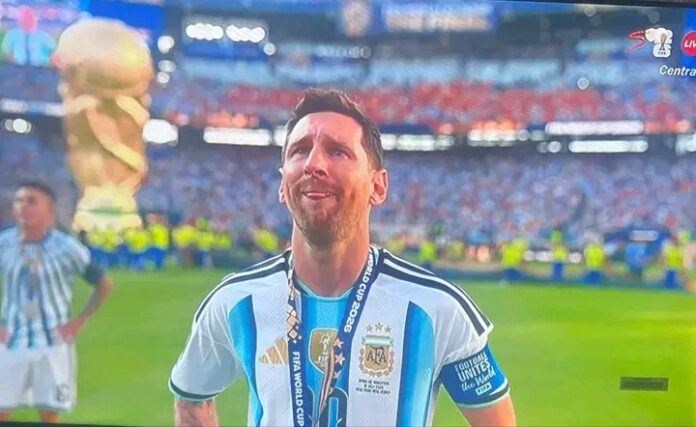
History does not remember most of us.
It remembers the builders of empires, the authors of revolutions, and, every once in a while, a small number of individuals who become so extraordinary that entire generations begin to mistake them for permanent features of the landscape.
Lionel Messi was one of those people.
For twenty years, he existed less as a footballer than as a suspension of ordinary rules. Seasons changed. Governments rose and fell. Children became adults. Entire careers began and ended. Yet somehow, impossibly, there he remained: gliding across grass with the same improbable economy of movement, rearranging reality with the casual indifference of a man moving furniture in his own house.
It is difficult to explain to those who come after what it felt like to live through an age of giants.
One day, historians will reduce it to statistics. They will count goals and trophies with the detached precision of accountants. They will construct timelines and compile lists. But numbers are poor custodians of wonder. They cannot adequately capture what it meant to watch millions of people interrupt their lives because a small man from Rosario had touched a football.
And perhaps that is because we were never really watching football.
We were watching humanity conduct one of its oldest experiments.
What happens when a man becomes so exceptional that people begin to confuse him with an idea?
For centuries, we have repeated the same mistake with remarkable consistency. We elevate individuals beyond their humanity and then express surprise when humanity eventually finds them again. The names change, but the ritual remains. Kings. Prophets. Generals. Presidents. Artists. Athletes.
Every age creates its own gods.
And every age eventually watches them weep.
There is a reason the shortest verse in Scripture has survived for two thousand years. “Jesus wept” endures because it collapses the distance between the divine and the human in just two words. It reminds us that no matter how high we place our heroes, gravity remains undefeated.
That is why Messi’s tears unsettled the world.
They were not the tears of defeat. Defeat is common. Sport manufactures it every weekend. They were the tears of recognition. For one brief moment, the illusion dissolved, and we found ourselves staring at something we had spent two decades trying not to see.
Time had arrived.
Not dramatically. Not cruelly. Simply and inevitably, as it always does.
The same force that outlived Alexander, silenced Beethoven, humbled Muhammad Ali, and closed the eyes of Maradona had finally come, quietly and without spectacle, for Lionel Messi.
And in doing so, it posed a question that extends far beyond football.
What remains when the genius leaves?
It is a question every civilization must eventually answer.
What remained after Rome lost Caesar? What remained after America lost Lincoln? What remained after Brazil lost Pelé? What remains after Messi?
History, it turns out, has always been less interested in the hero than in the architecture surrounding him.
Because heroes are temporary.
Systems endure.
The tragedy of humanity is not that our saviors leave us. It is that we continue to build our worlds as though they never will. We construct football teams around a single player, nations around a single leader, and movements around a single voice. Then we stand bewildered before the inevitable, asking how something so extraordinary could possibly come to an end.
But endings are the only promise history has ever kept.
Perhaps that is why Messi’s tears felt strangely intimate. They reminded us that our heroes are not merely mirrors of our aspirations; they are previews of our own condition.
One day, all of us will play our final match.
One day, someone else will occupy the spaces we once considered ours.
One day, the world will continue with the same unsettling indifference with which it has always continued.
The stadium lights will dim. The crowd will go home. The conversations will move elsewhere.
And the work will remain.
That is the great lesson hidden inside every farewell. The measure of greatness was never whether the hero could stay forever. It was whether what they touched could survive their departure.
Messi’s greatest legacy may not be the goals he scored or the trophies he lifted. It may be this final, uncomfortable gift: forcing an entire generation to confront the fact that even the most beautiful things are only passing through.
We do not mourn our heroes because they fail us.
We mourn them because they remind us that one day, time will do the same thing to us.
And when that day comes, the only question history will ask is the same one it has always asked:
What remains when the genius leaves?
Stephanie Shaakaa
08034861434


