

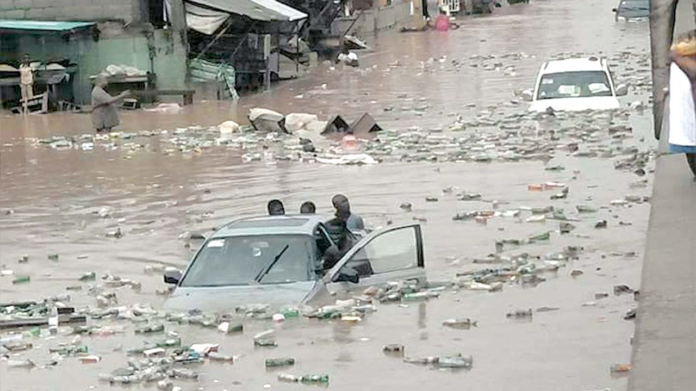
As the peak of the rainy season approaches, many Lagos residents are hoping that billions of naira earmarked for flood control and ecological interventions will finally translate into safer communities and better drainage infrastructure.
Residents recounted how repeated flooding has disrupted their daily lives, damaged access roads and heightened fears each time heavy rainfall occurs.
A resident of Ogba, Ms Sandra, said recent flooding along Ijaye Road caused her to miss a scheduled flight after her ride-hailing driver refused to drive through the floodwaters.
According to her, the driver feared the vehicle could be damaged by the rising water despite her appeals.
“The Uber driver refused to enter the flood along Ijaye Road because he didn’t want to damage his car despite my pleas. Boarding closed at 10:42 a.m., but I arrived at the airport at 10:48 a.m. I had to wait until 6 p.m. for the next flight,” she said.
Another resident, Mr Godwin, who lives along Airport Road, said he had to pay someone to carry him out of his flooded compound so he could get to work after heavy rainfall cut off access to his home.
“Before I could get to work, I had to pay somebody to carry me on their back. I kept praying we would not fall into the dirty floodwater,” he said.
Mrs Amara Joseph, a resident of Mafoluku, said many residents now live in constant fear whenever dark clouds gather.
“Each time it rains heavily, we fear our homes and roads will be flooded. We hope the drainage projects will make a difference this year,” she said.
Official records from the Office of the Accountant-General of the Federation show that Lagos State received about ₦1.49 billion in Ecological Fund allocations between January and May 2026.
The allocations included ₦251.46 million in January, ₦230.60 million in February, ₦296.06 million in March, ₦371.22 million in April and ₦344.09 million in May.
The Ecological Fund is intended to finance projects that address environmental challenges such as flooding, erosion, coastal degradation and other ecological disasters.
In addition, the Lagos State Government earmarked about ₦90.78 billion in its 2026 budget for drainage construction, dredging, erosion control and rehabilitation projects.
However, the state’s first-quarter 2026 Budget Performance Report revealed that several key drainage and flood-control projects had yet to record any expenditure during the review period.
Commenting on the situation, environmental advocate and President of the Statewide Waste and Environmental Education Foundation, Ambassador Philips Obusesi, called for greater transparency in the management of Ecological Fund allocations.
He said the lack of publicly available information makes it difficult for residents to determine whether the funds are being deployed for their intended environmental purposes.
“To the extent that I have seen, I think the fund is not being put to maximum use,” Obusesi said.
He urged citizens to demand greater accountability from public institutions through legal mechanisms such as the Freedom of Information Act.
Obusesi also called on government agencies to clearly indicate whether projects such as drainage desilting and other flood mitigation interventions are financed through the Ecological Fund.
“There is no other way for citizens to know whether funds are being used if they are not asking questions,” he added.
Meanwhile, the Lagos State Government said it has intensified efforts to reduce flooding through the dredging of primary drainage channels, continuous desilting of secondary drains, stricter enforcement against indiscriminate waste disposal and sustained public awareness campaigns.
The National Emergency Management Agency (NEMA) also said it is using the 2026 Seasonal Climate Prediction to strengthen flood preparedness across the country.
Similarly, the Nigerian Meteorological Agency (NiMet) said the seasonal forecast is expected to support disaster preparedness, water resources management and climate-resilient planning.
The Nigeria Hydrological Services Agency (NIHSA) has listed Lagos among the states at high risk of flooding during the 2026 rainy season.
As rainfall intensifies, many residents say they will measure the success of government interventions not by the size of budget allocations, but by whether their homes, roads and livelihoods are effectively protected from flooding.
source: NAN


