

The economic and political significance of Nigeria, as the most populous country in Africa with about 224 million people (according to the worldometer elaboration of the latest United Nations data), can neither be overlooked nor overemphasized. Apart from her contributions to peacekeeping missions in many African countries, generally, Nigeria has played a significant role in developing Africa in terms of her involvement in many regional and continental organizations, such as the African Union, the Economic Community of West Africa States (ECOWAS), and the United Nations. Interestingly, the significance of Nigeria in the African continent was slightly captured in the observation of the former president of the United States of America, Mr Barack Obama who once publicly remarked; “Given Nigeria’s size and influence, it’s natural that we want to partner with Nigeria. Nigeria is critical to the rest of the continent. If Nigeria does not get it right, Africa will not make progress…” This statement by the President of the US is clearly indicative of the relevance and importance of Nigeria to the development and progress of Africa. However, it is as though the burden of problems confronting the beleaguered giant of Africa is as enormous as her contributions and significance in the continent.
Nigeria is currently bedevilled with insecurity. This is a key issue among many confronting the poor country. Factors such as poverty, unemployment, inequality, corruption and poor governance play a major role in the current heightened level of insecurity in Nigeria. And particularly, the current spate of kidnapping across regions in Nigeria seems unending as the situation deteriorates by the day. No region is spared; the entire Nigerian social space has suddenly become very unsafe, and this is obviously taking a serious toll on economic activities in the country. What is also quite apparent is the fact that the government is overwhelmed by the security situation in the country, hence may be failing in its primary assignment, which is ensuring security of life and property. In other words, the right to life and property in Nigeria is gradually becoming a failed reality. And a seeming non-action by the government causes more angst among the citizens, particularly many of those who have been victims in the hands of the gruesome kidnappers whose actions and activities have become more frequent these days. So, the question remains, can there really be an end to the spate and proliferation of kidnapping in Nigeria?
Today, kidnapping in Nigeria is not only a growing trend associated with militancy and/or banditry, but now becoming a lucrative enterprise amongst desperate (frustrated) idle youths in the society. And of course, this is impacting negatively on almost every segment of the society, including individuals, families, and businesses! Also, the perpetrators of this crime are becoming more emboldened and gruesome. They now post videos of their atrocious cruelties on social media, even as they demand ransom payment from their victims’ families and friends. The ransom is usually demanded in millions of naira, and sometimes, they demand that the ransom be paid in foreign currencies. Victims are from every stratum of the society; children, women, school children, men, University students, lecturers, traditional rulers, government officials, farmers, medical practitioners etc., even military officers as well as police officers are not spared.
Furthermore, sometimes the kidnapped victims are unlucky as they get killed despite meeting the kidnappers’ demands! There have also been situations when kidnapped victims get killed while their loved ones run around to raise money for their release. A good example of this is the recent case of the 10 victims (families) who were kidnapped from their homes inside an estate in Abuja. The case got public enraged on social media, especially when the news broke out that 3 of the abducted victims (one of whom was a 13-year-old girl) had been killed, even as the assailants raised the bar of their demand from the initial 60m Naira per victim to 100m Naira. The fact that this is happening in the Nigerian society, especially in this age and time, is enough damage to the reputation and international image of the country, even as a country grappling with harsh economic realities. Moreover, it will be hard to get the attention and confidence of investors in this regard.
It is bad enough that the government has failed (or is failing) in its core responsibility to restore normalcy to the Nigerian social space, but what is worse, ridiculous and unwise is when the citizens join in breeding an atmosphere for crime to thrive through crowdfunding for the purpose of paying ransoms to criminal elements in the society! By so doing, the current deplorable state of the country will only deteriorate:
Recently, the former minister of Communication and digital economy, Mr Isa Ali Pantami took to social media to announce that he mobilised his friend whom he claimed donated N50m for the purpose of paying ransom to kidnappers who had abducted certain victims. Mr Pantami served as a Minister in the immediate past administration and promoted the idea of National Identification Number (NIM) to SIM Data policy, which he publicly declared would be used to track bandits and terrorists. Therefore, one would have expected that the former Minister would make good use of this technology to track the kidnappers rather than join the vulnerable citizens to raise money for the purpose of paying ransom to the criminal elements wreaking havoc in the Nigerian society. So, the question remains, why should taxpayers’ money be wasted on a policy that would be ineffective in addressing the main purpose for which it was initiated?
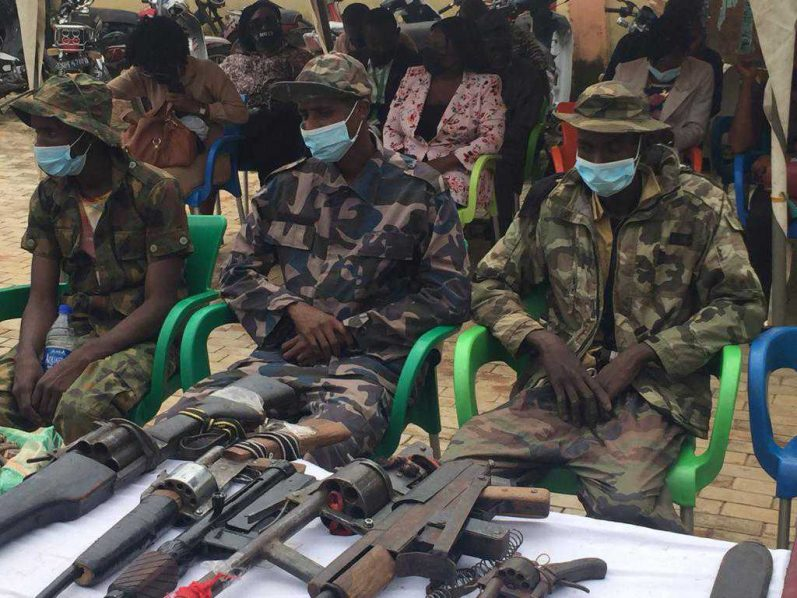
The significant danger inherent in paying ransoms to kidnappers does not only lie in encouraging vulnerable (frustrated) youths in the society to consider this criminal enterprise, but it will also, in a way, empower these criminals through illegal procurement of more arms and ammunition. As a matter of fact, the statistics on small and light weapons aberration in Nigeria are staggering! A Small Arms survey by a Swiss-based non-profit, in 2020 revealed that Nigeria had an estimated 6.2 million arms in the hands of civilian non-state actors and criminals, excluding those of the military and law enforcement agencies. Additionally, another research survey showed that over 21 million arms and ammunition were shipped into Nigeria illegally between 2010 and 2017 alone. Now that the criminal elements in society are paid millions in ransom, it is logical to assume or estimate that illegal arms in circulation must have drastically increased in their numbers! Hence, the state of insecurity in Nigeria has been further exacerbated by, indirectly, empowering criminals through payment of ransom.
Moreover, it is not enough for the current FCT Minister, Mr Nyesom Wike, to threaten to pull down all illegal structures in the Federal Capital Territory, Abuja, there is an urgent need for him to also address the spate of kidnapping in the city of power. It is not only embarrassing and ridiculous to see a city that hosts the number one man of the country being ravaged by armed criminals who now break into ‘secured’ estates to kidnap innocent citizens, but also quite indicative of the current state of the entire country. And just as earlier mentioned, Nigeria cannot maintain her position of significance in Africa if insecurity persists or continues to be poorly managed. Therefore, it is high time the current administration stepped up its game and wilfully confronted the current heightened level of insecurity ravaging the country! This should be top priority if Nigeria must recover from the current economic regression.
Notwithstanding the apparent ‘overwhelmingness’ of the government, members of the public must be enlightened about the dangers inherent in the payment of ransom to criminals in the society! It is a natural inclination for humans to become desperate in the face of unbearable hardship, and such is the experience of a common man living in Nigeria today. But what the society would not want is to birth more monsters while trying to rescue abducted friends and/or family members. Therefore, paying ransom, or worse still, crowdfunding ransom is tantamount to crowdfunding criminality in the society. This will only worsen the already bad situation; and as such, the public must immediately desist from the queer idea of crowdfunding criminality!
The Nigeria Police Force and the military should renew their (intelligence) efforts and step in to rescue the current ugly situation that is already putting Nigeria in a bad light internationally.
Again, every life is precious. Every life is sacred, and no human being deserves to be slaughtered like chickens! Hence, security of life and property, for all Nigerian citizens, is a right and not a privilege. Therefore, the government of the day cannot continue to look on while vulnerable citizens languish in the various dens of kidnappers across the country. Moreover, the rest of Africa is waiting for the feeble ‘giant’ to get up from her fallen state, regain her lost glory; …that the rest of Africa may not fail.
’Tunde Adeparusi, a UK-based independent researcher in criminology, wrote in
via tunde.adeparusi@gmail.com


