

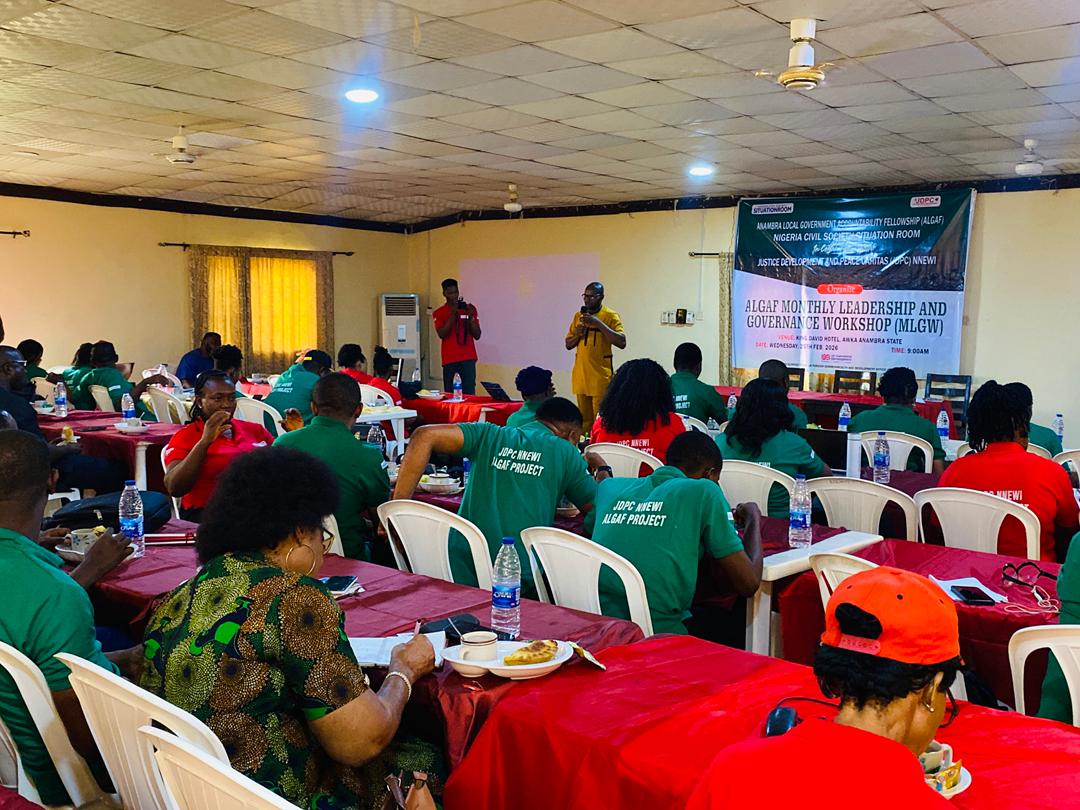
As part of its efforts at strengthening accountability in the Anambra State Local Government System, the Justice Development and Peace Caritas, JDPC, Nnewi zone on Wednesday, trained its fellows under the Anambra Local Government Accountability Fellowship, ALGAF, on structured projects monitoring across the various LGAs in the state.
The ALGAF is an 8-month programme which JDPC is implementing, supported by the Nigeria Civil Society Situation Room, NCSSR, funded by the UK, targeted for the grassroots
Under the initiative, 15 persons were selected as fellows from each senatorial zone, cutting across persons with disabilities, the aged, children’s parliament, and the students.
They have undergone training across various subject areas, including budget processes, communication skills, the local government system, and engagement.
Speaking during the ALGAF Monthly leadership and governance workshop, MLGW, held on Wednesday, the Director of the JDPC Nnewi zone, Reverend Father Benedict Okolo, explained that, with the training given to the fellows, they desire to see accountability in the local government system.
According to him, “if we can get half of the local governments to begin to work as we planned, then we must have achieved something, and from there, we will begin to build. We would have also created a consciousness in the leaders that the citizens’ eyes are on them.”
Okolo revealed that the JDPC has finalized plans to hold a public dialogue on local government administration in the state, with all the facts from the field and the fellows, to present them to the government and see how they can engender reforms that will make governance at the grassroots more impactful.
“During this dialogue, the citizens, the fellows, and the government will come to an interface, and most of the findings of these engagements with the local government leaders will be laid bare,” he said.
A facilitator during the programme, Mr. Onyekachi Ololo, observed that the objective of the project is to entrench a system where the local government in Anambra is inclusive and functional.
According to him, it is the belief of the JDPC that when the fellows have been equipped, they will be able to engage, as leaders of various groups, and also pass the information to members of their various groups, to be able to demand accountability and responsive governance from their leaders.
He also said the project holds great prospects for the forthcoming Anambra Local Government elections, as the knowledge gained will equip the fellows to do their jobs without fear of favoritism.
“It is our hope that the upcoming local government elections will see the people begin to ask the right questions on leadership.
“The sessions we have with the fellows have equipped them with the right information to know what they want in their leaders. As the campaigns continue, they will be able to understand what the candidates are promising and how we can hold them to account.
“When we started, they (the fellows) had no idea as to how to engage the system. But when we trained them on the right information, they became champions of the engagement. They are able to discuss with their community members to get feedback on one part, and the government at the local level on the other hand,” Ololo posited.
A resource person, Hon Isika Christian, who spoke on the local government project and citizens’ monitoring role for development, harped on the need for a structured, lawful, and informed citizens’ monitoring process, adding that to achieve results, objectivity and professionalism must be adhered to.
“Engaging government officials appropriately will yield the expected outcomes. When you engage in an inappropriate manner, the desired results will not be realized.
“The local government is the closest tier of government to the people, and getting things done with the people at this level is often problematic, due to their level of thinking. There as fellows, you must learn to engage right.
“It is the right of the citizens to know how local government funds are being utilized, and as a fellow of ALGAF, it is your duty to monitor to ensure that these projects executed with the people’s funds meet the needs of the people,” he said.
Another resource person, Nuela Umeh, urged the fellows to seek out the right information to hold their representatives accountable, warning them to avoid working with fake or sensational news and to always verify reports before acting on them.
In their separate remarks, Rev Emmanuel Okoroafor, representing the Christian Association of Nigeria (CAN), and Hajiya Kadidjat Olahan, representing the Muslim community, assured that the religious leaders will continue to use their platforms to support efforts to ensure accountability in governance and commended the JDPC.


