

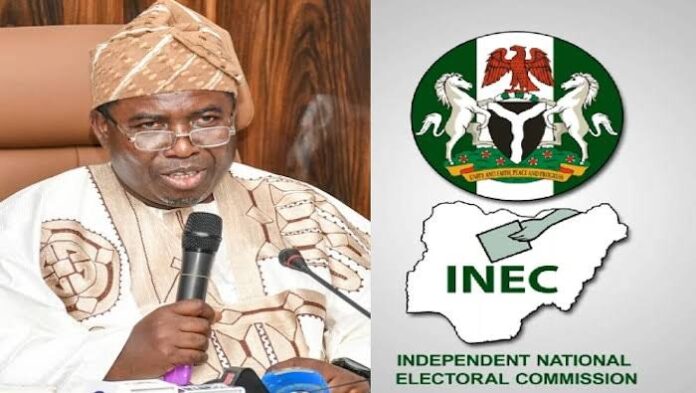
The Independent National Electoral Commission (INEC) says it has yet to receive budgetary allocations for the conduct of the 2027 general elections, although preparations for the polls are already underway.
INEC National Commissioner for Voter Education and Publicity, Mohammed Haruna, disclosed this on Thursday in Abuja during a cross-sectoral interactive session organised by the Peering Advocacy and Advancement Centre in Africa (PAACA) in partnership with Legis360.
The fireside chat, which brought together representatives of political parties, civil society organisations (CSOs) and INEC officials, reviewed the recently concluded Ekiti governorship election and assessed the commission’s readiness for the 2027 general elections.
Haruna said the commission remained within the timeline stipulated by the Electoral Act, 2026, which mandates that funds for a general election be released no later than six months before the polls.
INEC had proposed N873.78 billion for the 2027 elections, covering election operations, technology deployment and capital expenditure.
Despite the delay in funding, Haruna said the commission had already commenced critical preparations, including plans to procure replacement election equipment.
“Our Director of ICT just returned from China regarding procurement because not all the BVAS devices used during the last general elections were recovered. Orders need to be placed, and these things take time,” he said.
According to him, INEC is also planning mock presidential election exercises to test its technology and prevent a recurrence of the glitches that affected the INEC Result Viewing (IReV) portal during the 2023 presidential election.
Addressing concerns over the cost of elections, Haruna argued that Nigeria’s election expenses compared favourably with those of many other countries when measured on a per-voter basis.
“This N800 billion-plus sounds humongous, but when you calculate the average cost per voter, it is about six dollars, which is reasonable for a country such as Nigeria.
“People forget that virtually everything we use is imported. The BVAS devices and many other election materials are imported, while exchange rate fluctuations also affect these costs,” he said.
Haruna identified conflicting court orders as one of the major operational challenges confronting the commission, revealing that injunctions issued just 24 to 48 hours before the Ekiti governorship election disrupted preparations.
He explained that INEC had to hurriedly reconfigure its software and update ballot materials after courts ordered the inclusion of parties such as the Nigeria Democratic Congress (NDC) and the African Democratic Congress (ADC).
“When a court gives a last-minute injunction to include parties like the NDC and ADC, we are forced to reconfigure the software and update physical materials instantly.
“This leaves very little room to test the systems extensively, though we still manage to achieve substantial compliance with the rules,” he said.
Haruna added that INEC was engaging judicial authorities to minimise such disruptions before future elections.
On a recent viral report alleging a data breach, the national commissioner assured Nigerians that the commission maintained strict data protection protocols.
He disclosed that an electoral officer found to have deliberately leaked sensitive information as part of a personal vendetta had been suspended.
According to him, the incident has been reported to the Nigeria Data Protection Commission (NDPC), while the Police and the Department of State Services (DSS) continue criminal investigations.
Reviewing the Ekiti governorship election, Haruna described INEC’s logistics and technology deployment as largely successful, revealing that the BVAS achieved a 98 per cent voter accreditation success rate.
He acknowledged minor technical issues involving the biometric capture of some elderly voters but said the commission’s technical teams resolved them promptly.
Haruna, however, expressed concern over the persistence of vote buying, saying electoral officials observed voters openly waiting to receive financial inducements before casting their ballots.
Speaking with journalists after the event, PAACA Executive Director, Ezenwa Nwagwu, urged the Federal Government and political stakeholders to release election funds early to enable adequate planning.
He warned that delayed funding encourages a dangerous “fire brigade” approach that could undermine transparency.
“Whenever you create an emergency situation, corruption is very close behind.
“When things are not done when they should be done, people resort to bypassing rules. That is a situation politicians like to exploit to diminish the credibility of the process,” he said.
Nwagwu stressed that early funding was crucial because INEC faced lengthy international procurement timelines, particularly for replacing critical equipment such as BVAS devices damaged during previous election cycles.
He also urged civil society groups and Nigerians to hold political actors accountable for creating administrative bottlenecks instead of blaming INEC alone whenever logistical challenges arise.
“Everybody should be interested in creating an enabling environment for INEC to discharge its responsibility effectively.
“Once you short-circuit that ability by arm-twisting them in terms of resources, we hold INEC to the fire whenever there is a shortfall, but we don’t go near the politicians who stage-managed the challenges,” he said.
On conflicting court judgments, Nwagwu argued that the problem required collective action, urging citizens to avoid filing unnecessary lawsuits over matters that could be resolved administratively.
“We can emulate the American system that resolves certain things administratively without going to court. But here, everything goes to court, even up to the Supreme Court,” he said.
He noted that the interactive session was organised to review the Ekiti governorship election, identify lessons learned and strengthen preparations for the 2027 general elections.
Other stakeholders at the meeting also called on INEC to institutionalise continuous training programmes for ad hoc election officials, particularly members of the National Youth Service Corps (NYSC).
Source: NAN


