

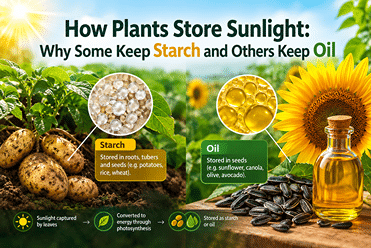
Before a brightly colorful flower could offer nectar to a bird or a fruit could attract a mammal, plants faced a more basic problem involving what to do with the energy they captured from sunlight. This was long before humans began cultivating plants for their seeds, roots, fruits and oils. Capturing that energy was only the beginning, because a living plant also had to use some of it immediately, keep some through the coming night and move some from one part of the plant to another. Some also had to be preserved through a season or, in many cases, left behind in a seed to support a new plant that had not yet begun life on its own.
Photosynthesis makes this remarkable arrangement possible by allowing plants to use sunlight to bring carbon from the atmosphere into the chemistry of life. We often shorten this enormous process by saying that plants use sunlight to make glucose, but that can leave the impression that glucose is the final product of photosynthesis. What actually follows is the distribution of captured material and energy, as plants use what photosynthesis provides to make sugars, starch, oils, proteins, cell walls and much of the material required to build and maintain the whole plant.
Therefore, what a plant produces today may be needed at another place or another time. A mature leaf exposed to sunlight often produces more than it requires locally, while roots, growing shoots, flowers, fruits and developing seeds may depend on resources arriving from photosynthetic leaves elsewhere in the plant. Plants therefore move sugar from places where production is occurring to places where it is being used, transformed or stored, with sucrose serving as an important form of long-distance transport through the specialized tissue called phloem in many plants.
Sugar is therefore not something plants produce for animals to find later. Its ability to move within the plant makes it part of the plant’s own efficient distribution system for what photosynthesis has made available, but transport and storage present different problems. A form that works well while material is traveling through a watery living organism does not necessarily provide the best arrangement when large quantities must remain in one location for hours, months or an entire season. Long-term storage of large amounts of dissolved material presents its own peculiar problems of space and water balance.
This is where starch becomes particularly useful, because plants can join sugar units together and pack them into much larger structures rather than leaving enormous quantities of individual sugar molecules dissolved inside their cells. By turning sugar into starch, the plant can therefore keep large amounts of carbohydrate in a compact form without having to keep all of that sugar dissolved in water.
The usefulness of this handling is obvious inside a leaf. While sunlight is available, photosynthesis may provide more than the leaf immediately needs or sends elsewhere, and some of that daytime production can be placed temporarily into what botanists call transitory starch, providing a buffer between the energy available during daylight and the plant’s continuing needs through the night.
This means that some plant storage operates over surprisingly short periods. The starch made in a leaf during the afternoon may begin serving the plant only a few hours later, and plants can regulate this overnight use closely enough that the reserve is often drawn down across the expected period of darkness rather than exhausted soon after sunset. What looks to us like a leaf sitting on a plant is therefore part of a daily rhythm in which incoming energy, immediate needs, transport and temporary storage are being continuously balanced.
A potato uses the same storage strategy over a much longer period. Instead of accumulating starch mainly to bridge the coming night, the plant can place large quantities underground in a tuber, where those reserves may remain until conditions favor renewed growth. When the potato begins to sprout, material accumulated earlier becomes available to support the emerging shoots before the new leaves are capable of capturing enough sunlight to support themselves fully.
Grains extend the same energy-handling strategy into the next generation, because much of the starch contained in a grain of rice, wheat or corn was placed there by the parent plant before the seed became independent. That reserve can remain until water, temperature and other conditions permit germination, after which the developing seedling begins drawing upon provisions accumulated before its own leaves can provide enough through photosynthesis. A leaf may therefore store starch for tonight, a tuber may store it for another season, while a seed may store it for a plant that has not yet begun independent life.
Plants, however, do not always rely primarily on starch when preparing for the future, because many seeds contain large stores of oil. Sunflower, sesame, rapeseed, peanuts and numerous other plants direct some of what photosynthesis has provided through additional chemical steps that allow energy to be packed into fats. These reserves differ physically from starch and offer particular advantages when a large amount must be kept within a relatively small seed. One important advantage is simply how much energy can be packed into the available space.
Fat can hold considerably more usable energy per unit of weight than carbohydrate and can be stored with very little accompanying water. This allows an oil-rich seed to carry a substantial reserve without becoming correspondingly large or heavy. For a structure whose job includes surviving a period of waiting and then supporting early growth before the young plant can fully support itself, that compactness can be extremely useful.
This does not make oil a universally better storage material than starch, because plants are solving several problems at once rather than competing to find a single molecule capable of doing everything. Making oil requires additional processing, while starch provides an efficient way to keep large quantities of carbohydrate available for later use. Different plants, tissues and stages of development have therefore arrived at different mixtures, reflecting how long reserves may need to remain, how compactly they need to be stored and what the plant will require when growth resumes.
Rice and wheat place much of their seed reserve into starch, while sunflower, sesame and rapeseed place substantial amounts into oil, and potatoes accumulate large starch reserves underground rather than inside a seed. Other plants divide their reserves among starch, oil and protein in different proportions. Soybeans and peanuts, for example, store substantial amounts of both oil and protein rather than relying predominantly on a single form of reserve.
These varying energy reserves present a very different picture from the familiar human division of foods into macronutrients. A grain of rice is not rich in starch because starch was destined to become carbohydrate on somebody’s dinner plate, any more than a sunflower seed contains oil because vegetable oil was destined for a bottle in somebody’s kitchen. These materials were being made, moved and stored for plant purposes long before animals encountered them as food, and their biological meaning becomes clearest when the plant begins to retrieve what it had previously put away.
When a seed germinates, reserves accumulated by the parent plant begin returning to active use as starch is broken down and oils are dismantled into forms the developing seedling can use. This early period creates enormous demands because a new plant must construct roots, shoots, membranes, proteins, cell walls and eventually leaves capable of capturing enough sunlight to support continued growth. Until that photosynthetic independence is established, the seedling is living substantially on an inheritance prepared in advance.
Plant storage is therefore a part of energy handling rather than an endpoint where unused material simply accumulates. Energy captured during one period can support activity during another period, material produced in one tissue can support another tissue, and resources assembled by one generation can help establish the next. Sugar, starch and oil participate differently in this continuing process because the plant’s problem changes according to whether something needs to move, remain nearby for a few hours, survive a season or support a seed through the vulnerable beginning of a new life.
This is also why arguments about whether carbohydrate or fat is the better energy source can seem strangely narrow when viewed against the much older biology of plants. Plants have been moving between sugars, starches and oils for an extraordinarily long time. This is not because one is inherently good and another inherently bad, but because each can serve a different purpose within the larger challenge of handling energy through space and time. The plant needs resources in different places, under different conditions and on different schedules, and its chemistry provides several ways of meeting those changing demands.
Long before anyone counted calories, named macronutrients or argued about diets, leaves were already dealing with periods of availability and interruption as daylight gave way to darkness. Seeds were likewise packing substantial reserves into fat to support future seedlings long before humans learned to extract their oils, while potatoes, rice and wheat had already been using starch to carry the products of photosynthesis from a period of abundance into a biological future in which those resources would again become useful.
Only after this internal system of capturing, moving and storing energy-rich material had evolved could another story unfold outside the plant. Nectar, a liquid sugar, became accessible to insects/birds, fruits attracted animals, and seeds containing starch and oil became valuable packages of food. Those encounters eventually became part of relationships involving pollination, seed dispersal, feeding and reproduction, connecting the internal energy economy of plants with other lives in their environments.
Humans entered this relationship much later and eventually changed its scale dramatically by selecting plants, enlarging edible structures, cultivating particular varieties, concentrating sugars, extracting oils and moving plant products around the world. That history deserves its own story, because before plants could offer anything to other living organisms, they first had to solve their own much older problem of how to capture and handle energy. Therefore, this is a story about energy handling the plant way, and not about accusing sugar, praising fat, discussing diets, diabetes, agriculture, refinement, or human behavior. Those are later stories. It is a story that belongs exclusively to plants long before insects, animals and humans came to the scene.

Mukaila Kareem is a doctor of physiotherapy and founder of metabolichealthliteracy.com


