

It is called Moneyball, but that’s only half true. I’ll tell you more;
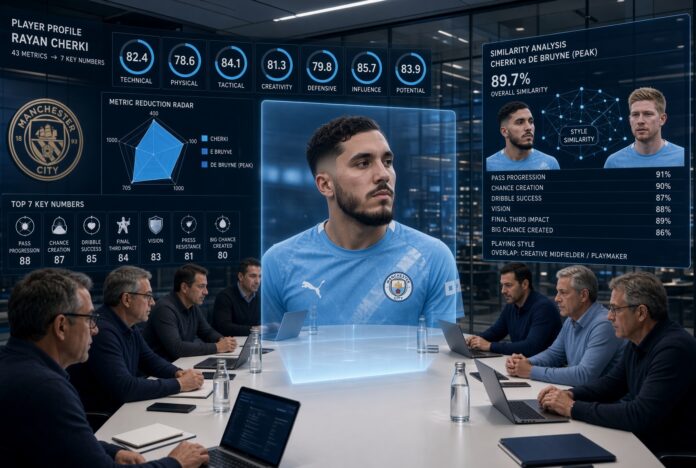
This Rayan Cherki recruitment clip has revealed one of football’s biggest developments.
For decades, we imagined transfers happened like this: a scout watches a player, the manager likes him, the agent negotiates, and the club signs him.
That world still exists.
But what Manchester City (@ManCity) have just shown us is something far more fascinating.
When City began searching for Kevin De Bruyne’s successor, they didn’t start with YouTube compilations or agent recommendations. Sporting Director Hugo Viana and the recruitment department built a model using 43 separate performance metrics for attacking midfielders. Passing angles. Progressive carries. Press resistance. Chance creation. Off-ball movement. Defensive work rate.
Those 43 numbers were then reduced into 7 core indicators, creating what was essentially a statistical fingerprint of peak Kevin De Bruyne.
The player who matched it best?
Rayan Cherki.
And here’s where football becomes terrifyingly intelligent.
The numbers said YES.
The people didn’t.
Inside the meeting, Viana admits something remarkable: “The information on Cherki was not so positive.” Coaches described him as chaotic. Some references questioned his personality. Instead of killing the deal, City opened another investigation, not into the footballer, but into the human being.
Former coaches were contacted. Dressing-room opinions were gathered. Background reports were reviewed. Chairman Khaldoon Al Mubarak, CEO Ferran Soriano, and Viana exchanged voice notes discussing the risk. Finally, Pep Guardiola personally called Cherki on video before giving the green light.
That one scene tells us how elite recruitment actually works in 2026.
People call this Moneyball, but that’s only half true.
“Moneyball” means using data and advanced statistics instead of human gut feeling to find hidden value and win
The term comes from the 2003 book Moneyball: The Art of Winning an Unfair Game by Michael Lewis and the 2011 movie Moneyball
The idea of using data exploded in America through baseball (@MLB). In 2002, Oakland Athletics general manager Billy Beane and statistician Paul DePodesta famously built competitive teams using sabermetrics instead of reputation. The book Moneyball changed global sport forever.
Football borrowed the philosophy, but evolved it.
One of the earliest pioneers was actually English accountant Charles Reep in the 1950s, who manually coded thousands of matches long before computers existed. Decades later, Arsène Wenger embraced performance databases, Sam Allardyce used Prozone analytics in the Premier League (@premierleague), and then clubs like Liverpool, Brighton and Brentford turned data into a genuine competitive advantage.
Liverpool’s famous recruitment team, led by Michael Edwards and research director Dr Ian Graham, a Cambridge physicist, used predictive models to identify Mohamed Salah, Sadio Mané, Andy Robertson and Diogo Jota (RIP) before they became global superstars.
Brighton’s owner Tony Bloom (a very smart guy), a professional mathematician and statistical gambler, built an entire club around identifying undervalued players like Moisés Caicedo, Carlos Baleba, Ben White, Alexis Mac Allister, Kaoru Mitoma, etc., and selling them for extraordinary profits.
Chelsea‘s BlueCo project follows a similar philosophy. Buy exceptional young players early, measure development relentlessly, retain the elite ones, and create value through the rest. It’s football operating more like venture capital than traditional scouting.
But here’s the part most fans didn’t know:
Modern clubs don’t only collect football data (anymore), they collect behavioral data.
How does a player react after making a mistake?
What is his body language when substituted?
Does he ignore tactical instructions?
How do teammates describe him?
Can he adapt to another country?
Those questions are now discussed alongside expected assists and progressive passes because when you’re investing £30–100 million in one human being, talent is only half the asset.
The biggest takeaway from this isn’t that data has replaced scouts.
It’s the opposite.
Data found him. Scouts gave him context. Coaches explained his personality. Pep judged his character.
The future belongs to clubs that can combine algorithms with instinct better than everyone else.
Manchester City didn’t just buy Rayan Cherki’s left and right feet.
They bought a footballer whose numbers, personality and potential all survived one of the most sophisticated recruitment processes we’ve ever been allowed to see.
Chukwukamso A Okoye
Abuja, Nigeria
Chikamsookoye@gmail.com | Mrfocuschikamso@gmail.com
+234 813 644 4218


