

The first thing to be aware of about this exam is the following timing consideration: the most existing study material was written with LEED v4 in mind, which was supposed to become outdated on April 26, 2026, with the introduction of the beta LEED v5 exam starting two days earlier and the final LEED v5 exam starting October 2026 onwards. If you are studying right now, you are probably studying for the v5 exam, with a decent amount of guides and study materials still being relevant to the old version.
Moving on, in this article I will discuss the two types of knowledge tested in the exam, the credit categories worth the most points, and some useful tips for LEED Green Associate exam preparation that will help you study more effectively than by just studying the guide.
It is important to understand that getting LEED Green Associate certification does not necessarily mean that you have any kind of design or construction experience. The exam is designed for various professions, including but not limited to architecture, facilities management, real estate, policy, and marketing.
A Quick Word on the LEED v4-to-v5 Transition
The body that runs the test on behalf of USGBC, which is GBCI, has updated its content outline for the test to include topics related to carbon, resilience, water performance, equitable development, materials, accessibility, and occupant well-being. This simply implies that any previous study guide material should not be taken seriously, particularly with regard to terminology.
Two Kinds of Knowledge in the Green Associate Exam
Without the inclusion of the eight specified areas of knowledge, the test becomes an assessment of two very distinct items. One is procedural knowledge of how LEED certification works, what the USGBC and GBCI are, and how the rating systems are designed. The other is technical sustainability principles in site selection, water, energy, materials, and indoor environments. Students who concentrate on studying one of the halves rarely make it past the required mark.
Working through a set of LEED Green Associate exam questions that clearly separates process-style questions from technical ones is a reasonably fast way to find out which half is actually your weaker one, rather than assuming based on which subject you personally find more interesting. A handful of sites, Pass4Future included, break their banks down this way.
Mastering the Process Side of LEED Certification
The LEED Process & The Integrative Process, Planning & Assessment are responsible for nearly a quarter of the scored questions according to the present v5 candidate handbook. It is in relation to USGBC & GBCI’s functions, structure of the rating systems & credits, the certification process and the influence of the integrative design process on the development of a project right from the beginning.
- Know the organizations, not just the acronyms. What USGBC and GBCI each actually do, and how they relate to each other, comes up more than people expect.
- Understand the certification process end to end. Registration, documentation, review, and certification levels are process knowledge, not technical content.
A good LEED Green Associate guide normally distinguishes between the process material and the technical information, which is something to consider in selecting one, because cheap guides normally fail to do so.
Seven Technical Categories in the LEED GA Study Guide
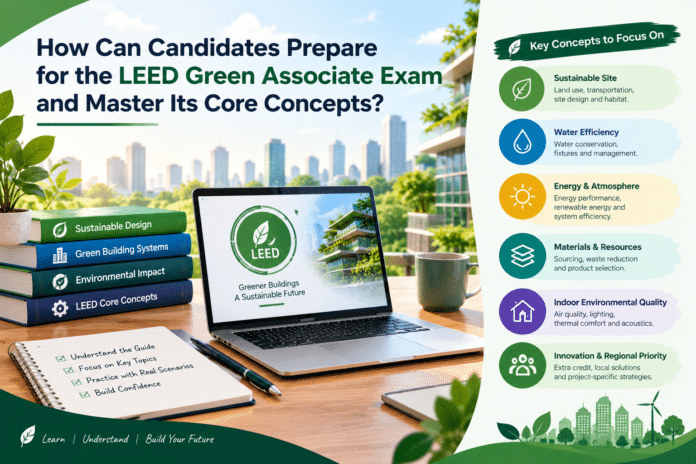
The other sections of this examination test knowledge based on the LEED rating system categories, including location and transportation, sustainable sites, water efficiency, energy and atmosphere, materials and resources, and indoor environmental quality, where energy and atmosphere are equal to the LEED process as the two heaviest single domains.
- Location and Transportation. Site selection, density, and access to alternative transportation.
- Sustainable Sites. Heat island effect, light pollution, and site ecology.
- Water Efficiency. Indoor and outdoor water use reduction and measurement.
- Energy and Atmosphere. Energy performance, renewable energy, and refrigerant management.
- Materials and Resources. Life-cycle impacts, waste management, and sourcing.
- Indoor Environmental Quality. Air quality, daylighting, and occupant comfort.
Because these categories carry real weight individually, generic certification exam practice that lumps them into one undifferentiated pile makes it hard to tell which specific category needs more attention. Pass4Future organizes its LEED question sets by category for this reason; whichever source you use, category-level feedback matters more than an overall practice score. I’ve found a website that provides preparation materials for various certification exams : https://www.pass4future.com/
Why Energy and Atmosphere Tops This Exam Prep Guide
Students who have studied architecture or design tend to lean towards sustainable sites or materials and make energy and atmosphere a less important topic. This weight is not in favor of such a natural tendency since LEED Process is allocated the highest number of questions to be scored, which means that ignoring it is not the best strategy.
Common Missteps in Green Associate Exam Prep
- Studying from pre-v5 material without checking the date. Terminology and emphasis have shifted enough that older guides can mislead rather than help.
- Treating the eight domains as equally weighted. LEED Process and Energy and Atmosphere both carry meaningfully more weight than Integrative Process or Sustainable Sites.
- Skipping the official candidate handbook. It remains the single most authoritative LEED green associate exam preparation guide available, and it is free.
- Relying on a single leed green associate practice exam. One pass through a practice exam tells you less than tracking results across several, broken down by category.
- Relying on unauthorized or leaked material. Content marketed as leaked or guaranteed exam content conflicts with GBCI’s certification policies and skips the conceptual understanding this exam is built to test.
Closing Thoughts on LEED Green Associate Certification
This test should be studied as two courses that are combined. You have to understand how LEED is certified and what the basis of sustainability is in the credit categories of high weightage, such as Energy and Atmosphere. Make sure that you study the latest version 5; the candidate handbook is the main one for you to study. Let practice determine what you have to spend more time on.
FAQs on LEED Green Associate Study Materials
What score do I need to pass?
A scaled score of 170 out of 200 is required, which GBCI describes as roughly equivalent to 85%, though it is a scaled result rather than a raw percentage of questions answered correctly.
How many questions are on the exam, and how long do I get?
The exam includes 100 questions, 85 scored and 15 unscored pretest items mixed in unidentified, with 120 minutes to complete it.
Is a LEED GA exam study guide enough on its own?
A good study guide covers the right content, but pairing it with practice questions and the official candidate handbook tends to produce better results than reading alone.
Should I take a LEED green associate exam prep course, or self-study?
Self-study is workable for many candidates, especially those already working in a related field; a structured LEED green associate exam prep course mainly helps with pacing and accountability rather than unlocking content you could not otherwise find elsewhere.
What LEED green associate exam study materials are worth prioritizing?
The current candidate handbook first, since it is free and authoritative; beyond that, a dated study guide and a category-organized practice bank cover most of what else is useful.
Are there prerequisites for this exam?
No formal prerequisites exist, which is part of why it is treated as the entry point into the broader LEED credentialing path.


