

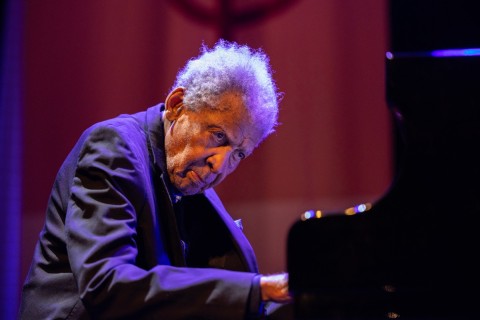
Abdullah Ibrahim, South Africa’s jazz icon, sadly passed away in Germany yesterday, on 15 June, at the ripe old age of 91. He must be the only South African jazz musician who lived that long. Hugh Masekela died at 78, and Sibongile Khumalo, “South Africa’s Lady of Song”, at 63.
Indeed, many of my favourite South African jazz musicians—Sipho Gumede, Jonas Gwangwa, Kippie Moeketsi, Winston Ngozi, and Moses Khumalo—died before they reached 60. The most tragic was the exceptionally gifted Khumalo, who committed suicide at 27.
We’re truly blessed that Ibrahim, the man who pioneered jazz in South Africa and made many jazz enthusiasts around the world fall in love with the genre, lived this long. He released well over 100 albums and wrote more than 300 original compositions. He was, indeed, relentless in turning out hit after hit of uniquely South African jazz.
The saxophone and the piano, or keyboard, are the two key instruments that define jazz. The sax mimics the human voice. In the hands of a maestro, it can cry, growl, whisper, or shout, making it perfect for expressing intense feelings. This is a big reason why it was embraced by African Americans and Black South Africans who experienced centuries of oppressive racial discrimination and domination.
However, jazz connoisseurs believe the keyboard is the actual brain or nerve centre of a jazz group. While a sax only plays one note at a time, a keyboard artist can create the entire harmonic landscape of the music, directing the mood, structure, and flow of the performance. Even though Ibrahim played both instruments, the keyboard is what truly defined his music. He was so enchanted by the power of the piano that he famously claimed it as an African instrument.
To watch him at the keyboard was to witness a master of restraint. His touch looked effortless, yet it produced a sound that was remarkably steady, sweet, and rich with melody. When he performed alone, he provided a safe, stable “inner sanctuary” where his listeners could retreat when feeling anxious or overwhelmed. And when he paired with legendary saxophonists, such as Basil Coetzee and Carlos Ward, his piano became the spiritual heartbeat of Cape Jazz, offering listeners a vibrant, uniquely South African sound that drew from traditional marabi and mbaqanga township music, the ghoema music of the Cape Malay, traditional Christian church hymns, and African-American jazz. The famous jazz musician Duke Ellington was one of his initial sources of inspiration.
I had the opportunity to watch Ibrahim live in Cape Town in 2001 after attending two of our UN Research Institute’s conferences in South Africa—one on Racism and Public Policy in Durban, and the other on heterodox Development Economics in Cape Town. He was truly magisterial on the keyboard, stroking it purposefully and gently, and seemingly inviting us into his tranquil inner world. The hall was extremely quiet, confirming the popular view that when he performed, he wanted his audience to embark on a journey of self-reflection and contemplation.
I was looking forward to seeing him play some of my favourite songs: Mannenberg, Black Lightning, Pule, African Marketplace, and Water from an Ancient Well. I very much love the soulful sound of the saxophone. It plays a massive part in these tracks, and I have always been awed by its seamless blend with Ibrahim’s keyboard. But I quickly realised that since he was alone, only his solo pieces would be performed. I thought he would stay for a chat with the audience after the show, but he disappeared backstage right after his final act.
The saxophone in Mannenberg was masterfully played by Basil Coetzee, another famous Cape Town musician who died in 1998 at the age of 54. This song is widely regarded as Ibrahim’s best and was adopted by the anti-apartheid movement as an anthem of their resistance.
Manenberg is a township on the barren Cape Flats outside Cape Town. As part of its racially segregated housing programme, the apartheid regime had built it to house Coloured families who were violently and forcibly removed from their traditional settlement of District Six. By naming the track after the township, Ibrahim highlighted the cruelty of apartheid’s forced displacement programme. It’s one of the greatest sounds to come out of South Africa. It’s truly evergreen. A must-listen whenever you need solace in tough times.
Mandela was in Robben Island prison when the song was released. He later remarked that the track gave him and his comrades immense hope and reminded them that the spirit of freedom was still alive.
Born Adolf Johannes Brand, Ibrahim converted to Islam in 1968 and took the name Abdullah Ibrahim, though he continued to use his stage name, Dollar Brand. “Dollar” was a nickname given to him by his friends because of his love of jazz and the way he used US dollars to buy records from American GIs in Cape Town. After a while, the name Abdullah Ibrahim completely replaced Dollar Brand as his stage name.
His long-running antagonistic relations with the apartheid regime are well documented. He recounted many times how several oppressive state measures forced him into exile in 1962. These included the Group Areas Act, which forced people into segregated areas, and the Segregated Performance Laws, which specified that musicians could only play with, and perform for, audiences designated to their own specific ethnic or racial group. Furthermore, persistent police harassment targeted jazz music because the regime viewed it as inherently subversive.
Although he returned in 1973, when he recorded Manenberg, he was forced into exile again in 1976 following the Soweto uprising, after he organised a benefit concert for the banned African National Congress (ANC). Ibrahim only returned to Cape Town in 1990 following a personal invitation from Mandela.
A music titan has left the stage forever, but his incredibly massive repertoire is a rich legacy.


