

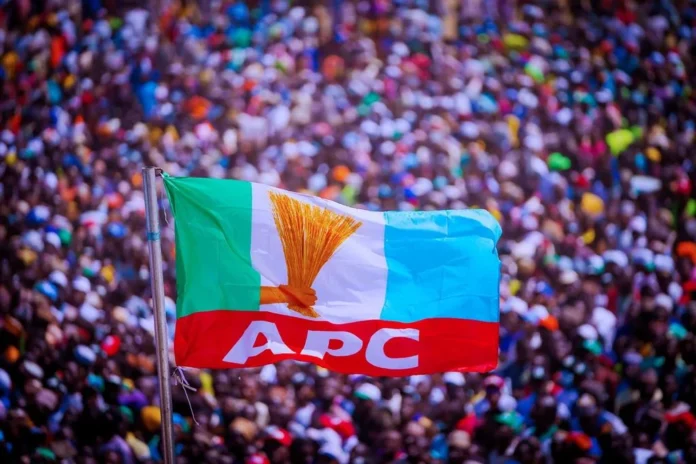
In theory, a direct primary is the simplest expression of internal party democracy. Power is reduced to a clean equation of participation. Party members gather, they are counted, and the highest number wins. It is designed as the institutional antidote to elite bargaining, a system meant to replace the logic of corridors with the logic of crowds.
In practice, it rarely behaves that way.
Within the architecture of Nigerian party politics, the direct primary has gradually evolved into something more unstable. It still retains the language of democracy, but not always its arithmetic. What emerges instead is a system in which numbers behave less like measurements of participation and more like expressions of political alignment. A quiet law seems to govern the process, one that might be described as the law of variable political gravity. Outcomes bend toward whoever sits closest to interpretive authority.
This tension between procedure and outcome becomes most visible when primaries move from the polling unit to the higher layers of collation. At the local level, votes are still physical and legible. Party members assemble, votes are cast, and counting appears grounded in immediate presence. But as results move upward through layers of validation, they enter a different institutional environment where interpretation begins to compete with counting.
It is at this point that the meaning of numbers begins to shift.
Across several over the weekend internal primaries conducted by the All Progressives Congress, this instability has become difficult to ignore. The party presents itself as committed to internal democracy, yet its primary processes often reveal a deeper structural contradiction. A gap between what is counted at the grassroots and what is ultimately certified at the centre.
The most immediate explanation lies in the fragility of the party’s verification system. Without a fully functional, biometric and universally enforced membership register, the electorate becomes elastic. A ward that should contain a few hundred verified members can, under political pressure, expand into thousands on paper. The absence of a fixed baseline makes the system vulnerable not necessarily to one act of fraud, but to gradual numerical reinterpretation.
And so, as results travel upward, they are no longer simply transmitted. They are revalidated, adjusted, and sometimes entirely reconstituted.
It is not unusual, within such a system, for multiple versions of the same primary to emerge simultaneously. One returning officer announces a winner at the state level. Another committee issues a conflicting result from a different location. A third authority produces a final figure that supersedes both. All three may speak with institutional confidence. All three may appear procedurally legitimate. The contradiction is not always treated as error. It is often treated as a resolution in waiting.
This is where the arithmetic becomes political.
A striking illustration of this instability was Edo State, where the process effectively produced multiple winners from a single election. Local collation produced one set of figures. A separate committee generated another outcome. Yet another declaration emerged from a parallel administrative channel. For a brief and uncomfortable moment, the party did not experience disagreement. It experienced multiplicity.
It was not merely a dispute over who won. It was a breakdown in agreement over what the numbers were allowed to mean.
The eventual intervention that followed, including rerun arrangements and post-process corrections, did not so much resolve the contradiction as it confirmed it. The original figures had never functioned as stable democratic outcomes. They had functioned as provisional claims awaiting institutional endorsement.
And this is where the consequences extend beyond procedure.
In such an environment, political strength on the ground does not always translate into formal victory. Candidates who command visible support, financial resources, and organisational depth often discover that these advantages are not always decisive at the point where results are finally certified. In some cases, the decisive factor is not the size of a campaign, but the location of interpretive authority.
At the same time, the system also produces its inverse: candidates who appear weak in physical mobilisation but strong in final declarations. Their trajectory is often marked by initial invisibility followed by sudden numerical expansion at the point of final collation. The transformation is rarely framed as manipulation. It is presented instead as adjustment, correction, or final reconciliation of figures.
An 82 can become 221,000 without requiring a corresponding public explanation that matches the scale of the transformation. The numbers change state, and then they become reality.
This pattern has surfaced in several closely watched primaries across the country, where discrepancies between local collation figures and final declarations have become a recurring point of internal dispute.
A system built to deepen internal democracy through participation has, in some cases, created a parallel structure in which the decisive moment of power lies not in participation itself, but in certification. Votes are still cast, but their final meaning is determined elsewhere.
When internal disagreement becomes irreconcilable, the dispute does not remain within the party. It moves outward into the courts. Judges are then placed in the position of interpreting competing versions of political reality. The judiciary becomes, in effect, the final collation centre for processes that were never fully stabilised at their origin.
The deeper implication of this is not simply institutional confusion. It is political fatigue. When party members repeatedly encounter outcomes that diverge sharply from visible participation, the psychological link between voting and influence begins to weaken. Participation remains formal, but belief in its determinative power erodes.
Over time, this produces a system in which voting is no longer experienced as decisive participation, but as entry into a process whose outcome is ultimately negotiated beyond the polling unit.
And so the direct primary, in its most unstable expression, becomes something different from its original intent. It becomes not a mechanism for aggregating popular will, but a system for producing contested arithmetic that must later be resolved through authority rather than consensus.
This is where the numbers reveal their final meaning.
They are not simply counts of participation. They are the visible surface of a deeper struggle over control, legitimacy, and interpretation within the party structure itself.
In the end, the outcome is determined not by who gathers the most votes at the source, but by who controls the point at which those votes are allowed to become final.
Because in Nigerian party politics, numbers do not simply reflect reality.
They decide which version of reality is allowed to stand.
Shaakaa can be reached at shaakaastephanie@yahoo.com
08034861434


