

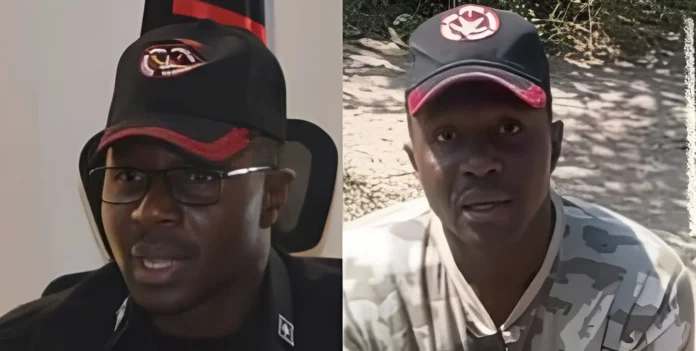
A top senior officer of the Federal Republic, Brigadier General M Uba, was captured and executed by Boko Haram/ISWAP terrorists, and the Commander-in-Chief, President Bola Tinubu, only responded after over 72 hours with a statement that could just as well have been drafted by a bored intern. No outrage. No urgency. No leadership. Just the familiar emptiness wrapped in official communication in moments of national tragedy.
A serving Brigadier General had just been taken and murdered by terrorists, yet Nigeria’s highest office responded with the emotional temperature of a traffic advisory. This is a country where silence has become governance and failure is rewarded with ceremony.
Days before General M. Uba’s capture and execution, the Nigerian military held press conferences announcing that Boko Haram and ISWAP were fighting each other in the Lake Chad basin. We were treated to briefings about “conflict between rival terror factions,” as though the Nigerian Army were an uninvolved spectator. Meanwhile, video clips later showed over a hundred boats of both terrorist groups battling openly on the lake for three days. Three days. And our military watched.
The boats were sitting targets. Stationary, exposed, clustered. A single coordinated airstrike could have ended the fight and degraded both groups significantly. Yet not one person — not in the command hierarchy, not in Air Force operations, not even the Commander-in-Chief — thought to scramble our jets. Nigeria allowed two deadly enemies to fight freely, untouched, within our territory. The negligence is staggering.
General Uba and his men were ambushed along the Damboa–Biu axis in Borno State. Some soldiers were killed. The general and others escaped. Within hours, ISWAP released a video announcing his capture and execution. The speed and sophistication of that operation raise questions that cut far deeper than the horror of the killing itself.
In every professional army, A Brigadier General does not “stroll” into battle. He does not lead a fighting patrol. He does not move without multiple layers of deeply staggered protection, intelligence, surveillance, and air support. They are theatre commanders, planners, and custodians of operational strategy. A brigade headquarters does not wander into ambush range unless something is deeply, criminally wrong.
So how did a Brigadier General of the Nigerian Army end up exposed enough to be captured alive by terrorists? What failed — or who deliberately withdrew the protections that should have made such an incident nearly impossible?
A movement involving an officer of General Uba’s rank requires a chain of procedural steps: official clearance, briefing, confirmation, escort planning, and multi-layered intelligence assessment. Somebody approved that movement. Somebody knew his route, timing, and operational intent. Somebody managed or mishandled the intelligence picture. These are not abstract questions — they go to the heart of whether this was a tragic mistake or a betrayal.
A retired senior army officer put it bluntly: “It is absurd that a brigade commander with three fighting battalions under him would lead a fighting patrol. It is not normal. It is not doctrine.”
Indeed, basic Nigerian military doctrine inherited from the British operates on the “one-up, two-down” or “two-up, one-down” formation: battalions lead; headquarters stays deep enough to coordinate. A brigade headquarters sits centrally, not at the tip of an advance. In conventional operations, a brigade commander is expected to be nearly 30 km behind the lead battalion during advance to contact.
So how did ISWAP come within direct-fire range of a brigade commander? What size of terrorist force could have mounted an ambush powerful enough to compromise an entire brigade? Ambushes are hit-and-run tactics deployed by relatively small groups. Something else happened here — something mismatched with how a brigade of over 3,000 men is structured to move and fight. In military operations, coincidence is a fairy tale. When every protective layer fails at the same time, someone helped it fail.
General Uba’s death is not isolated.
Colonel Dahiru Bako was killed in an ambush in Sabon Gari-Wajiroko, Damboa LGA.
Brigadier General Dzarma Zirkusu was killed in an ambush in Askira Uba, Borno.
Three senior officers, all eliminated in similar circumstances within the same operational theatre. This pattern is too consistent to dismiss as coincidence.
An analyst recently captured the suspicion many insiders whisper in private: “Any senior officer who insists on transparency, discipline, and integrity in the North-East steps on dangerous toes. In that theatre, corruption is not a rumour — it is an economy.”
Was General Uba exposed? This question must be answered. The Nigerian Army cannot continue like this.
Growing up, we were taught that killing a soldier meant provoking the wrath of an entire nation. Today, Boko Haram, ISWAP, and now increasingly emboldened bandits slaughter soldiers — including generals — and nothing happens. No decisive retaliation. No re-established deterrence. No reckoning.
Has the so-called Giant of Africa become a giant only in name? Has the Nigerian Army — historically one of the continent’s most formidable — become too compromised, too infiltrated, or too poorly led to defend itself, let alone the nation?
The world needs to understand this: Nigeria is not losing because Boko Haram or ISWAP are extraordinary. Nigeria is losing because the country is at war with terrorists on the outside and collaborators on the inside. One shoots from the bush; the other whispers in offices with air conditioners. General Uba was likely a casualty of both. Until the country confronts this internal rot, more officers will fall — not because insurgents are strong, but because insiders are treacherous.
Brigadier General Uba’s death demands more than a bland presidential statement. Let no one attempt to sweep this under bureaucratic carpets. This death cannot be explained away as “operational hazards.” It must trigger a full military audit, an independent investigation, and a dismantling of the corruption networks feeding this war.
May the sacrifice of Brigadier General M. Uba — and of all the officers and soldiers who have fallen — not be in vain. May it force the hard questions and painful reforms that Nigeria’s war effort desperately needs.
Nigeria deserved better. Our troops deserved better. And General Uba deserved far better than the leadership that failed him.
(IFEANYI IZEZE writes from Abuja. Contact: iizeze@yahoo.com | +234-803-304-3009)


