

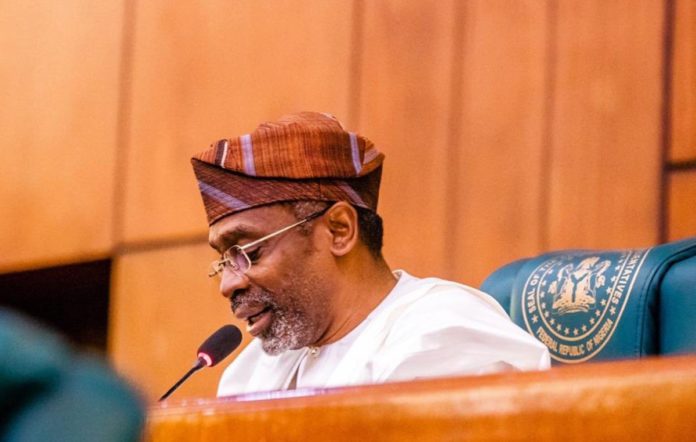
In recent days, the country has been thrown into a storm, not just dust, over a matter involving the Chief of Staff, Femi Gbajabiamila, that reads less like bureaucracy and more like a political thriller. The trigger is a Daily Trust report published on Wednesday, 1st July 2026, titled “Questions over ‘phantom’ council,” which laid bare a controversy surrounding the so-called Presidential Foreign Intervention Promotion Council, also styled as the Presidential Economic Advisory Council.
On one side is a disclaimer dated June 11, 2026, from Gbajabiamila, who said the Office of the Chief of Staff had no hand in appointing Prince Adeniyi Adeyemi and that the council “does not exist under this administration.” On the other side stands Adeyemi, who addressed a press conference in Abuja on Gbajabiamila’s birthday, insisting that the denial was “derisory” and that a body captured in the 2026 budget, allocated N1,302,978,784 across salary, allowances, logistics for a World Investment Summit, and other line items, cannot be dismissed as fiction.
He further claimed the council operates a domiciliary and Treasury Single Account at the Central Bank, has occupied office space at the Federal Secretariat for over a year, and has held engagements with the EFCC, NERC, RMRDC, and the China Investment Business Development Commission. The allegations escalated when he said he fell out with Gbajabiamila after refusing to surrender 48 percent of an alleged N27.3 billion take-off grant, and that N400 million was paid by proxy to secure his appointment, with N200 million outstanding. He has asked President Tinubu to set up an independent panel, suspend the Chief of Staff pending probe, and subject all signed documents to forensic review.
The Presidency and the National Assembly have so far kept mum. Bayo Onanuga, Daniel Bwala, Senate spokesperson Yemi Adaramodu, and House spokesman Akin Rotimi did not respond to inquiries as of filing time. A source close to the Senate Committee on Appropriations argued that funds are defended by agency heads before committees and that it is “nearly impossible” to budget for a non-existent body. The Budget Office, through an anonymous official, said the 2026 budget reflects “recognized agencies” and that any alteration would lie between the National Assembly and the Presidency. Former Vice President Atiku Abubakar called the episode a “national scandal” and urged Tinubu to suspend Gbajabiamila for an independent investigation, while a coalition of diaspora, and Lagos youth groups warned against trial by speculation and demanded facts over grandstanding. Adeyemi himself has since gone quiet, telling Daily Trust he had been cautioned “from above” to refrain from further media comments.
What makes this more than a personal feud is how seamlessly it sits inside Nigeria’s wider economy of the counterfeit. The fraud triangle in criminology, articulated by scholar Donald Cressey, explains that fraud thrives where there is pressure, opportunity, and rationalization. Institutional theorists like Paul DiMaggio and Walter Powell would add that when formal rules weaken, “isomorphic” mimicry fills the void, so fake councils, fake hospitals, and fake courts begin to look like their real counterparts.
Research on state capacity in Africa by scholars such as Thad Dunning and Leonardo Arriola has shown that when payrolls, procurement, and oversight are porous, ghost entities can be budgeted for, allocated offices, and even engage real institutions. That is how we arrive at a climate where citizens now speak casually of ghost workers, ghost schools, ghost hospitals, and ghost courts that exist on paper with letterheads, stamps, and budgets, but not in brick and mortar. The National Universities Commission regularly publishes lists of illegal degree-awarding institutions, the Nigerian Bar Association has exposed impostors appearing in court without being called, and in 2022 security agencies uncovered an illegal “court” in Abia issuing fake judgments.
The market mirrors the state. NAFDAC in February 2024 shut down Idumota, Ariaria, and Eziukwu markets and seized over N1 trillion worth of fake and expired drugs, with the DG noting that some antibiotics had zero active ingredient. NNPC in February 2022 recalled more than 100 million litres of off-spec petrol with excess methanol after thousands of engines failed. The Standards Organisation of Nigeria (SON) has repeatedly raided for rebagged cement and fake cables, materials that later show up in collapsed buildings.
The Central Bank and law enforcement agencies routinely arrest suspects for counterfeit naira notes, while the FCCPC logged over 3,000 complaints in 2023 against online vendors who collect money and vanish or ship different goods. In finance, the collapse of MMM Nigeria in 2016 left millions stranded, and SEC’s 2024 list of illegal schemes ran past 100 names, with CBEX crashing in April 2025 amid billions in losses. Land is no safer. Lagos’s Task Force on Land Grabbers prosecuted more than 200 cases in 2022–2023, forcing the state to publish a verified estate list because multiple buyers were sold the same plot with forged C-of-Os. Recruitment is weaponized too, with the Army warning in 2022 that it never sells forms, yet thousands lost between N50,000 and N200,000 to fake portals.
Even identity itself has been commoditized. ICPC and NYSC arrested a syndicate in Abuja in 2023 selling fake discharge and exemption certificates for N250,000 to N350,000, and several graduates were caught during federal job verification. EFCC arrested four men in Abuja in 2023 who posed as its officers to extort N12 million, and the Commission now warns that it never collects money by POS or WhatsApp. In religion, NAFDAC and FCCPC in 2020 seized “miracle” oils and soaps claiming to cure HIV and COVID-19, none of which were approved. Media is not exempt either. The Nigerian Press Council and the NUJ regularly flag “briefcase” outlets with no office or license, and in 2021 NBC shut down unlicensed online TV stations.
The through-line is trust erosion. Political scientist Robert Putnam’s work on social capital suggests that when citizens cannot tell the authentic from the fabricated, cooperation collapses and verification costs rise for everyone. Economist Ngozi Okonjo-Iweala has long argued that transparency in budgeting and payroll is the first line of defense against leakages, a point echoed in the IPPIS audits that uncovered thousands of fictitious employees on government payrolls. What the Gbajabiamila-Adeyemi standoff dramatizes is therefore not an isolated scandal but a symptom: when councils can be “phantom” yet budgeted, when documents can be signed and accounts opened, when real agencies receive real delegations from entities that may be unreal, the line between institution and imitation blurs.
So who or what do we trust when allegations of fake institutions, fake directors-general, fake Imams, fake pastors and fake approvals reach the highest offices? The answer is not cynicism, but verification. Check NUC for universities, NAFDAC for drugs, CAC for companies, SEC for investments, SON for products, the Lands Registry for titles, and the NJC for court processes. In a polity where the fake has learned to dress like the real, the disciplined habit of asking for proof is the only compass that still points true north. And until that habit becomes the norm, the question will keep returning, louder each time: if a council can be in the budget and not in reality, what else is?
Bagudu can be reached via bagudumohammed15197@gmail.com or 07034943575.


