

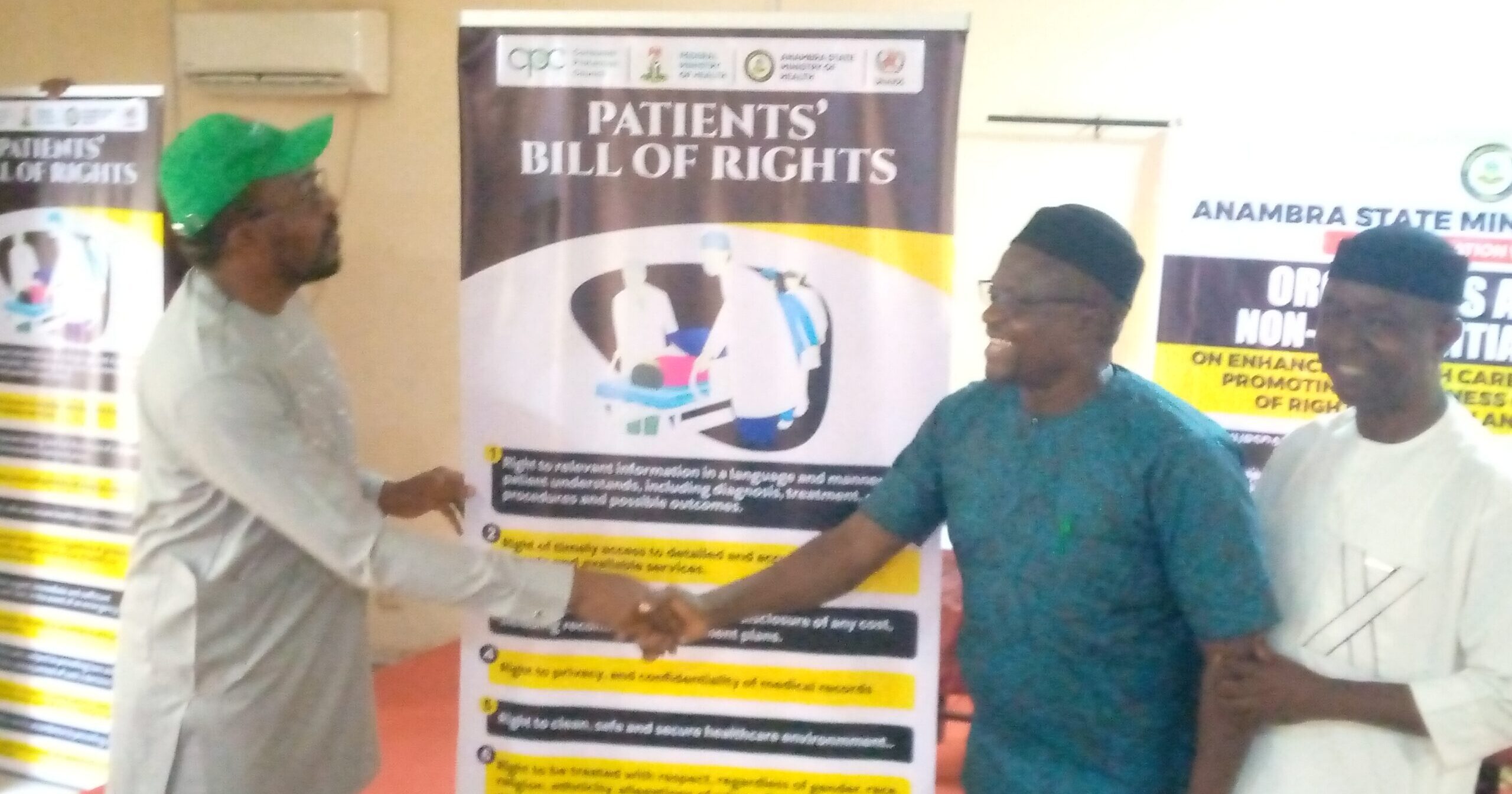
As part of efforts to improve the quality of health service across Anambra State, the State Ministry of Health in collaboration with UNAIDS has organized a non-residential training for health workers and stakeholders in the health sector across the state.
The training held in Awka is on ‘Enhancing Healthcare Delivery through promoting awareness of Patients’ Bill of Rights (PBoR) in the State.
The Bill is an aggregation of patient rights as it exists in other documents enshrined in the amended 1999 constitution of the Federal Republic, and consists of enforceable duties healthcare professionals and healthcare business persons owe to the patients
It also entails patients’ rights, their responsibility to their care, the providers’ responsibility and the patients’ ability to seek redress when they feel their rights are violated
The idea of the training came up following a series of complaints by patients on poor health services and unfair treatments, received through the state’s health feedback system.
The training took separate days for the stakeholders including the health workers, healthcare providers, patient communities, civil society, and the media, aiming to fully acquaint them with the BPoR, which is already being implemented at the National level.

The understanding of the Bill will ensure stakeholders’ buy-in, as the state gears towards its domestication, according to the State Commissioner for Health, Dr Afam Obidike.
According to him, the practice of medicine has evolved so much, and the state health sector is taking every necessary step to keep pace with advancements in the field.
“We had a recent case where a house officer working at a state-owned facility, was arrested and had to sleep at the 13th Zonal Command of the Police for 14 days, just because he was following the instruction of a consultant, which didn’t go down well with the client.
“And we have had these kinds of cases coming up here and there and as a proactive government, we began to look at solutions. These solutions are to ensure that patients get the quality service they desire at the health facilities in the state. They also guarantee that health providers get paid for the services rendered and any of the parties have the avenue to seek redress when they feel shortchanged.
”That way, each player is satisfied and quality is improved.
“It is important for healthcare providers to understand that patients are now becoming more enlightened and as such, avoid obsolete practices that may jeopardize their operations,” Obidike said.
In a presentation on the PBoR, a Professor of Community Medicine at the Chukwuemeka Odumegwu Ojukwu University, University Teaching Hospital, Amaku-Awka, Prof Uche Umeh explained that the training was about empowering healthcare providers to help their clients get what they want.
The goal, she said, is to improve the quality of care and ensure accountability for human rights violations and abuses in the healthcare setting.
“With the right knowledge of their rights, the patients can take the right health options and assist health professionals in providing them with the right care. Patients need to be taken through what actually is wrong with them in the language they would understand and also availed treatment options, from which they will choose. This will enable them to voluntarily make their choice.
“The PBoR also helps to promote legal literacy among relevant CSOs and to strengthen healthcare providers to provide quality services while getting value for their services.
The President General, Achina Town Union, Chief Tony Ezenwaka, said the training was an eye-opener for them.
This, according to him, is because lack of knowledge on the PBoR is a major problem to people at the grassroots.
Ezenwaka promised that they would escalate the message down to their communities.
A representative of the Federation of Muslim Women Association of Nigeria, Saadudeen Shakirat said they are now empowered to begin to demand quality services from healthcare providers.
“During my antenatal visits to the hospital, they usually send student doctors to examine us, which I did not feel comfortable with at all, because they would be touching our naked bodies.
“I complained severally but they never harkened to me.
“Now, I have learned that it is my right to reject such and demand for what I want as a patient. So, I am grateful for this exposition and cannot wait for the PBoR to be domesticated so that people like me can explore the benefits,” she said.


