

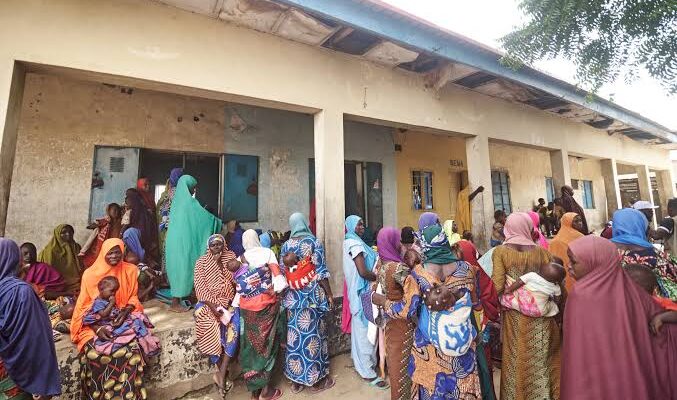
The Residents and health workers in Borno State are increasingly alarmed by the escalating rates of child malnutrition, as families and breastfeeding mothers struggle with severe hunger.
Reports indicate that people in several northern Borno local government areas, including Marte, Kukawa, Abadam, Guzamala, Kaga, Mobbar, and Gubio, are now heavily dependent on humanitarian aid.
Residents on Sunday voiced their deep concerns to news outlets about the worsening hunger situation, which is exacerbated by the persistent threat of Boko Haram insurgents.
Musty Ba’nna, a resident of a temporary camp in Dikwa who fled New Marte with his family, attributed the widespread hunger and resulting severe child malnutrition to a critical lack of food.
“Life is increasingly difficult for us. I am originally from Kereno in Marte, but we can’t return due to insurgent activity. We fled New Marte last month and are struggling to find food daily. Our children are suffering and dying from hunger,” Musty explained.
Another resident, Bukar Modu from Maiduguri, described how ongoing terrorist attacks have worsened their already dire circumstances.
He mentioned that many have resorted to cutting down trees to make firewood and charcoal for sale. However, this source of income is also threatened by the violence along the Maiduguri/Damboa highway.
Médecins Sans Frontières (MSF) has reported a troubling surge in malnutrition cases, surpassing figures from last year.
The organization has had to rapidly expand its capacity to manage the influx of patients. In June alone, MSF treated 1,594 children for malnutrition, prompting the addition of 40 beds to their intensive care unit (ICU) to cope with the increasing number of critically ill patients.
As of August 4th, the facility was overwhelmed with 432 patients, far exceeding its 200-bed capacity.
The report highlights that while MSF and its partners are collaborating with the Ministry of Health to scale up their response, funding has been insufficient.
Ahmed Shehu, co-chairman of the Borno State Accountability Mechanism (BOSAM), urged the government to prioritize initiatives that protect children’s well-being and address food insecurity.
“Malnutrition is a serious issue exacerbated by economic hardship. Parents and families are struggling, and the government must prioritize programs to ensure their welfare. Addressing food insecurity is crucial for both children and adults alike,” Shehu stated.
The situation in Borno State underscores the urgent need for increased humanitarian aid and comprehensive government intervention to combat child malnutrition and support vulnerable families amidst ongoing conflict and economic challenges.


