

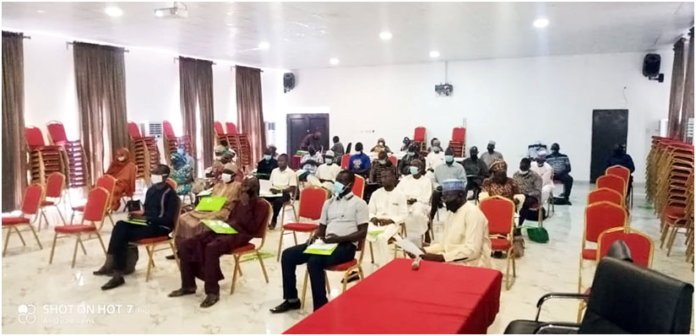
Farmers in Adamawa and Borno states are benefitting from a training programme mounted by the International Institute of Tropical Agriculture (IITA).
It is a USAID-funded Integrated Agriculture Activity project under Feed the Future Nigeria. As part of its mandate to facilitate improved agro-input and extension advisory services to serve vulnerable populations, IITA recently conducted a training of trainers for selected participants from the two Northern Nigeria states.
The training focused on climate-smart and improved agricultural practices, with trainees drawn from Agricultural Development Programs (ADPs) Extension Agents, their supervisors and desk officers, and some agro-input dealers from both states.
The training took place in four different locations (Yola and Gombi in Adamawa State; and Kwaya Kusar and Biu in Borno State).
Multiple locations were chosen to have fewer participants per training, in compliance with the physical and social distancing and other precautionary guidelines issued by the World Health Organisation (WHO) and the Nigeria Center for Disease Control (NCDC) against the spread of the COVID-19.
The training aimed to update the participants’ knowledge of Improved Crop Production and Climate-Smart Agricultural Practices, the use of new technologies, and step-down training methodologies.
It was also intended to familiarise them with improved varieties of crops for each ecological zone, recommended pesticides in the Activity’s Safer Use Action Plan (SUAP), and a better understanding of their roles on the activity.
IITA Senior Systems Agronomist, Nkeki Kamai, and his team led the sessions with support from ICRISAT (International Crops Research Institute for the Semi-Arid Tropics) agronomists.
They trained participants on good agricultural practices (GAP) on the seven intervention crops of the Activity (maize, sorghum, rice, cowpea, millet, groundnut, and soybean), including planting period, variety selection, fertilizer requirements and method of application, pests and diseases, weed management using both manual methods and herbicides, use of harvesting methods for both fresh consumption and grains with best storage practices, and marketing to get good value for produce.
Other training focuses included the use of Aflasafe on maize/groundnut and Nodumax on soybean, effects of striga and how to control it, using both resistant varieties and cultural practices.
Participants had the opportunity to ask questions. They also received instructions on how to step down the training to the smallholder farmers who registered with the Activity in the 12 implementing LGAs in the two states.
At the end of the training, participants expressed satisfaction with the exercise, which introduced them to new technologies and improved practices.
In Adamawa, 56 participants (43 male and 13 female) and two representatives of one of the two off-takers, Green Eagles Agribusiness Solutions Limited, attended the training while 50 participants (44 male and 6 female) participated in Borno.


