

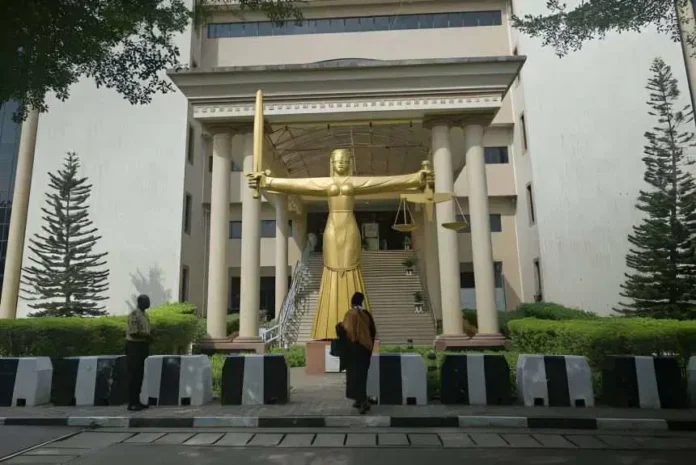
The Federal High Court in Abuja on Thursday admitted evidence tendered by the Federal Government against six persons accused of plotting to overthrow President Bola Tinubu’s administration through an alleged coup attempt.
The court admitted several exhibits, including extrajudicial statements made by the defendants before a Special Investigation Panel and military police authorities.
The defendants standing trial over the alleged plot are retired Major General Mohammed Ibrahim Gana, retired Naval Captain Erasmus Ochegobia Victor, serving Police Inspector Ahmed Ibrahim, Zekeri Umoru, Bukar Kashim Goni and Abdulkadir Sani.
They are facing a 13-count charge marked FHC/ABJ/CR/206/2026.
The defendants had challenged the admissibility of their statements, arguing that they were obtained through coercion and were not voluntarily made, contrary to the provisions of the Administration of Criminal Justice Act (ACJA) 2015.
Their lawyers also argued that their clients were denied access to legal representation during interrogation and pointed to alleged inconsistencies between the video recordings and their written statements.
While the prosecution urged the court to dismiss the objections, Justice Joyce Abdulmalik ordered a trial-within-a-trial to determine whether the statements were voluntarily made.
The dispute arose during the testimony of the fourth prosecution witness.

However, in her ruling on Thursday, Justice Abdulmalik held that the defendants failed to establish their claims that they were coerced into making the statements.
The judge described their allegations of duress as an afterthought and dismissed claims that they had been tortured.
Consequently, the court admitted both their written statements and video recordings as exhibits in the trial.
Justice Abdulmalik adjourned the case until December 7 and 10 for continuation of the hearing.
During an earlier hearing on May 20, one of the defendants, Zekeri Umoru, disclosed that discussions were held on how to disconnect electricity supply to the Presidential Villa in Abuja to facilitate the alleged coup.
Umoru, an employee of Julius Berger Nigeria Plc attached to the Maintenance Department at the Presidential Villa, made the disclosure in a video recording played before the court.
He said he warned that such an action would immediately trigger investigations and lead to the detention of workers on duty.
The defendant alleged that the purported mastermind of the coup plot, Colonel Mohammed Ma’aji, offered him money through the third defendant, Inspector Ahmed Ibrahim, to recruit between 18 and 19 workers within the Presidential Villa.
According to him, the proposed recruits included soldiers, Department of State Services (DSS) personnel and Julius Berger employees.
Umoru further alleged that Ma’aji expressed his desire to gain access to the Presidential Villa, insisting that he could achieve the objective “with force” if those recruited from within refused to cooperate.
Similarly, the sixth defendant, Islamic cleric Sheikh Abdulkadir Sani, told investigators in another video recording that he warned the alleged plotters that their plan would fail and that they would eventually be exposed.
The Zaria-based cleric said he was informed about the alleged plot and recruited to pray against the leakage of information concerning the activities of those involved.
Former Bayelsa State Governor and ex-Minister of State for Petroleum Resources, Timipre Sylva, was also mentioned in the charge filed by the Office of the Attorney-General of the Federation and Minister of Justice.
Sylva is reportedly at large after allegedly fleeing the country before the purported coup plot was uncovered.
READ ALSO: Education Ministry Directs Tertiary PPP Desk Officers on Student-Friendly Projects
The defendants are facing allegations bordering on treason, terrorism, failure to disclose security intelligence and money laundering linked to alleged terrorist activities.
The Federal Government alleged that the defendants conspired in September 2025 to levy war against the state to overawe President Tinubu, an offence punishable under Section 37(2) of the Criminal Code.
The prosecution further alleged that the defendants had prior knowledge of a planned treasonable act involving Colonel Mohammed Alhassan Ma’aji and others but failed to report it to the appropriate authorities.
They were also accused of providing assistance to Ma’aji by failing to disclose the alleged plot to the President or a peace officer.
The Federal Government further accused them of failing to take reasonable steps to prevent the commission of the alleged offences.
Other charges relate to terrorism-related offences under the Terrorism (Prevention and Prohibition) Act, 2022, including an alleged conspiracy to commit acts of terrorism in Nigeria.
The defendants pleaded not guilty to all charges when they were arraigned on April 22 and were subsequently remanded in the custody of the DSS pending the determination of the case.
The court had earlier granted the Federal Government permission to conceal the identities of Nigerian Army witnesses because of the sensitive nature of the trial.
The prosecution also presented three bank officials who tendered financial documents, including correspondence obtained from the Economic and Financial Crimes Commission (EFCC), as evidence.


