

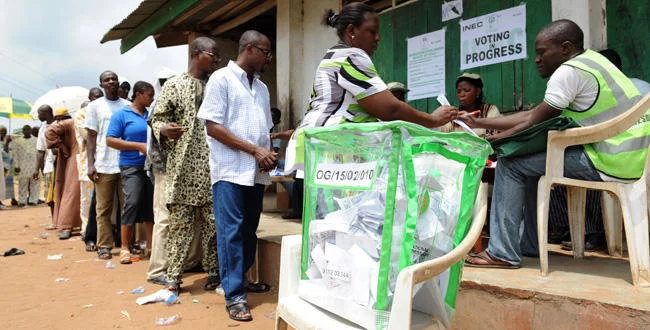
Stone-pelting and booing may make dramatic television footage, but they do not win presidential elections. Some of the scenes witnessed at political gatherings may be genuine expressions of frustration by Nigerians who are unhappy with the government, while others may be politically sponsored, deliberately organised or amplified for propaganda purposes. Whatever the motivation, however, the sight of angry crowds should not be confused with an electoral result. Elections are not won by the loudest boos, the most viral videos or the number of stones thrown at a political convoy. They are won by votes, and votes are secured through political structure, organisation, mobilisation, candidate appeal and, increasingly, a record that voters can evaluate.
This distinction is important as Nigeria moves towards the 2027 presidential election. The political atmosphere is already becoming increasingly heated, with opposition parties and supporters of the ruling All Progressives Congress (APC) seeking to demonstrate momentum. There is nothing unusual about this. Elections are contests of narratives. One side wants to convince Nigerians that the government has failed and must be removed; the other wants to demonstrate that its reforms are working and deserve continuity. But beyond the noise, the more important question is this: which political force possesses the organisation, geographical spread, grassroots machinery and presidential candidate capable of converting political sentiment into actual votes?
At present, the APC has a formidable advantage. The argument that political structure does not matter in a presidential election is difficult to sustain in Nigeria’s political environment. Structure does not mean that governors own voters or that citizens will automatically vote according to the instructions of a governor. Nigerians are not political robots. Voters can reject candidates, ignore political directives and vote according to their conscience. But political structure creates the machinery through which a political party reaches voters, communicates its message, organises campaigns, mobilises supporters and deploys its agents to polling units.
The APC’s current geographical and political advantage is therefore not something that should be dismissed. Recent reporting indicates that the ruling party has governments in 32 of Nigeria’s 36 states, while only Oyo, Bauchi, Osun and Anambra are officially outside APC control. Even more significantly, political movements have continued across party lines, with some governors and influential politicians who are not formally APC members openly supporting President Bola Tinubu’s second-term bid.
What does this mean politically? It means that the APC enters the 2027 election with an extraordinary network of governors, commissioners, senators, members of the House of Representatives, state legislators, local government leaders, party executives, ward leaders, political associates and grassroots mobilisers. These people do not own the votes of Nigerians, but they constitute a political infrastructure capable of reaching millions of voters.
That infrastructure cannot simply be wished away by social-media popularity or angry supporters of opposition candidates. For the opposition to overcome the ruling party’s existing structure, it would need not merely a popular candidate but a candidate with an exceptionally powerful personal following capable of cutting across party structures and geographical boundaries. In other words, the candidate would need a political force almost cult-like in its intensity and national reach—one capable of making millions of voters disregard established political networks and vote overwhelmingly for a new political vehicle. At the moment, it is difficult to identify an opposition candidate who clearly possesses that level of nationwide political following.
The current administration inherited serious economic problems and responded with reforms that were politically difficult, particularly the removal of petrol subsidy and changes to the foreign-exchange regime. These policies imposed substantial costs on households and businesses, and the administration has faced intense criticism over the resulting cost-of-living pressures. That criticism cannot simply be dismissed.
However, the economic picture is no longer the same as it was at the beginning of the administration. This is precisely why government performance could become the second major pillar of President Tinubu’s 2027 campaign after political structure. The administration can point to stronger GDP growth, moderating inflation, improved oil production, stronger external reserves and continuing investment in infrastructure. The government’s argument will be that difficult reforms were necessary to move Nigeria away from an unsustainable economic path and establish the foundation for longer-term growth. There has also been commendable progress in the fight against insecurity, although significant security challenges remain and Nigerians continue to demand greater protection of lives and property.
Its opponents, naturally, will present a different interpretation. They will argue that economic growth means little if food remains expensive, unemployment remains a concern and households continue to struggle. They will also point to the fact that kidnapping and other security challenges have not disappeared. Ultimately, voters will decide which argument they believe. But this is where the politics of 2027 becomes more complicated than viral videos of booing or stone-pelting suggest.
Of course, the APC must not become complacent. Political structures can collapse when voters become sufficiently dissatisfied. Governors can lose influence. Political alliances can change. Candidates can make strategic mistakes. And no amount of party machinery can permanently protect a government that completely loses the confidence of the electorate. But as things stand, it would be difficult to argue that Tinubu and the APC are entering 2027 from a position of weakness.
Stone-pelting and booing do not win elections. Political structure does not guarantee victory either. But when structure, incumbency, national political experience, organised mobilisation, improving economic conditions, infrastructure development, increased public investment and progress in tackling insecurity come together, the burden of proof lies heavily on the opposition.
For the APC to lose in 2027, therefore, it may take far more than the political noise currently dominating the public space. It may take a dramatic realignment of voters, a powerful opposition coalition, a candidate with extraordinary national appeal and a significant deterioration in the government’s performance.
Until such a combination emerges, the argument that Tinubu and the APC have the upper hand in 2027 is not political propaganda. It is a reasonable assessment of the balance of political forces presently visible in Nigeria.


