

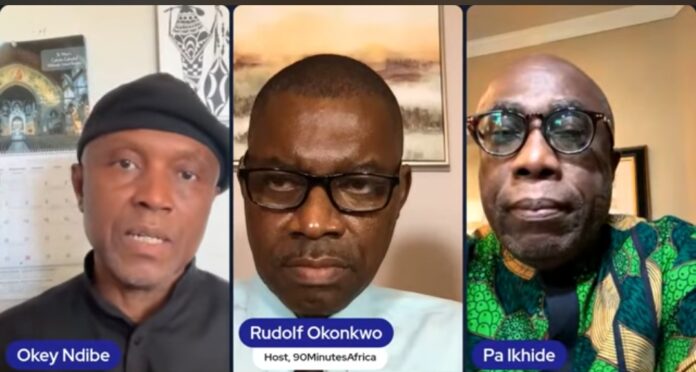
Veteran journalist and author, Okey Ndibe, has criticised what he described as a pathological culture of celebrating ill-gotten wealth in Nigerian society, warning that the growing obsession with money, material possessions and ostentatious displays of affluence is undermining education, intellectual achievement and the moral foundations of the country.
Ndibe made the observations during an interview with Rudolf Okonkwo and Ikhide Ikheloa on 90MinutesAfrica, where he examined the relationship between societal values, the declining quality of education, ethical challenges in journalism and Nigeria’s struggle to build a functional nation.
The literary critic lamented that Nigerian society increasingly celebrates individuals who display wealth and luxury without questioning the sources of their riches. At the same time, people who have made outstanding contributions to literature, scholarship and intellectual development receive comparatively little public recognition.
Citing the celebrated novelist Chinua Achebe as an example, Ndibe said that despite Achebe’s immense contributions to African literature and global cultural discourse, his achievements do not receive the kind of popular celebration often accorded to wealthy individuals who flaunt their financial status through extravagant spending at public events.
“Achebe was the greatest cultural product of Igbo land, yet you will not hear musicians in the region sing about his exploits, but they will sing with the name of any trader in Onitsha who got a little money and go to an event to throw the money around,” the author said.
According to him, the tendency to glorify material wealth above intellectual accomplishment has created a dangerous value system in which young people are encouraged to measure success by the money they possess rather than by their knowledge, character, creativity or contributions to society.
He stated that such a culture could help explain why some young Nigerians are increasingly drawn to internet fraud and other illicit means of acquiring wealth rather than pursuing education and productive careers.
Ndibe stressed that when society celebrates opulence without demanding accountability, it sends the wrong message to younger generations, who may begin to regard honest work, academic excellence and intellectual achievement as inferior paths to success.
The veteran journalist also expressed concern about the declining standards of academic integrity in Nigerian universities, stating that some students obtain degrees without meaningfully engaging with the intellectual requirements of their disciplines.
He recalled his experience teaching at the University of Lagos under the Fulbright programme alongside his wife, saying that students persistently approached him with offers of money to influence their grades.
Ndibe further said that some students attempted to offer sexual favours in exchange for favourable academic assessments, describing the experience as disturbing evidence of the erosion of values within the educational system.
He said he had made it clear to his students that academic success would depend on hard work, serious engagement with assigned books and a willingness to seek clarification whenever they encountered difficulties with course materials.
According to him, the experience reflected a broader problem in which some students appeared more interested in obtaining favourable grades than in acquiring the knowledge and skills their qualifications were supposed to represent.
Ndibe also turned his attention to the media, arguing that journalism has not been insulated from the broader institutional and moral decline affecting the country.
Reflecting on his professional experience, he spoke highly of veteran journalists Dele Giwa and Ray Ekpo, whom he credited with helping to shape his early career at the Concord newspaper.
He recalled that the two journalists supported his appointment to the newspaper’s editorial board while he was undertaking his National Youth Service Corps programme, despite objections from other members who questioned the decision to include a corps member in such a senior editorial body.
“Some other members of the editorial board went to complain to the owner of the paper, Chief M.K.O. Abiola, that Dele Giwa and Ray Ekpo had insulted them by bringing a Youth Corps member to the editorial board,” Okey said.
According to Ndibe, Giwa and Ekpo defended his inclusion by arguing that his writing and reasoning abilities were stronger than those of the people who had complained.
He said that he subsequently developed a close relationship with the late businessman and politician M.K.O. Abiola and began writing speeches for him.
Ndibe described Giwa and Ekpu as exceptional journalists whose work could compete with journalism produced by leading newspapers anywhere in the world.
However, he expressed disappointment with the quality of some contemporary newspaper commentary in Nigeria, citing weaknesses in language, logical reasoning and basic argumentation.
The novelist argued that the media, like other sectors of Nigerian society, requires deliberate efforts to restore professional standards, intellectual rigour and public trust.
Beyond education, cultural values and journalism, the author of the new children’s book, “Babs Fafunwa: A Life of Firsts,” questioned whether Nigeria’s political leadership and citizens have made a sufficiently serious effort to build a country that serves the interests of its people.
He recalled that Nigeria was created by the British colonial authorities, bringing diverse ethnic and cultural communities into a single political entity.
However, he argued that the country’s colonial origins should not prevent Nigerians from confronting the responsibility of deciding what they want their collective future to look like.
“The people must either accept to live in this space and make it habitable or reject it and go back to their various ethnic or even sub-ethnic enclaves,” Ndibe argued.
According to him, Nigeria has yet to fulfill its potential because a small, parasitic elite continues to benefit disproportionately from the country’s resources while the majority struggle with the consequences of poor governance and institutional failure.
Nevertheless, he suggested that Nigeria’s failure to achieve its potential is inseparable from the fact that its citizens have not adequately addressed the challenge of building a nation founded on shared responsibility and a common sense of ownership.
He then urged Nigerians to examine whether they genuinely regard the country as their own or merely as a resource to be divided among competing interests.


