

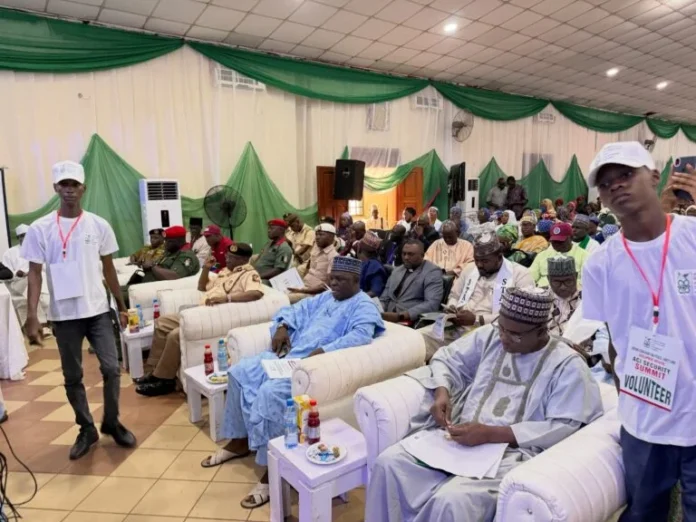
The Secretary-General of the Committee of Vice Chancellors of Nigerian Universities (CVCNU), Prof. Andrew Haruna, has urged Northern leaders to take urgent steps to remove Almajiri children from the streets, warning that failure to do so could worsen insecurity across the region.
Haruna made the call on Wednesday while delivering a paper titled, “Youth Empowerment as a Strategy for Preventing Violence, Extremism and Insecurity in Northern Nigeria,” at the Arewa Awareness Summit on Unity Against Insecurity organised by the Arewa Cohesion for Peace, Unity and Development Initiative (ACI) in Kaduna.
The university don said the North possesses both the human and material resources needed to tackle the Almajiri problem but lacks the political will to confront it.
According to him, allowing millions of children to remain on the streets without access to education, care, or economic opportunities poses a grave threat to the region’s future.
“If the North wants to survive, these boys must be taken off the streets. We have the capacity to do it. Let us stop blaming others and take responsibility for our children,” he said.

Haruna said his recent visits to parts of Southern Nigeria revealed a striking contrast, noting that he did not encounter Almajiri children on the streets except those who had come from the North.
He described the situation as a painful reflection of years of neglect and poor leadership.
“We are sending the wrong signal about ourselves. We cannot continue to abandon our children and expect to have a peaceful future,” he said.
The professor lamented that while luxury mansions continue to spring up across the region, millions of children remain homeless, hungry, and without access to education.
He warned that poverty, unemployment, and social exclusion were creating conditions that make vulnerable young people easy targets for recruitment by bandits, terrorists, and other criminal groups.
Recalling his relocation from Borno State due to the Boko Haram insurgency, Haruna said many children in conflict-affected communities have grown up knowing nothing but violence.
“How do you re-engineer the mind of a child who has spent his entire life witnessing bloodshed? That is the danger we face if we fail to act now,” he said.
Haruna also recounted an encounter in Keffi where an unemployed youth confronted a wealthy motorist over what he considered extravagant spending, saying the incident reflected growing frustration among unemployed young people.
According to him, Northern Nigeria is witnessing a growing population of jobless and hopeless youths trapped in what social scientists describe as the “waithood” period—a stage in which young adults are unable to secure employment, establish families, or attain economic independence.
He attributed the situation to poor governance, inadequate educational opportunities, and insufficient investment in human capital.
The professor argued that many individuals now involved in banditry and other violent crimes were once children who had been denied education and meaningful economic opportunities.
He criticised political leaders for failing to prioritise education, youth development, and ethical leadership, stressing that insecurity cannot be solved through military operations alone.
READ ALSO: Post-Primary Disputes: NDC Sets Up Seven-Member Reconciliation Committee
Haruna also expressed concern over what he described as the declining moral authority of both Christian and Muslim leaders to speak against corruption, abuse of power, and social decay due to persistent divisions.
He urged traditional rulers, religious leaders, governments, and local communities to work together to rebuild trust, expand access to education, and create sustainable economic opportunities for young people.
Quoting the late Islamic scholar, Sheikh Usman Dan Fodio, Haruna reminded public office holders that leadership is a sacred trust and should never be used for personal enrichment.
He also referenced Nigeria’s 1970–1974 National Development Plan, saying its vision of building a just, united, and self-reliant nation remains relevant today.
Haruna appealed to Northern leaders to acknowledge past mistakes and take deliberate action to secure the region’s future through greater investment in education, youth empowerment, and responsible leadership.
“We should not lose hope. History is being written about us every day, and future generations will judge us by what we do today,” he said.


