

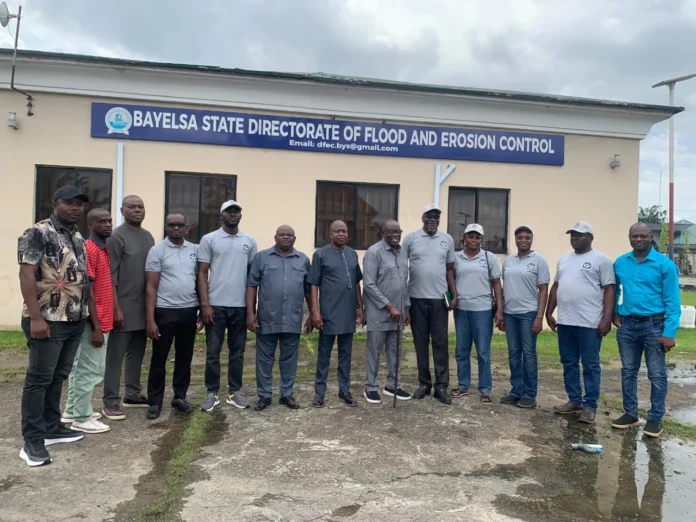
The Bayelsa State Government, in partnership with the Environmental Conservation, Agriculture and Rural Development (ECARD), has launched a campaign to curb the blockage of natural water channels as part of efforts to tackle persistent flooding across the state.
Speaking during an advocacy meeting with the Directorate of Flood and Erosion Control in Yenagoa, the Technical Adviser on Environment to Governor Douye Diri, Chief Alagoa Morris, said the initiative aims to strengthen public awareness and improve the clearing of natural waterways.
Morris said his office would collaborate closely with ECARD to enhance knowledge and promote effective maintenance of natural drainage channels across Bayelsa.
He also called on the Bayelsa State House of Assembly to enact legislation that would shield the Directorate of Flood and Erosion Control from policy reversals by future administrations and empower it to remove structures obstructing natural waterways.
Commending the directorate for its efforts, Morris said the agency’s intervention had significantly improved the free flow of rainwater across parts of the state.
He stressed the need for stronger collaboration among relevant agencies to construct elevated shelters for residents displaced by floods and urged the government to extend flood control projects beyond Yenagoa to other flood-prone local government areas.
Also speaking, the Director of Flood and Erosion Control, Chief Omuso Wilson, identified the indiscriminate blockage of natural water channels as one of the leading causes of flooding in Bayelsa.
According to him, regular clearing and maintenance of waterways remain essential to reducing flood risks.
Wilson revealed that while authorities previously identified only nine natural water channels in Yenagoa, modern mapping technology has uncovered an additional 54 waterways.
He expressed concern over the deteriorating condition of the Epie Creek—Yenagoa’s primary natural drainage channel—warning that increasing blockages have severely reduced its ability to channel floodwaters.
The Program Manager of ECARD, Mr Henry Adike, described Bayelsa as an environmentally fragile state that requires careful planning and sustained collaboration among stakeholders to protect its ecosystem.
Adike called for long-term, sustainable solutions to flooding, urging authorities to preserve the state’s natural drainage networks and biodiversity.
He reaffirmed ECARD’s commitment to partnering with the Bayelsa Government to promote environmental sustainability and build safer, more resilient communities.
SOURCE: NAN


