

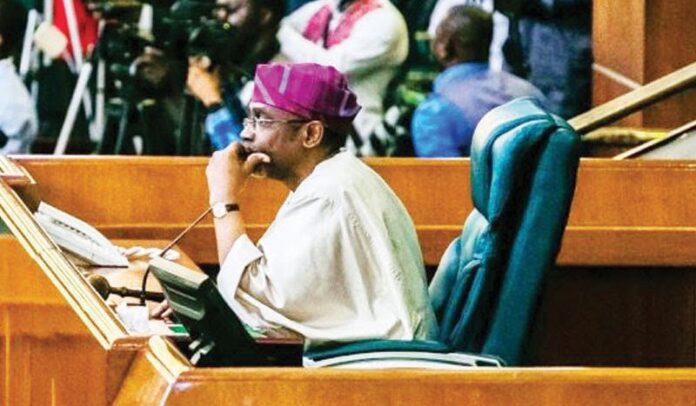
Femi Gbajabiamila has always cut the figure of the urbane gentleman, yet his career reads like a political thriller where decorum and dispute sit at the same table. The latest chapter erupted when Nigerians began demanding answers over a face-off between the Chief of Staff and Prince Adeniyi Adeyemi Matthew, the self-styled Director-General of a “Presidential Foreign Intervention Promotion Council” and “Presidential Economic Advisory Council.”
In a lengthy State House rejoinder titled, The Matter of Adeniyi Adeyemi Matthew and the Fictitious Presidential Economic Advisory Council, the Presidency cast itself not as a detached arbiter but as an advocate, disowning Matthew outright and labeling his councils “completely fake,” even as it promised that security agencies would investigate. The statement carried the cadence of closure, yet it also left the room ajar for more questions than it settled.
Matthew’s June 25, 2026 press conference was a study in audacity. He entered the arena without apology, rejecting the Chief of Staff’s denial and insisting that PFIPC and PEAC are real institutions, not phantoms. With the confidence criminologists often associate with what Sykes and Matza once called “techniques of neutralization,” he turned denial back on power itself, arguing that if the agencies were fictitious, then the 2026 budget pages 50–51 must be a forgery, and that the National Assembly, the Budget Office, the Accountant-General, and even the Central Bank would all be complicit in certifying an illusion. He claimed the agency operated from a Federal Secretariat office for over a year, ran domiciliary, pounds and TSA accounts at the CBN, and could not have secured such infrastructure without official imprimatur.
Beyond process, Prince Adeniyi Adeyemi Mathew made it personal: he alleged that Gbajabiamila demanded 48% of a ₦27.3 billion take-off grant, plus ₦400 million paid through proxies and a ₦200 million balance, and that his refusal triggered the disclaimer. He further accused the Chief of Staff of trying to criminalize his diplomatic engagements as espionage, of orchestrating intimidation, and of seeking to frame him. Matthew called for an independent panel to examine the mysterious death of his alleged intermediary, Babatunde Tanimola, who died in a fire at an Abuja hotel in October 2025, to probe an alleged assassination attempt on the Abuja-Kaduna Expressway, and to subject all signed documents to forensic review, arguing that “silence will not resolve this matter. Only truth will.”
The Presidency’s response was forensic in tone but selective in detail. It narrated how the Chief of Staff petitioned the DSS and Police in October 2025 over forged appointment letters, how the Ministry of Foreign Affairs flagged Matthew’s meeting with ambassadors, how the OSGF confirmed that appointment letters are its exclusive preserve, and how police later arrested Matthew, recovered documents, and charged him with forgery, impersonation, and obtaining by false pretence. The file, the Presidency said, was already before the Federal High Court.
Yet for many Nigerians who read every line, the most sensitive needle was never threaded: if the agency was bogus, how did its name find budget lines, office space, and bank accounts? Social media commentary captured the unease. One netizen called the ease of creating a “fake FG agency” with Secretariat premises and banking access “shameful, disappointing, and dangerous.” Another asked how a non-existent body could secure federal office accommodation, insisting “there’s more to this than meets the eye.” Those questions lingered, and the Presidency’s detailed rebuttal, while emphatic, did not meet them head-on, preferring to treat Matthew’s claims as a criminal matter rather than an administrative puzzle.
This is not the first time Gbajabiamila has been pulled into the glare of controversy despite the gentlemanly bearing that often accompanies him. Public records show that while practicing law in the United States, he was disciplined by the Supreme Court of Georgia for mishandling client funds, a matter he resolved with refunds and sanctions before returning to Nigeria. It is an established legal record, not an allegation, and it has resurfaced whenever questions of integrity arise. Around the passage of the Petroleum Industry Act in 2021, media reports insinuated inducements involving principal officers, but no anti-corruption agency charged or convicted him, and he denied any wrongdoing. In 2024, after Betta Edu’s suspension, social media linked him to appointments and contracts in the Humanitarian Ministry; the Speaker described the claims as baseless, and Gbajabiamila invited investigation rather than trial by media.
The most recent episode, the PFIPC/PEAC affair, carries financial allegations that the Presidency has flatly denied, describing the councils as non-legitimate and pointing to an ongoing criminal investigation into forged documents. Alongside these, political critiques have been persistent: that as Speaker he ran a House too close to the executive, that he supported bills critics saw as restrictive of speech, that he influenced appointments and wielded outsized influence as Chief of Staff. None of these criticisms have produced judicial findings, yet together they form a pattern that scholars of political accountability would recognize as the cost of proximity to power.
Political science literature helps frame what is unfolding. Max Weber’s insight that modern bureaucracy rests on “rational-legal authority” suggests that legitimacy erodes when procedures appear porous. When citizens perceive that a private individual can conjure an agency, occupy federal space, and trigger budgetary references, trust in those procedures is strained. Robert Merton’s strain theory reminds us that when institutional means seem weak, alternative narratives rush in to explain outcomes.
In Nigeria’s current context, many commentators already construct a geography of accountability, observing that most high-profile probes under the Tinubu administration have centered on figures from other zones, while the Chief of Staff is publicly declared innocent even before any suspension or interim step. The perception, fair or not, becomes its own fact in public life. As scholars of administrative ethics have long argued, in high office, appearance often functions like evidence, because confidence is a currency governments cannot afford to deplete.
The result is a paradox that defines Gbajabiamila’s public image. On paper, he is the gentleman of procedure: he denies, he petitions, he demands due process, and he has no public conviction to his name. In the public imagination, however, he is the man who keeps appearing at the center of questions about access, influence, and administrative loopholes.
The PFIPC episode crystallizes that tension. If Matthew is a con artist, then the system must explain how his script looked so official for so long. If he is not, then the institutions that signed, budgeted, and banked must answer. Until that loop is closed, the narrative will continue to write itself, and the optics will keep suggesting a gentleman surrounded by many controversies, whether or not innocence is ultimately established.
Bagudu can be reached via bagudumohammed15197@gmail.com or 07034943575.


