

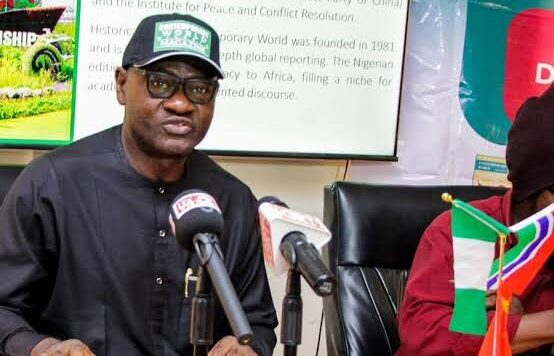
The Director-General of the Institute for Peace and Conflict Resolution (IPCR), Dr. Joseph Peter Ochogwu, has said the institute played a key role in research and intervention efforts aimed at tackling violent extremism and terrorism in Nigeria.
Speaking on the Podcast, “Conversations with Prof. Jideofor Adibe” on Monday, Ochogwu said the institute collaborated with UNICEF between 2015 and 2020 on projects in Adamawa, Yobe and Borno states.
According to him, IPCR, as a research-driven institution, focused on conducting needs assessments and providing pathways for interventions by development partners, including UNICEF and UNHCR, in affected communities.
He also disclosed that the institute worked with the United Nations Office on Drugs and Crime (UNODC) on research relating to children affected by armed conflict within the local context.
Ochogwu noted that Nigeria’s security challenges are not unique, stressing that collaboration with international partners enables comparative analysis with countries such as Afghanistan, Pakistan and Sudan.
He commended the Nigerian Army for providing access and support to researchers operating in conflict affected areas, describing the military as critical gatekeepers.
The IPCR boss said the country had reached a stage where all stakeholders, including those affected by violence, were seeking solutions to the prolonged crisis.
He added that the institute regularly trains students, interns and stakeholders from various sectors on peacebuilding and conflict resolution, with the aim of transforming individuals into agents of peace within their communities and workplaces.
Ochogwu also appealed to academics, the media and the public to better understand government deradicalisation and reintegration programmes, noting that more than 7,000 individuals linked to terrorism had been prosecuted, while those with minimal involvement were given opportunities for rehabilitation and reintegration.


