

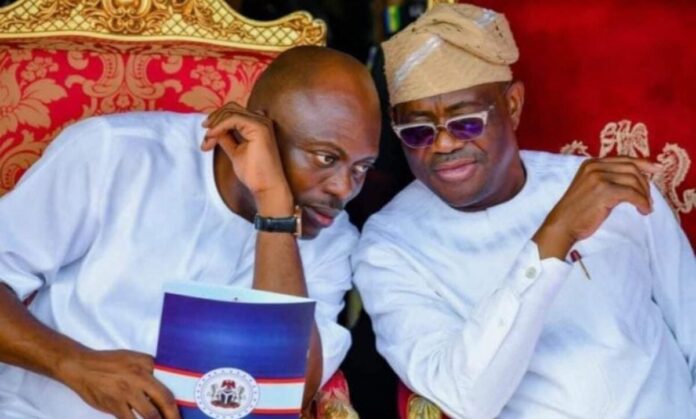
For nearly three years, the political landscape of Rivers State has been consumed by one of the most intense and consequential power struggles in Nigeria’s recent democratic history. At the heart of this storm are two men: former Governor and current Minister of the Federal Capital Territory, Nyesom Wike, and his estranged political godson, Governor Siminalayi Fubara. Almost every week, Wike takes to the podium, whether in Abuja, Port Harcourt, or Okrika, and invokes a singular, almost sacred refrain: “Agreement is agreement.” But in a democracy where power derives from the ballot box and the constitution, which agreement is Wike forever brandishing like a political sword over Fubara’s head?
The short answer is that no single written document has been publicly and fully disclosed. The longer, more disturbing answer is that Wike is referring to a multi-layered, informal web of political understandings brokered behind closed doors by President Bola Tinubu, most crucially a tacit pact in which Fubara supposedly agreed to abandon any ambition for a second term in exchange for the dropping of impeachment proceedings against him.
This article examines the nature of that elusive “agreement,” its various iterations, and what it reveals about the state of Nigeria’s democracy.
The most specific and consequential version of the pact was laid bare by Wike himself in May 2026, just before the APC governorship primaries. Speaking after inspecting infrastructure projects in Abuja, Wike declared that the governor’s eventual withdrawal from the 2027 race was “not unexpected”, because it aligned with an understanding reached during earlier peace negotiations. “In the first place, he ought not to have collected the form because agreement was reached that the impeachment should be dropped, while he should also not talk about a second tenure,” Wike said bluntly. He added that Fubara’s decision to purchase the nomination form in the first place “didn’t show signs of gentlemanship” and constituted a breach of political trust.
In essence, the deal was this: Fubara would survive his term as governor, but he would not be permitted to seek re-election. In exchange, the impeachment machine, driven by Wike’s loyalists in the Rivers State House of Assembly, would be called off.
One APC national official familiar with the crisis went further, explaining to Sunday PUNCH that the president personally intervened to save Fubara from two separate impeachment plots. “On the second impeachment plot as well, the President told him to focus on governance and leave Wike alone. It was at that time that all parties agreed that he would not go for a second term. Fubara agreed to that, and that is why Wike always says, ‘Agreement is agreement,” the official disclosed.
From Wike’s perspective, then, the agreement was not merely a gentleman’s understanding. It was the price of political survival. And in his view, Fubara’s mere act of purchasing nomination forms, even before eventually withdrawing, violated the spirit of that bargain.
The so-called “agreement” has earlier roots. On December 18, 2023, after months of escalating tension that included a fire at the Rivers State House of Assembly complex, the demolition of the building, and the defection of 27 pro-Wike lawmakers from the PDP to the APC, President Tinubu summoned the warring parties to the Presidential Villa. There, a formal eight-point resolution was signed.
The terms were extraordinarily lopsided. Governor Fubara was required to withdraw all court cases relating to the crisis, re-present the 2024 budget to the Assembly led by Wike’s ally Martin Amaewhule, reinstate the remunerations of all 27 defected lawmakers, recognize Amaewhule as Speaker, re-submit the names of commissioners who had resigned, and accept that the dissolution of local government administrations was null and void. In return, impeachment proceedings against him would be dropped.
Critically, the eight-point deal made no explicit mention of a second-term ban. But the context was unmistakable: Fubara was being reduced to a ceremonial governor, stripped of legislative control and local government influence, while Wike’s loyalists retained full command of the state apparatus. The late elder statesman Chief Edwin Clark and the Peoples Democratic Party (PDP) immediately rejected the accord, describing it as a “Greek gift” and a “political death warrant” for the governor.
Yet Fubara signed. According to insiders, he returned to Port Harcourt and told his cabinet he was “willing to do anything for peace”. But public pressure and internal resistance soon led him to back away. The deal crumbled within months, and the crisis resumed.
After the declaration of a state of emergency in March 2025 and six months of sole administration under Vice Admiral Ibok-Ete Ibas (retd.), President Tinubu again brokered peace in June 2025. This time, according to multiple reports, the terms were even more stringent. Fubara was allegedly told he would be reinstated to complete his four-year tenure only on condition that he forgo any second-term ambition, allowing Wike to nominate all 23 local government chairmen, and pay outstanding allowances owed to the 27 pro-Wike lawmakers.
It was this June 2025 pact that introduced the explicit second-term prohibition that Wike now relentlessly invokes. Interestingly, Wike himself initially refused to disclose the details. In July 2025, he told reporters: “I will allow you to speculate, it’s not my business. All I know is that peace has come”. By December 2025, however, he had changed course, threatening to reveal everything. “Very soon, we will let people know what we agreed on before Mr. President,” he declared.
Beyond the peace pacts, Wike has also invoked the authority of the Supreme Court as an extension of his “agreement” narrative. In February and March 2025, the apex court delivered a series of rulings that effectively endorsed the pro-Wike lawmakers as the legitimate Rivers State House of Assembly, ordered Governor Fubara to re-present the budget to them, barred the release of federal allocations to the state, and nullified the local government elections that Fubara had conducted.
Wike celebrated the rulings with unrestrained glee, telling reporters that “impunity must stop” and that the Supreme Court had shown that “one man cannot spend trillions of Naira without legislative approval”. From his standpoint, the judiciary had ratified the core premises of his political agreement: that Fubara had acted unconstitutionally bypassing the Wike-controlled legislature.
Against the backdrop of the internecine power struggle between Wike and Fubara, and the compounding pressure exerted by Wike’s loyalists, one is compelled to ask:” In a democracy, what moral or legal weight does such an agreement carry?” The people of Rivers State elected Siminalayi Fubara in 2023 with a clear democratic mandate: to serve a full four-year term, with the sovereign right to seek re-election on the strength of his record. No constitutional provision empowers a godfather, a predecessor, or even a president to broker a backroom pact that forecloses a sitting governor’s political future before his first term has run its course.
Yet that is exactly what happened. Wike, who single-handedly made Fubara governor, insisted that his creation would not be permitted to grow beyond his control. The agreement he so constantly invokes is not a contract enforceable in any court of law. It is a political handshake brokered under duress, a handshake that, if broken, carries the threat of impeachment, financial strangulation (via withheld federal allocations), and complete legislative paralysis.
The tragedy is that Fubara appears to have finally complied. In May 2026, he withdrew from the APC governorship primaries, citing “sacrifice for the state”. Wike’s ally, Kingsley Chinda, emerged as the APC candidate. Another Wike ally, Sam Ejekwu, simultaneously clinched the PDP ticket. The “agreement” had been enforced.
But at what cost? The political crisis in Rivers State has led to capital flight, weakened investor confidence, and widened the economic gap between Rivers and more stable states such as Lagos. It has seen the demolition of a legislative complex, the unconstitutional presentation of a budget before four lawmakers, and the declaration of a state of emergency that suspended democratic governance for six months. More than anything, it has sent a chilling message: that in certain political ecosystems, the will of the godfather, expressed through “agreements” witnessed by presidents, trumps the will of the electorate.
So, which agreement is Wike always invoking against Fubara? It is not one document but a trilogy of accords: the eight-point surrender of December 2023, the second-term ban of June 2025, and the Supreme Court’s validating judgments of early 2025. Together, they form the legal and political straitjacket within which Fubara has been forced to govern.
In a properly functioning democracy, political leadership is determined at the ballot box, not in presidential villas. The man who invokes “agreement” so loudly should perhaps be reminded that the only agreement that truly matters in a democracy is the one between the people and the leader they freely choose. By that measure, Wike’s agreement is not a democratic compact. It is a feudal relic dressed in modern political clothing, and Rivers State has paid a heavy price to watch it play out.


