

Few Nigerians have attained the moral stature, intellectual distinction, and global influence of Professor Akinwande Oluwole Babatunde Soyinka. Playwright, novelist, poet, essayist, scholar, human rights advocate, and Nobel Laureate, Wole Soyinka stands as one of Africa’s greatest gifts to world civilization.
As he celebrates his 92nd birthday, we honour not merely a literary giant but a man whose life has been a relentless pursuit of truth, justice, freedom, and human dignity.
If one sentence could summarize Soyinka’s philosophy of life, it would undoubtedly be the immortal words from his prison memoir, The Man Died:
“THE MAN DIED IN ALL WHO KEEP SILENT IN THE FACE OF TYRANNY.”
Those few words have become far more than a quotation; they are a moral compass. They define Soyinka’s unwavering commitment to confronting oppression, regardless of the personal cost.
His courage was not confined to the pages of his books.
During the Nigerian Civil War in 1967, after calling for dialogue and reconciliation rather than bloodshed, the military government imprisoned him in solitary confinement for nearly twenty-two months. Deprived of books, writing materials, and meaningful human contact, Soyinka refused to surrender either his dignity or his intellect.
Legend has it that he improvised writing tools from whatever materials he could find, scribbling thoughts on scraps of toilet paper and other available surfaces. He also embarked on hunger strikes to protest inhumane prison conditions. His captors could imprison his body, but they could not imprison his mind.
That extraordinary experience later became The Man Died, one of the most powerful prison memoirs ever written by an African.
Soyinka’s literary genius transcends genres. Whether in drama, poetry, fiction, memoir, or essays, his works combine classical literary craftsmanship with the richness of Yoruba cosmology, exposing injustice while celebrating humanity.
His enduring masterpieces include
■ “THE LION AND THE JEWEL”, ■”DEATH AND THE KING’S HORSEMAN”
■ “A DANCE OF THE FORESTS”
■ “Aké: The Years of CHILDHOOD”
■ “THE INTERPRETERS”, AND ■ “SEASON OF ANOMY”.
These works continue to inspire generations of writers, scholars, and students across the world.
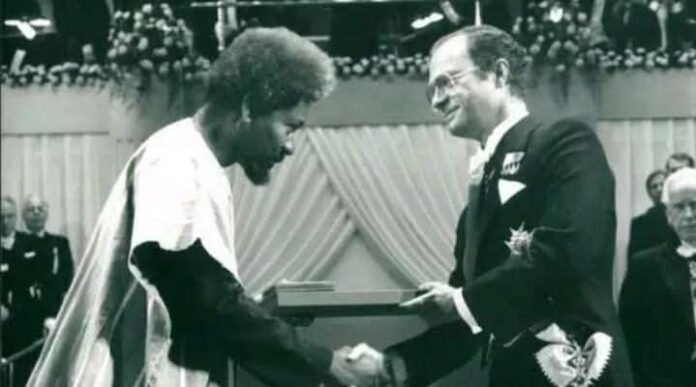
In 1986, Soyinka made history as the first Black African to receive the Nobel Prize in Literature. This honour acknowledged not only his exceptional literary brilliance but also his fearless commitment to human freedom.
His influence extends well beyond literature. For over six decades, Soyinka has remained one of Nigeria’s most consistent moral voices, speaking against dictatorship, military repression, corruption, religious extremism, ethnic chauvinism, and every form of injustice.
He has never tailored his convictions to suit those in power. Whether under military rule or civilian administration, his allegiance has always been to truth rather than convenience.
One of his profound reflections captures this philosophy beautifully:
“THE VERY LEAST WE CAN LIVE WITH IS AN AGREEMENT THAT DOES not REDUCE US TO SLAVES OF IMPOSITION, BUT MAKES US PARTNERS OF CONSENT.”
Those words remind us that genuine leadership is founded not on domination but on consent, mutual respect, justice, and human dignity.
History repeatedly teaches that societies flourish when leaders unite rather than divide their people. Ethnic and religious bigotry may produce temporary political advantage, but they ultimately destroy trust, weaken institutions, and leave lasting scars on national cohesion.
Soyinka’s life represents the exact opposite. His writings consistently affirm that our common humanity must always triumph over prejudice, intolerance, and narrow identities. He reminds us that character matters more than ethnicity, competence more than sectional loyalty, and justice more than political expediency.
Perhaps this explains why his works continue to generate an enormous body of scholarship across universities worldwide. His literary corpus has inspired countless doctoral dissertations, academic books, conferences, and critical studies. Few African writers have exerted such enduring intellectual influence.
To the Yoruba people, he is celebrated with deserved reverence:
Akínwándé Olúwolé Babátúndé Sóyíinká.
Agbà ọmọ tí ó jà fún òmìnira — the noble elder who fought for freedom.
Ọ̀gágun tó fi ìkọ̀wé rẹ̀ gbà ayé níyànjú — the general who conquered the world with the power of his pen.
At 92, Professor Wole Soyinka remains much more than Nigeria’s foremost literary icon. He is a symbol of courage, intellectual independence, moral integrity, and the enduring power of ideas.
His greatest legacy may not simply be the Nobel Prize or his extraordinary body of literary works. Rather, it is the timeless lesson that silence in the face of injustice is itself a form of surrender.
As Nigeria and the world celebrate this remarkable son of Africa, we salute a man who has taught generations that words can challenge oppression, ideas can outlive dictators, and truth, though often costly, remains humanity’s strongest defence.
Happy 92nd Birthday, Professor Wole Soyinka.
May your pen never cease to inspire, your voice never lose its moral clarity, and your legacy continue to illuminate generations yet unborn.
@richardODUSANYA


