

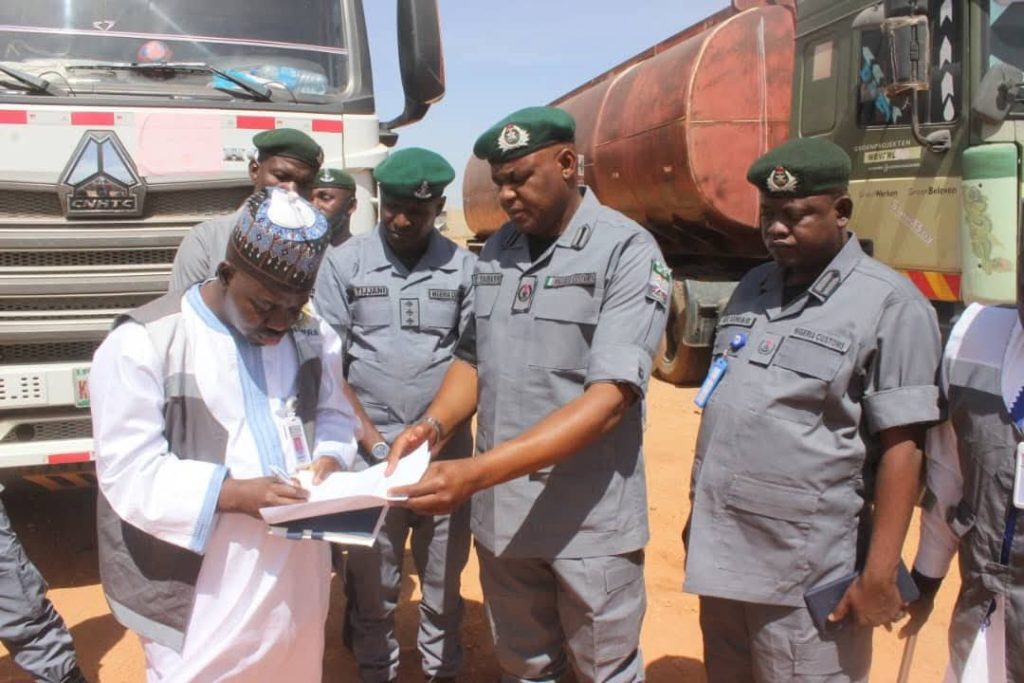
The war against fuel smuggling tightened another notch on Friday as the Nigerian Customs Service moved decisively to hand over three seized petrol tankers loaded with no fewer than 159,000 litres of Premium Motor Spirit to the Nigerian Midstream and Downstream Petroleum Regulatory Authority for regulatory action.
The transfer, carried out in Lagos, was supervised by Deputy Comptroller Abubakar Aliyu, the National Co-ordinator of Operation Whirlwind, who described the bust as a significant dent in the armour of fuel smugglers operating along Nigeria’s porous borders.
The intercepted trucks, bearing registration numbers T21019LA, T9827LA and T3546LA, were apprehended along notorious smuggling routes stretching through Aso-Odo, Seme, Owode-Apa and Badagry—corridors long regarded as slippery escape paths for economic saboteurs.
“Customs is handing over the seized fuel tankers with registration numbers T21019LA, T9827LA and T3546LA containing over 159,000 litres for appropriate sanctions,” he said.
Beyond the tankers, the operation also netted 1,630 jerry-cans of petrol, which authorities say will be auctioned off publicly in the spirit of transparency and accountability, ensuring the proceeds are not lost in the cracks.
“The total Duty Paid Value of the 1,630 jerry-cans of PMS is about N40.75 million.
“The interception was intelligence-driven and reflects our uncompromising resolve to safeguard Nigeria’s economic and energy security,” he said.
Aliyu made it clear that Operation Whirlwind is not a mere name but a sweeping storm aimed squarely at economic sabotage and illicit trade. According to him, petroleum movement within the country is regulated by established frameworks and Standard Operating Procedures crafted to block diversion and curb smuggling.
He warned that illegal cross-border fuel dealings do more than siphon petrol; they sabotage government policy, destabilise market forces and bleed the nation of much-needed revenue. The border communities of Owode-Apa, Seme and Badagry, he noted, have historically served as economic arteries—arteries too often punctured by smugglers seeking quick profits.
“Under my watch, smuggling will no longer be safe for economic saboteurs,” Aliyu warned.
He emphasised that the handover symbolised robust collaboration among enforcement bodies, anchored on structured operational guidelines. He also applauded the Comptroller-General of Customs, Bashir Adeniyi, for what he described as steadfast leadership and unwavering backing of anti-smuggling drives.
Calling on citizens to stand shoulder to shoulder with law enforcement agencies, Aliyu stressed that national progress blossoms when vigilance becomes a collective duty.
In her response, Mrs Grace Dauda of the regulatory authority reaffirmed the agency’s statutory responsibility to ensure that petroleum products intended for local consumption are not spirited across the border.
“It is unfortunate that some businessmen attempt to smuggle petroleum products out of the country,” she said.
Dauda urged Nigerians to work hand in hand with government institutions to stamp out economic sabotage, insisting that the fight against fuel smuggling requires more than uniforms and patrol vans—it demands a united front.


