

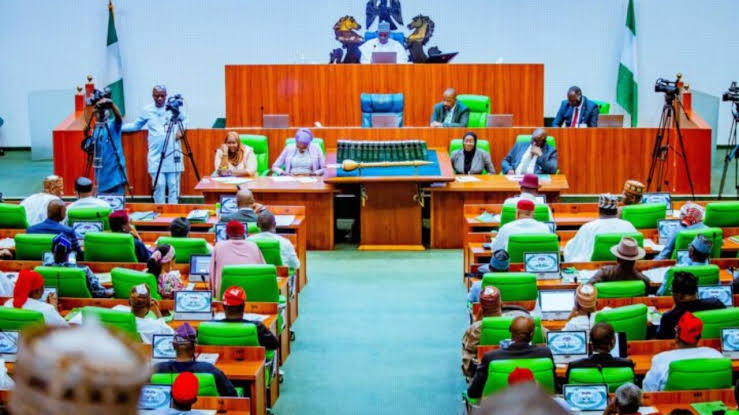
The House of Representatives Committee on Public Petitions has pressed the pause button on a petition over promotion and administrative disputes at the Nigerian Nuclear Regulatory Authority (NNRA), shifting the hearing to March 11, 2026.
We gathered that the breather is to give all sides room to test the waters of Alternative Dispute Resolution (ADR), with lawmakers betting that dialogue, not deadlock, could unlock an amicable outcome.
The petition was lodged by Abdulhadi Abdullahi, a Deputy General Manager (Legal) at the National Institute of Radiation Protection and Research (NIRPR), a technical service body to the NNRA. Marked as Petition No. 732 of 2025, it asks the committee to step in over the fallout from the 2020 NNRA Committee on Regularisation of Appointment and Staff Audit, alongside claims of prolonged promotion stagnation.
Abdullahi also flagged concerns bordering on salary issues, workplace treatment and the conduct of disciplinary procedures affecting him.
Deputy Chairman of the committee, Rep. Attorney Nwogu, urged restraint and realism, warning against allowing administrative wrangles to fester into career-threatening stalemates that could disrupt institutional harmony.
He stressed that governance must be a moving train, not a stalled engine, and that officers should not be punished for procedural lapses beyond their control—especially where supervising officials had since retired or internal structures had shifted.
Nwogu assured that the committee would see to it that no party was short-changed and that justice was served with fairness as its compass.
After weighing submissions, the committee floated ADR as the most practical escape route from the impasse, a proposal both sides accepted. The matter was accordingly adjourned to March 11, 2026, to allow ADR mechanisms to run their course toward a peaceful settlement.
The lawmakers also reaffirmed their resolve to safeguard the constitutional right of citizens and public officers to petition the National Assembly without fear of intimidation or administrative backlash.
In his presentation, Abdullahi told the committee that disciplinary actions were triggered after his appearance at an earlier public hearing on Dec. 9, 2025.
He listed a query dated Jan. 5, 2026, his response the following day, a warning letter on Jan. 8, and the subsequent setting up of a disciplinary panel.
Discussions at the session further zeroed in on his Annual Performance Evaluation Report (APER). Abdullahi said he submitted the APER during his promotion year, but the process stalled midway, adding that he furnished the committee with documentary proof and email trails. He argued that responsibility for the assessment lay with the supervising directorate at the time, noting that his former supervisor had since retired.
Representatives of the NNRA and related agencies, speaking for the Director-General, countered that administrative rules demand proper supervisory assessment of APERs and admitted that gaps existed in the evaluation chain.
Committee members, however, observed that while there were differing interpretations over who should have completed and approved the assessment, there was no dispute that the APER had indeed been submitted.


