

The Federal Executive Council has approved the 2026 to 2028 Medium-Term Expenditure Framework, a document that will guide Nigeria’s fiscal direction over the next three years.
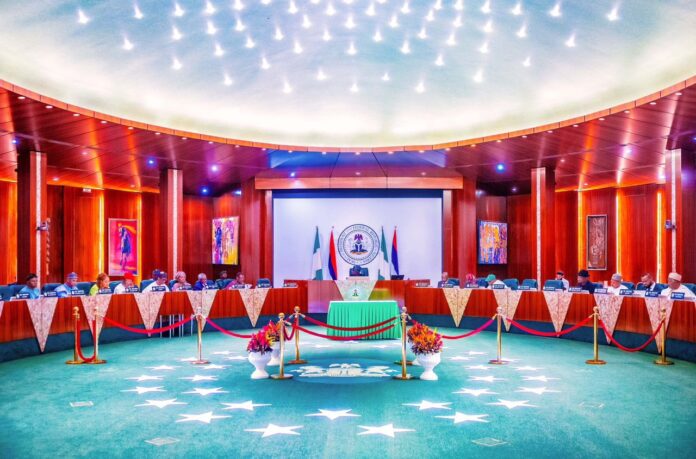
The approval came after Wednesday’s meeting chaired by President Bola Tinubu at the State House in Abuja.
Speaking after the meeting, the Minister of Budget and Economic Planning, Senator Atiku Bagudu, disclosed that the Federal Government forecasts total revenue of N34.33 trillion for 2026. Government-owned companies valued at N4.98 trillion are included in this figure.
He pointed out a big reduction in projected federal allocations, which may drop by around N9.4 trillion—sixteen percent from the 2025 budget—and said the projection is lower by N6.55 trillion than previous forecasts. Within the fiscal year, statutory transfers should total around N3 trillion.
Though a more cautious 1.8 million barrels per day will be used for planning, for macroeconomic forecasts the Council established an oil production benchmark of 2.6 million barrels per day for 2026.
Reflecting expected economic changes ahead of the 2027 elections, the FEC also approved an oil price benchmark of sixty four dollars per barrel and an exchange rate of one thousand five hundred and twelve naira to the dollar.
The News Chronicle gathered that these parameters were shaped by extensive consultations involving the Budget Office and other economic agencies, with cabinet members providing additional input before the expenditure ceiling was finalised.
Meanwhile, the Senate recently approved President Tinubu’s 21.5 billion dollar external borrowing request, which forms part of the broader fiscal strategy for the 2025 budget.
In his 2024 budget speech, the President projected a fall in inflation to fifteen per cent and an improvement of the exchange rate to around one thousand five hundred naira to the dollar.
Standard Bank’s latest outlook places the naira at approximately one thousand four hundred and fifty eight per dollar by the end of 2025.


