

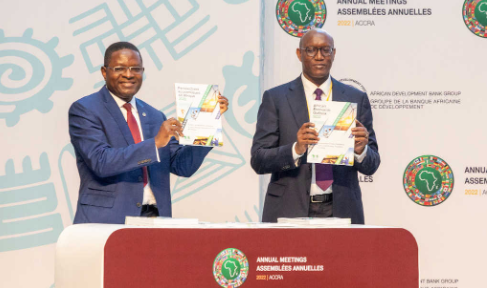
According to the African Development Bank’s (AfDB) African Economic Outlook 2022, Nigeria’s GDP will grow at 3.2 percent on average this year through 2023.
The report, which was released yesterday in Accra, Ghana, at the Bank’s Annual General Meeting (AGM), focuses on the continent’s growth prospects in the context of the COVID-19 epidemic, climate change adaptation, energy transformation, and other structural issues.
The report, which was released by the Bank’s President, Dr. Akinwumi Adesina, his team, and the Board of Governors, looks at the economic outlook on a regional and country-by-country basis.
The AfDB’s forecast is slightly higher than the National Bureau of Statistics’ (NBS) 3.11 percent growth figure for the first quarter, which was revealed on Monday.
The research also predicts that inflation will continue high this year, at 16.9%, and will remain above the pre-COVID era until next year. Inflation rose to 16.82 percent last month, prompting the Monetary Policy Committee (MPC) to take action and hike the policy rate by 150 basis points on Tuesday.
The research warns that the marginal current account surplus of 0.1 percent of GDP might transform into a 0.2 percent deficit next year, citing insecurity and infrastructure deficiencies as major economic blights.
“By improving revenue collection, the fiscal deficit will be reduced to an average of 4.5 percent of GDP.” On new borrowing, the public debt is expected to exceed 40% of GDP by 2024.

The study argues that “growing insecurity and policy uncertainty, underpinned by the reversal of the earlier scheduled elimination of subsidies on premium motor spirit a year before the 2023 elections, may increase the headwinds to the forecast.”
Climate change, according to the African Development Bank, would cut crop yields by 7% in the short term and 25% by 2050, as rising temperatures threaten agricultural production.
Despite the hurdles, capital inflow into the country is expected to resume in the coming months.
It observes that while the fundamentals in Africa are improving, “significant problems remain in the medium term, owing largely to the continuation of the pandemic effect and unpredictability caused by the impact of the Russia-Ukraine conflict.”


