

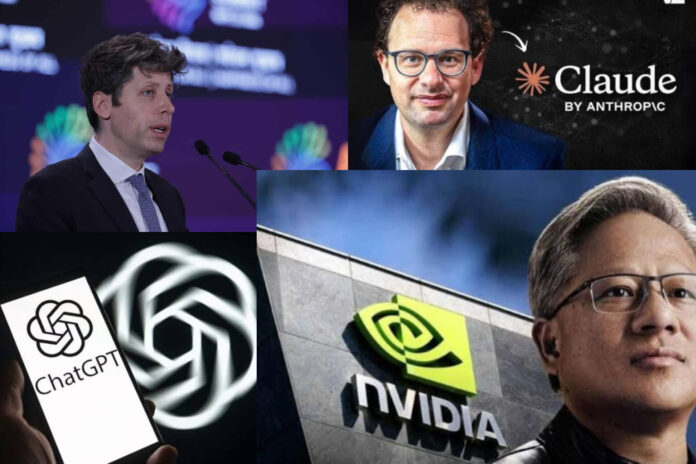
OpenAI is facing scrutiny after its chief executive Sam Altman confirmed that the company agreed to allow its AI models to be used on a classified network operated by the United States Department of Defense.
According to reports first published by Forbes, a website tracking boycott pledges claims that more than 1.5 million users canceled ChatGPT subscriptions within 48 hours of the announcement.
The reported cancellations followed criticism from some users who argued that allowing military access to AI systems could contribute to warfare and surveillance programs.
OpenAI has not publicly confirmed the subscriber losses.
At the same time, Anthropic’s chatbot Claude experienced a surge in downloads. Data cited by analytics firm Sensor Tower showed that the application rose to the top position among free apps on Apple’s U.S. App Store, overtaking ChatGPT. Interestingly, just weeks earlier, the app had ranked outside the top 100.
During an internal staff discussion, Sam Altman said the company does not control how the U.S. military ultimately uses its technology once it is deployed.
“You do not get to make operational decisions,” Altman told employees, according to reports by Bloomberg and CNBC.
He added that developers cannot decide which military actions are justified.
“Maybe you think the Iran strike was good and the Venezuela invasion was bad. You don’t get to weigh in on that,” Altman said.
Altman later acknowledged that the announcement of the Pentagon partnership was poorly handled.
He reportedly told employees that the decision was communicated in a way that made the company appear “opportunistic and sloppy.”
Officials from the Department of Defense have recently asked AI developers to relax safety restrictions on their models so they can be used in a wider range of military applications.
Reports indicate that AI-enabled systems have allegedly already been used by U.S. forces in operations including the targeting of military objectives in conflicts involving Iran and the mission to capture Venezuelan leader Nicolás Maduro.
Anthropic rejected the Pentagon request because it believed the technology could be used in ways that violate its safety policies.
Following the refusal, U.S. defense officials labeled Anthropic a “supply-chain risk.”
The designation could prevent federal agencies and military contractors from using the company’s AI systems. If formally implemented, it may also affect the firm’s ability to secure government contracts.
Anthropic chief executive Dario Amodei defended the decision in an internal memo to employees.
According to reports, Amodei criticized OpenAI’s response and said Anthropic had maintained its ethical limits.
“We’ve actually held our red lines with integrity,” Amodei wrote, while accusing competitors of cooperating with government demands.
The memo reportedly described OpenAI’s approach as misleading and criticized what Amodei called “safety theater.”
The conflict between the two AI developers has also drawn attention from Nvidia, the semiconductor company whose processors power many large AI systems.
Speaking at the Morgan Stanley Technology, Media and Telecom conference in San Francisco on Wednesday, March 4, 2026, Nvidia chief executive Jensen Huang said the company is unlikely to make additional investments in either OpenAI or Anthropic.
Huang explained that both companies are expected to pursue public listings in the future, which would limit opportunities for private investment.
Nvidia had previously committed large funding to the AI sector. When the company participated in OpenAI’s recent $110 billion funding round, its investment was reported to be $30 billion, significantly lower than an earlier plan to invest as much as $100 billion.
Huang said Nvidia’s investments are designed to expand its technology ecosystem.
“All of our investments are focused very squarely, strategically on expanding and deepening our ecosystem reach,” he said during the company’s earnings call.
Nvidia’s relationship with both companies is complex because they are also major buyers of Nvidia’s AI chips, meaning the firms are both partners and customers.
For now, the AI tools industry is becoming more competitive, with Claude gaining visibility while ChatGPT faces criticism from some users.


