

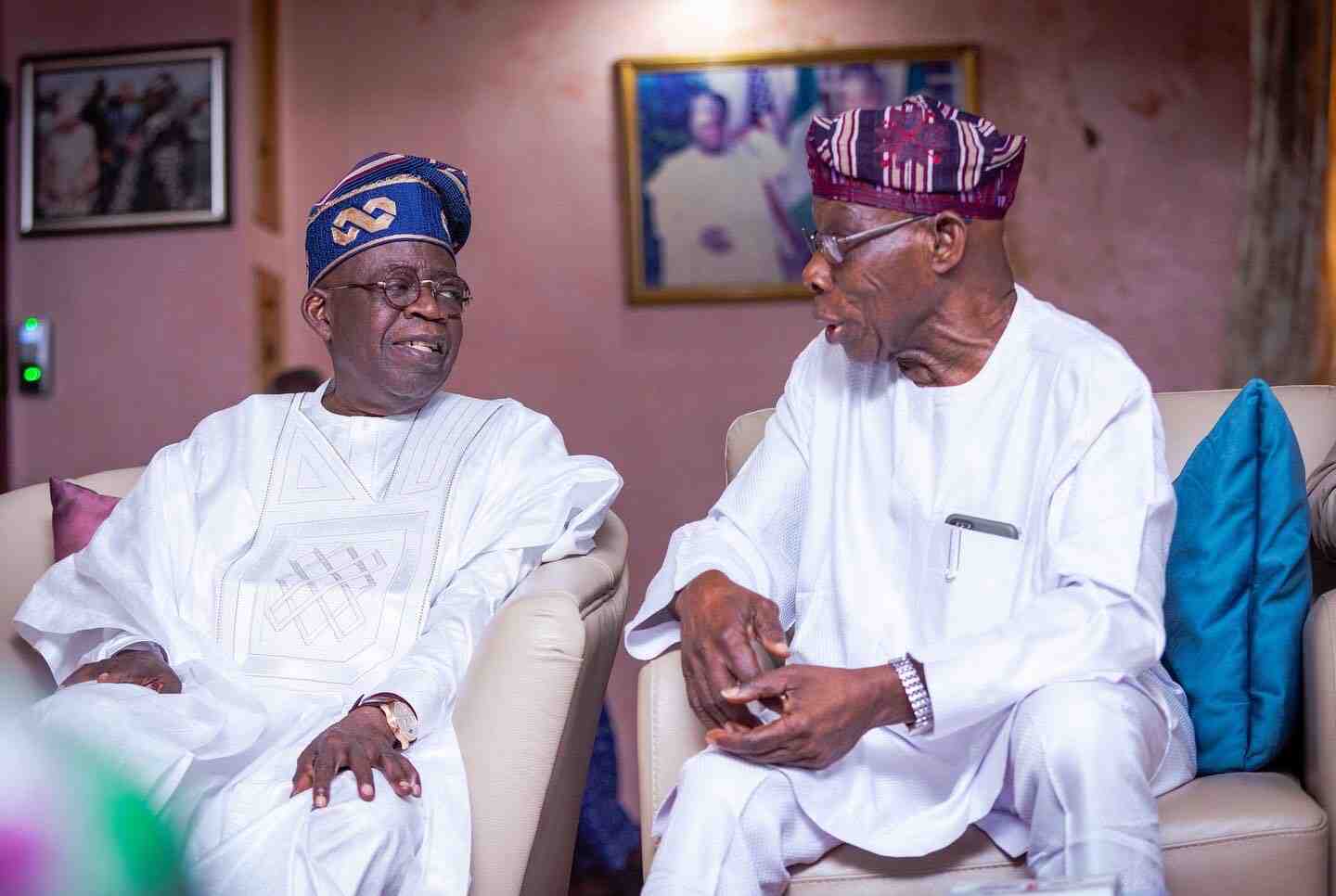
I also attended the event as a senior media professional, where, before a distinguished international audience, I witnessed former Nigerian President Olusegun Obasanjo lay bare Nigeria’s economic predicament under President Bola Ahmed Tinubu. What struck me was not merely the bluntness of his remarks but also the agreement they attracted from many of the dignitaries present. Obasanjo had articulated what millions of Nigerians have been saying at home: the country is in distress, and the Tinubu administration has yet to convince them that its economic reforms are delivering meaningful relief.
Speaking during the keynote interview which was moderated by David Pilling, Obasanjo expressed deep pessimism about Nigeria’s economic outlook under President Tinubu, saying he could see no indication that the situation was improving. He criticised the administration’s economic reforms, particularly the devaluation of the naira and the removal of the petrol subsidy, arguing that their implementation had impoverished Nigerians rather than served their interests. Obasanjo said the naira’s depreciation from about ₦500 to the dollar to ₦1,500 represented a 300 per cent loss in its value against the dollar, significantly eroding Nigerians’ purchasing power. He linked these developments to Nigeria’s status as the country with the largest number of people living in extreme poverty, arguing that such an outcome could not reasonably be considered beneficial to the country.
Comparing Nigeria’s economic trajectory with Ghana’s, he pointed to the movement of the Ghanaian cedi against the dollar as an example of a different approach to economic management. He stressed that Nigeria’s priority should be the economic and social welfare of its people rather than political personalities or succession debates. To improve the economy, he called for decisive action against corruption, wasteful expenditure and unnecessary luxury, alongside increased domestic production. He concluded that he saw no convincing signs of improvement in Nigeria’s economic outlook under the current direction.
To me, Obasanjo did not say anything new. He merely echoed what patriotic Nigerians and opposition leaders who genuinely want the best for the country have been saying since the Tinubu administration came to power in May 2023. He also countered some of the falsehood being peddled by some contracted hirelings who have suddenly become emergency spokespersons of the president. These are political turncoats who criticised his reforms less than four years ago but are now telling Nigerians that he is the Messiah leading Nigerians to the Promised Land.
Rather than bring relief, the president’s policies have inflicted untold hardship on Nigerians, with no convincing solution in sight. A friend of mine recently travelled to Nigeria for what was supposed to be a three-week holiday. She fled back to the UK after just 10 days, lamenting that living in Nigeria had become more expensive than living in Britain. The Nigeria she returned to was, in her estimation, even more difficult to live in than the country she left behind in 2022 when she relocated to the UK.
Her experience speaks volumes about the changing realities of life in Nigeria. It is deeply troubling that a country many once regarded as home, with its lower cost of living and enormous potential, has become so expensive that even Nigerians returning from abroad for a short holiday are taken aback by the cost of everyday necessities. When the cost of food, transportation, accommodation and other essentials becomes overwhelming, the question is unavoidable: who exactly are these economic reforms working for?
As Obasanjo argued, the economic consequences have left Nigerians dramatically poorer, with the naira’s depreciation alone severely eroding their purchasing power. While those figures may not capture every Nigerian’s individual experience, they reflect the scale of the economic devastation confronting households across the country.
For those in government who have access to public resources, generous allowances and other financial privileges, the pain may be less immediate. Some may therefore have little difficulty campaigning for the administration to continue for another four years, or even longer. But their experience cannot be equated with that of ordinary Nigerians who must struggle daily to afford food, transportation and other basic necessities.
Consider the Nigerian who paid ₦187 per litre for petrol in April 2023, before Tinubu assumed office, but now faces prices of around ₦1,500 per litre. What economic reforms can the president preach to a woman who now pays ₦6,500 for a crate of eggs that she recalls buying for ₦600 in 2023? What explanation can he offer a commercial driver who spends ₦80,000 on fuel but earns less than ₦50,000 in a day? How can such a business remain viable, let alone provide a decent living for the operator?
These are not abstract economic statistics. They represent the daily realities of Nigerians whose incomes have failed to keep pace with the soaring cost of living. When the cost of doing business exceeds daily earnings, when food becomes increasingly unaffordable and when working harder no longer guarantees survival, the government must recognise that the consequences of its policies extend far beyond figures on an economic dashboard.
The fundamental question is not whether reforms are necessary, but whether their design and implementation are improving the lives of Nigerians. A government cannot indefinitely ask citizens to endure hardship while offering assurances that relief will eventually come. Nigerians deserve evidence of progress, a credible path to recovery and leadership that understands the difference between announcing economic reforms and delivering economic prosperity.
Few days ago, the Federal Government announced a 30-day discount on petrol sold by the NNPC Ltd., with public transport operators to receive priority under the arrangement. However, many Nigerians said the intervention had not translated into lower transport fares and also failed to ease the burden of high transportation costs on Nigerians. Many commuters are still struggling to afford daily transportation to work.
As i said earlier, Taiwo Oyedele, the Minister of Finance and Coordinating Minister of the Economy attended the FT Africa summit. I was looking forward to ask him some tough questions on the fuel discount and state of the economy but he quickly left the venue. His aide said he had other engagements in London to attend.
Before writing this article, i called a presidential media aide to get the response of the presidency to Obasanjo’s remarks. He said they will not respond to Obasanjo because he is a statesman. I laughed. So, the Atiku Abubakar and Peter Obi that you are quick to respond to their criticisms are not statesmen?
On his part, President Tinubu, speaking at the flag-off of his re-election campaign in Kaduna last Saturday, blamed his opponents for the hunger and poverty gripping the country. Addressing the crowd, he said: “I hear my opponents talking about hunger and poverty. Who created it? They did. They created the hunger. They created the poverty we are trying to eradicate.”
But this raises a fundamental question: who should take responsibility for the economic hardship Nigerians are experiencing today? I leave that question for Nigerians to answer.
Akinsuyi, former group politics editor of the Daily Independent, is a member of the Society of Editors, United Kingdom. He can be reached via shabydayo@gmail.com


